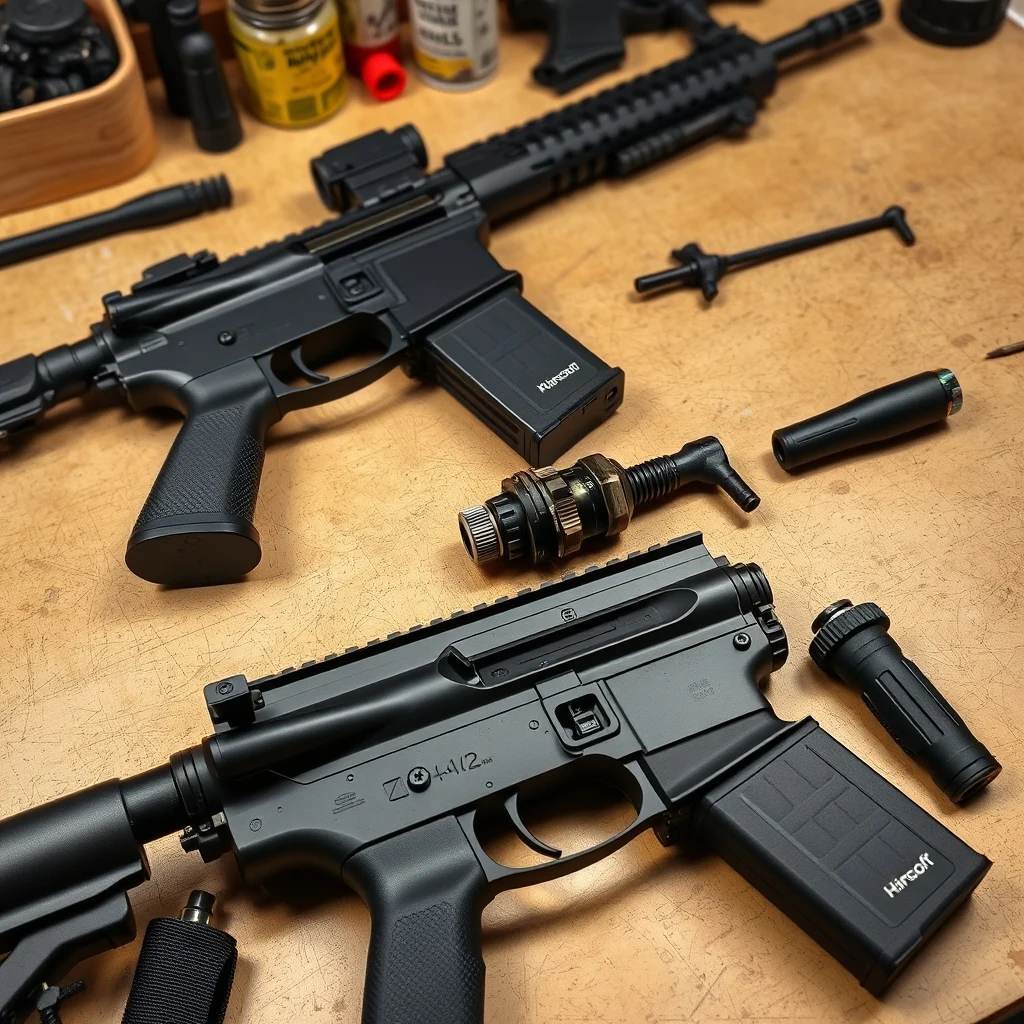
The three platform types: AEG, GBB, and HPA
AEG (Automatic Electric Gun)
An AEG uses an electric motor to drive a gearbox — a sealed gear assembly containing three interlocking gears (bevel, spur, sector) that compress a spring and release a piston with each shot. The motor runs on a rechargeable battery (NiMH or LiPo) and drives the gearbox in semi or full-auto. AEGs are the most common platform at most fields, the most widely upgradeable, and the most forgiving for new players.
The gearbox is the heart of the AEG. Gearbox version numbers designate different mechanical configurations:
- Version 2 (V2): The most common. Found in M4/M16/AR-platform replicas. Widest aftermarket support — nearly every internal upgrade part exists for V2 gearboxes. Easy to work on.
- Version 3 (V3): Found in AK-platform and some G36/SG replicas. Slightly different shape, similarly well-supported aftermarket. Marginally more durable in stock configuration.
- Version 6 (V6): P90 and Thompson format. Less common aftermarket.
- Version 7 (V7): M14/EBR format. Limited aftermarket.
Within V2 and V3 platforms, quality ranges from $60 budget blowback guns with plastic gears that strip under LiPo use to $300+ guns with steel gear sets, reinforced gearbox shells, and properly shimmed bearings. The external body material (polymer vs metal) matters far less than what's inside.
Gas blowback (GBB and GBBR)
Gas-powered guns (GBB pistols, GBBR rifles) use propane/green gas or CO2 to cycle the bolt carrier or slide, ejecting the BB and cycling the next round. The result is a tactile recoil sensation closer to a real firearm than an AEG can produce. GBBRs are heavily favored in milsim (military simulation) events where realism is part of the game.
The trade-offs are significant: gas performance drops in cold weather (below roughly 50°F / 10°C green gas degrades noticeably; CO2 performs somewhat better in cold), magazines are larger and heavier (holding both gas and BBs), and gas-driven internals generally require more maintenance (nozzle seals, magazine lips, bolt O-rings). Magazine costs run $30–$80 each vs $10–$25 for AEG hi-cap or mid-cap magazines.
HPA (High-Pressure Air)
HPA systems replace the gas reservoir in a GBB or AEG with an external regulated air supply from a tank (similar to paintball HPA) via a remote line. An HPA rig delivers extremely consistent output pressure regardless of temperature, is easily adjustable for velocity, and is near-immune to cold-weather degradation. HPA engines (Polarstar, Wolverine, Redline) drop into existing gun bodies, converting an AEG shell into an HPA-powered platform.
HPA requires a tank, regulator, and remote line — adding weight and a trailing air hose to your kit. The infrastructure cost is $200–$400 before the engine, making HPA primarily a choice for serious players who've already outgrown entry-level gear.
| Factor | AEG | Gas (GBB/GBBR) | HPA |
|---|---|---|---|
| Power source | Battery (NiMH/LiPo) | Green gas/propane/CO2 | External HPA tank |
| Temperature sensitivity | None | High (drops in cold) | None |
| Recoil feel | None | Realistic | Variable (engine-dependent) |
| Upgrade path | Extensive — V2/V3 parts widely available | Moderate — platform-specific | Mostly set by engine choice |
| Maintenance | Low-moderate | Moderate-high | Moderate (seals, regulator) |
| Entry cost | $80–$350 | $100–$400 | $400+ (tank + engine + body) |
FPS, joules, and field limits
Most airsoft fields set limits in FPS measured with a specific BB weight — commonly 0.20g. FPS varies with BB weight: the same gun shooting 400 fps with 0.20g will shoot approximately 350 fps with 0.25g. Fields that set joule limits (typically 1.0–1.5 joules for CQB, 1.5–2.0 joules for outdoor) are testing the actual energy of the shot regardless of the BB weight used to test — this is more accurate.
Common field limits by format:
- CQB (indoor close-quarters): typically 330–350 fps / 0.20g (roughly 1.0–1.1 joules)
- Outdoor full-auto: typically 350–400 fps / 0.20g (1.1–1.5 joules)
- Designated Marksman Rifle (semi-auto only, often with minimum engagement distance): 450–500 fps / 0.20g (1.9–2.2 joules)
- Bolt-action sniper (with MEDs): sometimes up to 550 fps / 0.20g with significant MEDs
Shopping for airsoft gear? Browse current eBay listings → (we earn a small commission; your price is unchanged).
BB weight selection
Heavier BBs are more accurate in field conditions because they're less deflected by wind and minor obstructions — but they require a hop-up system adjusted for the extra weight and drop more at range. The practical guide:
- 0.20g: chrono-ing only; don't shoot these in games — they're too light to be accurate
- 0.23–0.25g: general CQB use, lower-powered AEGs, entry-level builds
- 0.28g: a good all-around field BB for mid-range AEGs
- 0.30–0.32g: longer-range AEGs, DMR builds; requires well-tuned hop-up
- 0.36–0.40g: sniper rifles, HPA builds with flat hop or R-hop modifications
Always use quality, seamless BBs — budget BBs from unknown brands often have seams, inconsistent weight, and surface defects that cause inconsistent flight and can damage hop-up rubbers and barrels.
Battery types and gearbox compatibility
NiMH batteries (typically 8.4V or 9.6V stick packs) are safe with stock gearboxes and forgiving — they won't destroy components if misused, but trigger response is slower and they discharge completely before you notice. They're the safe choice for a new player's first gun.
LiPo batteries (7.4V / 2S for most stock AEGs; 11.1V / 3S for upgraded builds) deliver better trigger response and rate of fire, hold charge better during storage when stored at 3.7–3.85V per cell, and are lighter. The risks: running a LiPo to 0 permanently damages it; running 11.1V through a stock motor, trigger contacts, and AOE can strip gears and burn contacts rapidly. If running LiPo on a stock gun, use 7.4V and a basic MOSFET or MOSFET-equipped gun to protect trigger contacts.
Orange tip, legality, and safe handling
In the United States, federal law (15 U.S.C. § 5001) requires airsoft guns sold at retail to have an orange tip at least 6mm in diameter. Removing the orange tip after purchase is legal for adults in most US states, but some states and localities have additional restrictions — check local laws. Never transport airsoft guns in public without a case, and never display them in contexts where they could be mistaken for real firearms. Some countries prohibit airsoft entirely or require licensing — verify regulations for your location.
Upgrade priorities
If you're buying an entry-level AEG and want to improve it rather than buy up immediately:
- Hop-up rubber: Replacing the stock rubber with a quality unit (Lonex, Prometheus, Maple Leaf) improves consistency and range more than any other single upgrade. $10–$25.
- Inner barrel: A quality tight-bore barrel (6.01–6.03mm) improves BB consistency. Worth doing alongside the hop-up rubber. $20–$50.
- MOSFET: Protects trigger contacts from LiPo use, enables LiPo on stock guns, often improves trigger response. $15–$80 depending on features.
- Motor: A high-torque motor (Lonex A2, SHS High Torque) improves trigger response and cycling speed more than wiring changes. $30–$60.
- Gears, piston, cylinder: Only worth doing once you've addressed hop-up and motor. Full internals upgrades cost $100+ and require technical skill.
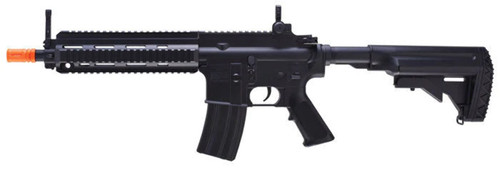 AEG Airsoft Rifles
 Gas Blowback Rifles
 GBB Pistols
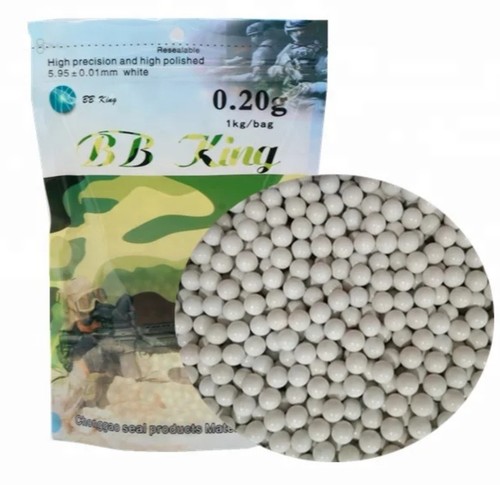 Airsoft BBs
 LiPo Batteries