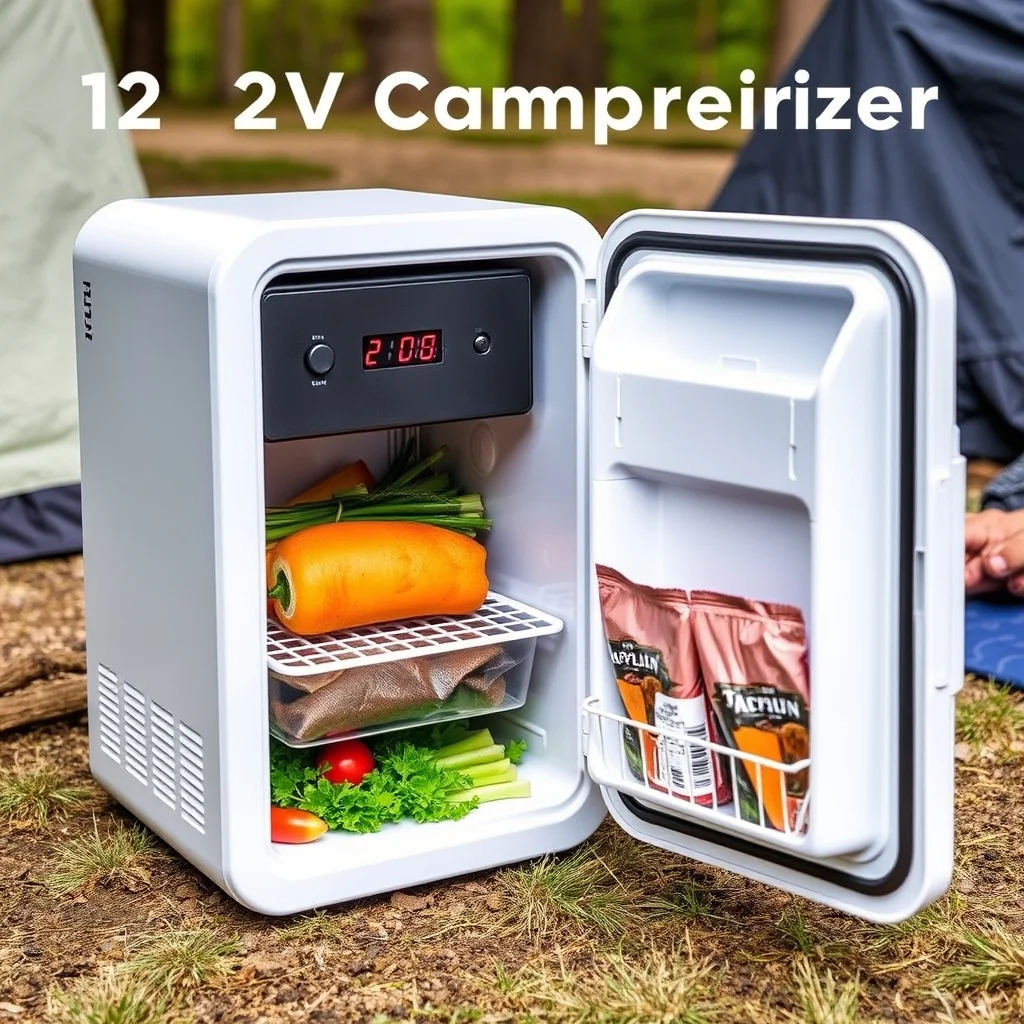
Compressor vs thermoelectric: the first decision
There are two fundamentally different refrigeration mechanisms in portable 12V fridges, and they are not interchangeable for serious off-grid use.
Compressor fridges
Compressor-based units work on the same vapor-compression refrigeration cycle as your home refrigerator. A compressor pumps refrigerant through a circuit, and heat is exchanged at the condenser and evaporator. They can cool to as low as −20°C regardless of ambient temperature, hold temperature accurately, and are efficient enough for 24/7 off-grid operation on a properly sized battery and solar system. The compressor runs intermittently — cycling on when needed and off when the target temperature is maintained — which is why average daily consumption is substantially lower than peak draw.
Compressor fridges are the correct choice for van, RV, boat, overlanding, and any application where the unit will run for days or weeks at a time.
Thermoelectric (Peltier) coolers
Thermoelectric coolers use the Peltier effect to move heat. They have no moving parts, are inexpensive, and are quiet. The critical limitation: they can only cool 15–20°C below ambient temperature, and their power draw is continuous (no compressor cycling). In a 35°C (95°F) vehicle interior, the best cooling you'll get is about 15–20°C — not refrigerator temperatures, and not capable of freezing. They also consume a fairly constant 4–5A at 12V regardless of how well-insulated they are.
Thermoelectric coolers are adequate for keeping drinks cool on a day trip. They are not suitable for food safety or multi-day off-grid use in warm conditions.
The compressor: what to look for
Not all compressors are equal. The dominant high-quality compressor used in premium 12V fridges is the Secop (formerly Danfoss) BD35F or BD50F — a variable-speed brushless DC compressor that adjusts its speed to match the cooling load. This variable-speed capability is a significant part of why premium units are so efficient in moderate conditions: the compressor runs slowly and quietly when the fridge is already cold, rather than cycling at full power.
Budget units use fixed-speed compressors, which consume more power at light loads and generate more heat internally. The Secop/Danfoss badge (or its Chinese equivalent, ASP, which makes similar compressors for licensed use) is a reasonable proxy for build quality. Listings for premium fridges often mention the compressor brand specifically; if the listing doesn't mention the compressor, it's likely a generic fixed-speed unit.
Capacity: liters vs quarts and how to choose
12V fridges are typically measured in liters (L) internationally and quarts (qt) in some North American listings. The conversion is roughly 1 liter = 1.06 quarts — close enough that the numbers are interchangeable for practical purposes.
Common capacity ranges and their practical applications:
- 20–30L: Solo use or weekend trips. Fits a case of drinks or a few days of food. Compact enough for most vehicle installs without significant cargo loss.
- 40–50L: The sweet spot for 1–2 people on extended trips. Roughly the equivalent of a small apartment bar fridge. Most popular size for van builds and overlanding setups.
- 60–80L: Family-sized capacity or for builds with dedicated fridge space. Higher power draw at this size is notable — plan battery and solar accordingly.
- Over 80L: Specialty builds (expedition vehicles, expedition boats) or dedicated fridge/freezer configurations. Typically requires 24V input for efficient operation at this scale.
Shopping for 12V fridges? Browse current eBay listings → (we earn a small commission; your price is unchanged).
Power draw: peak vs average daily consumption
This is where most buyers and many listings mislead. A fridge rated at 45W or 4A draw is quoting the peak draw when the compressor is running at full speed. In practice, a compressor doesn't run continuously — it cycles on and off to maintain the setpoint temperature. The actual duty cycle (percentage of time the compressor is running) depends on:
- Ambient temperature around the fridge (hotter = more run time)
- Target internal temperature (colder setpoint = more run time)
- How often the lid is opened and how warm the food added is
- Insulation quality of the unit itself
A rough guide to average daily consumption for a 40–50L compressor fridge in moderate conditions (25°C ambient, fridge set to 4°C):
| Build Quality | Avg Daily Draw | 12V Battery Capacity Needed (2 days) |
|---|---|---|
| Budget (fixed-speed, thin insulation) | 50–70 Ah/day | 200–280 Ah AGM or 120–160 Ah LiFePO4 |
| Mid-range (variable-speed, decent insulation) | 30–45 Ah/day | 120–180 Ah AGM or 70–110 Ah LiFePO4 |
| Premium (variable-speed, thick insulation, well-made seals) | 18–30 Ah/day | 70–120 Ah AGM or 45–70 Ah LiFePO4 |
These figures increase significantly in high-ambient conditions (35°C+) and when the unit is set to freezer temperatures. Manufacturers of premium units (Dometic, ARB) publish detailed consumption data at various ambient and setpoint combinations — this is worth reading before sizing your system.
Single-zone vs dual-zone
Single-zone fridges have one temperature-controlled compartment. The setpoint applies to the whole unit. Dual-zone fridges have two independently controlled compartments — typically one for refrigeration (2–8°C) and one for freezing (−18°C or lower). Some dual-zone designs share a single compressor and use valves or separate evaporators to maintain two temperatures; others use two separate compressors.
Dual-zone is genuinely useful for extended trips where you want both fresh food and frozen items. The trade-off is added complexity, higher initial cost, and meaningfully higher power draw when the freezer zone is active. If freezing isn't required, a single-zone fridge set to fridge temperatures is more efficient.
Build quality indicators
- Lid seal quality: Lid gaskets that seat firmly and evenly reduce cold-air loss every time the lid is opened. Thin or loose seals are a common failure point in budget units. If you can inspect the unit before buying, press on the lid and feel whether the gasket compresses uniformly.
- Insulation thickness: Premium fridges typically have 50–80mm of polyurethane foam insulation on the walls and lid. Thin-walled budget units may have 30mm or less. Thicker insulation = lower duty cycle in warm conditions.
- Drain plug: A drain plug at the bottom makes defrosting and cleaning straightforward. Absent in some budget units.
- Low-voltage cutoff: Most 12V fridges include a low-voltage protection circuit that shuts off the compressor at a configurable battery voltage to prevent battery damage. Verify the cutoff thresholds match your battery chemistry (lead-acid vs LiFePO4 cutoffs differ).
- 12V/24V compatibility: Many premium units accept both 12V and 24V input, which is useful if you have a 24V vehicle electrical system or a 24V battery bank. Budget units are often 12V only.
Sizing your solar system around the fridge
A 40L mid-range compressor fridge drawing 35 Ah/day at 25°C ambient is the baseline I'd recommend for planning. In a van build in summer conditions (35°C ambient), plan for 50–60 Ah/day for the fridge alone. Add your other loads (lighting, phone/laptop charging, diesel heater blower, water pump) and size your battery bank for 2 days of autonomy without solar. Then size the solar array to replace that daily load in your average sun conditions.
Example: 60 Ah/day fridge + 20 Ah/day other loads = 80 Ah/day total. At 50% DoD for AGM, you need a 320 Ah AGM bank. With a single 200W panel in good sun (4 peak hours), you'd produce roughly 200W × 4h × 0.85 derating ÷ 12V ≈ 57 Ah/day — covering 71% of daily load, with the bank providing the rest. A second 200W panel brings production to ~114 Ah/day, comfortably exceeding consumption and recharging the bank from overnight draw.