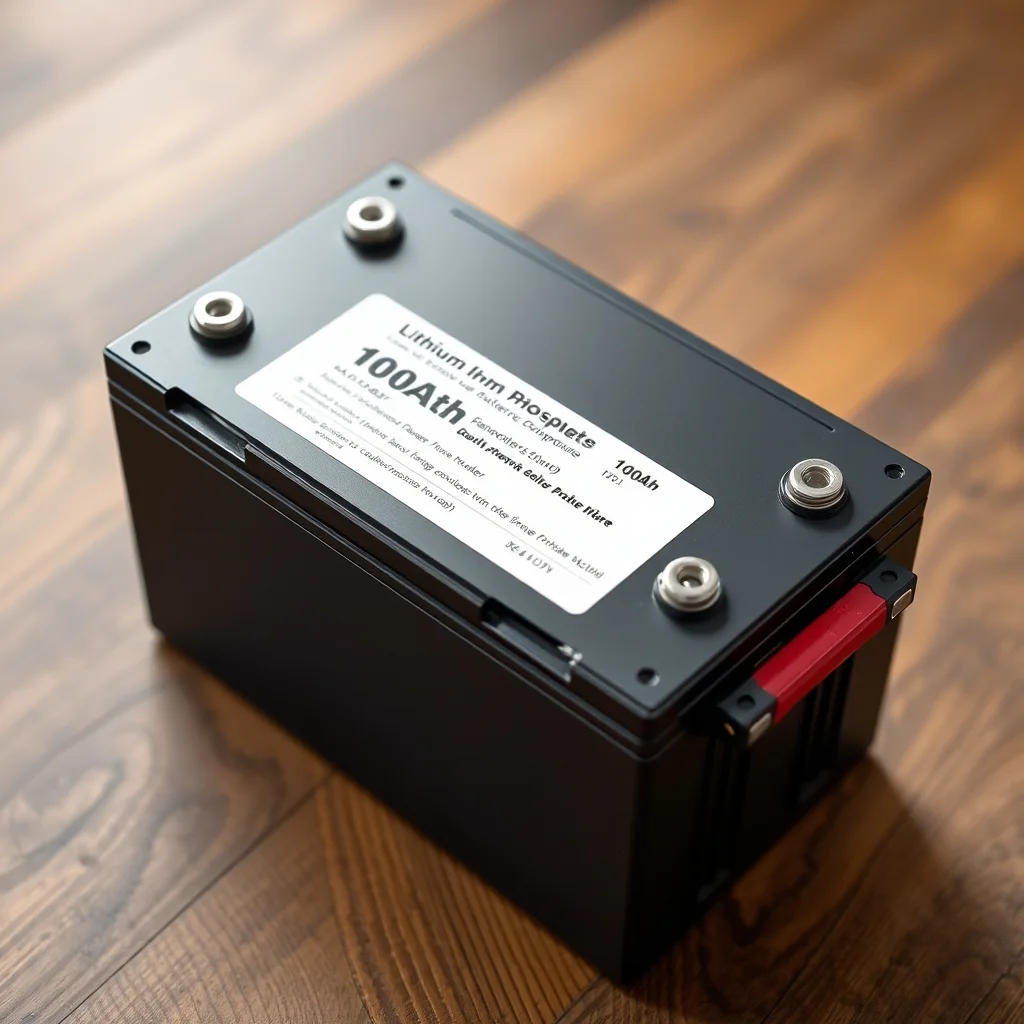
Usable capacity: the number that actually matters
Battery capacity is rated in amp-hours (Ah) measured at a standard discharge rate (usually C/20 — the 20-hour rate) down to the battery's minimum voltage. But that full capacity is only available if you're willing to discharge the battery completely, which damages lead-acid chemistries and voids many warranties.
Practical usable capacity by chemistry, as a rough guide:
- Flooded lead-acid (FLA): 25–30% usable for long cycle life; 50% if you're willing to accept reduced lifespan. Discharging below 90% regularly causes rapid sulfation and plate degradation.
- AGM (sealed lead-acid): 50% is the standard recommendation for longevity. Deep-cycle AGM tolerate this better than starting batteries but still degrade quickly if regularly discharged below 50%.
- LiFePO4 (lithium iron phosphate): 80–95% usable without meaningful cycle-life penalty. The battery management system (BMS) handles cutoff protection, so you don't need to manage depth of discharge manually.
LiFePO4 vs AGM vs flooded lead-acid
LiFePO4 (Lithium Iron Phosphate)
LiFePO4 is the safest lithium chemistry for stationary and mobile energy storage — it doesn't experience thermal runaway the way other lithium chemistries can under abuse. Cycle life is typically 2,000–4,000 cycles to 80% DoD (some premium cells claim 6,000+). A 100Ah LiFePO4 that does one cycle per day would last 5–10 years. Self-discharge is very low — around 1–3% per month. Temperature range for discharge is wider than lead-acid, but charging below 0°C (32°F) can damage cells without a low-temperature cutoff in the BMS.
Require a compatible charger: LiFePO4 has a different charge profile than lead-acid. Bulk chargers designed for AGM may not reach the correct absorption voltage or may overcharge. Most modern MPPT charge controllers have a LiFePO4 setting; older PWM units often do not.
AGM (Absorbed Glass Mat)
AGM batteries are sealed lead-acid with the electrolyte absorbed in glass mat separators. They can be mounted in any orientation (except inverted), don't require watering, and are safe indoors. True deep-cycle AGM (vs AGM starting batteries) have thicker plates rated for repeated deep discharge. Common in marine, RV, and off-grid applications. Charge profile is the same as other lead-acid: bulk, absorption, float. Charger compatibility is broad.
Temperature affects capacity significantly: at 0°C, AGM batteries may deliver only 60–70% of rated capacity; at −20°C, even less. They can be charged in cold weather, but at reduced acceptance rate.
Flooded Lead-Acid (FLA)
The oldest and cheapest chemistry per amp-hour. Requires periodic watering (distilled water tops up electrolyte lost to gassing) and ventilation (hydrogen gas during charging). Not suitable for enclosed spaces without adequate ventilation. Forklift-grade FLA batteries are extremely durable and rebuildable, popular in large off-grid systems where the maintenance cost is acceptable. For most van and RV builds, AGM or LiFePO4 is more practical.
| Chemistry | Usable DoD | Cycle Life | Upfront Cost | Notes |
|---|---|---|---|---|
| LiFePO4 | 80–95% | 2,000–4,000+ | High | Requires BMS; verify charger compatibility |
| AGM | 50% | 400–800 | Medium | Sealed, any orientation, broad charger compat |
| Flooded LA | 25–50% | 200–600 | Low | Requires venting; periodic watering |
Sizing your battery bank
The sizing process in three steps:
- Calculate your daily load in watt-hours. List every device, its watt rating, and hours of daily use. Sum them. Add 10–15% for inverter inefficiency if converting to AC.
- Determine how many days of autonomy you need. Off-grid systems often target 1–3 days of storage without solar input. Multiply daily load by autonomy days.
- Divide by usable DoD for your chemistry. If you need 300 Wh of storage and you're using AGM at 50% DoD: 300 ÷ 0.5 = 600 Wh of nameplate capacity, or roughly 50Ah at 12V. With LiFePO4 at 85% DoD: 300 ÷ 0.85 = 353 Wh, or roughly 29Ah at 12V.
Shopping for deep-cycle batteries? Browse current eBay listings → (we earn a small commission; your price is unchanged).
Series vs parallel wiring
Multiple batteries can be wired to increase voltage (series) or increase amp-hour capacity at the same voltage (parallel).
- Series: Connect positive terminal of battery 1 to negative terminal of battery 2. Voltage adds; capacity stays the same. Two 12V 100Ah batteries in series = 24V 100Ah.
- Parallel: Connect positive to positive, negative to negative. Voltage stays the same; capacity adds. Two 12V 100Ah batteries in parallel = 12V 200Ah.
- Series-parallel: Combine both. Two pairs of 2 batteries in series, the pairs then in parallel: 24V 200Ah from four 12V 100Ah batteries.
When wiring in parallel, use batteries of the same chemistry, age, and ideally the same manufacturer and model. Mismatched internal resistance causes unequal charging and can cause one battery to work harder than others, reducing the life of the weaker unit.
BMS: what it does and why it matters for LiFePO4
The battery management system (BMS) in a LiFePO4 battery monitors cell voltages, temperature, and current. It prevents overcharge, over-discharge, and excess current draw by disconnecting the load or charger when parameters go out of range. A missing or inadequate BMS is the primary failure mode in cheap lithium batteries — the cells themselves are generally reliable; the protection circuitry is where budget units cut corners. Look for a BMS rated for the continuous discharge current your inverter requires. If your 2,000W inverter at 12V draws ~167A, the BMS must be rated for at least 150–200A continuous.
Temperature considerations
Lead-acid and LiFePO4 both lose capacity in cold weather, but the critical difference is charging. LiFePO4 cells can be damaged (lithium plating on the anode) if charged when cell temperature is at or below 0°C (32°F). Quality LiFePO4 batteries include a low-temperature charge cutoff in the BMS. If you're building a system that will be charged in sub-freezing temperatures (van in winter, mountain cabin), verify the battery has this protection or plan for battery heating.