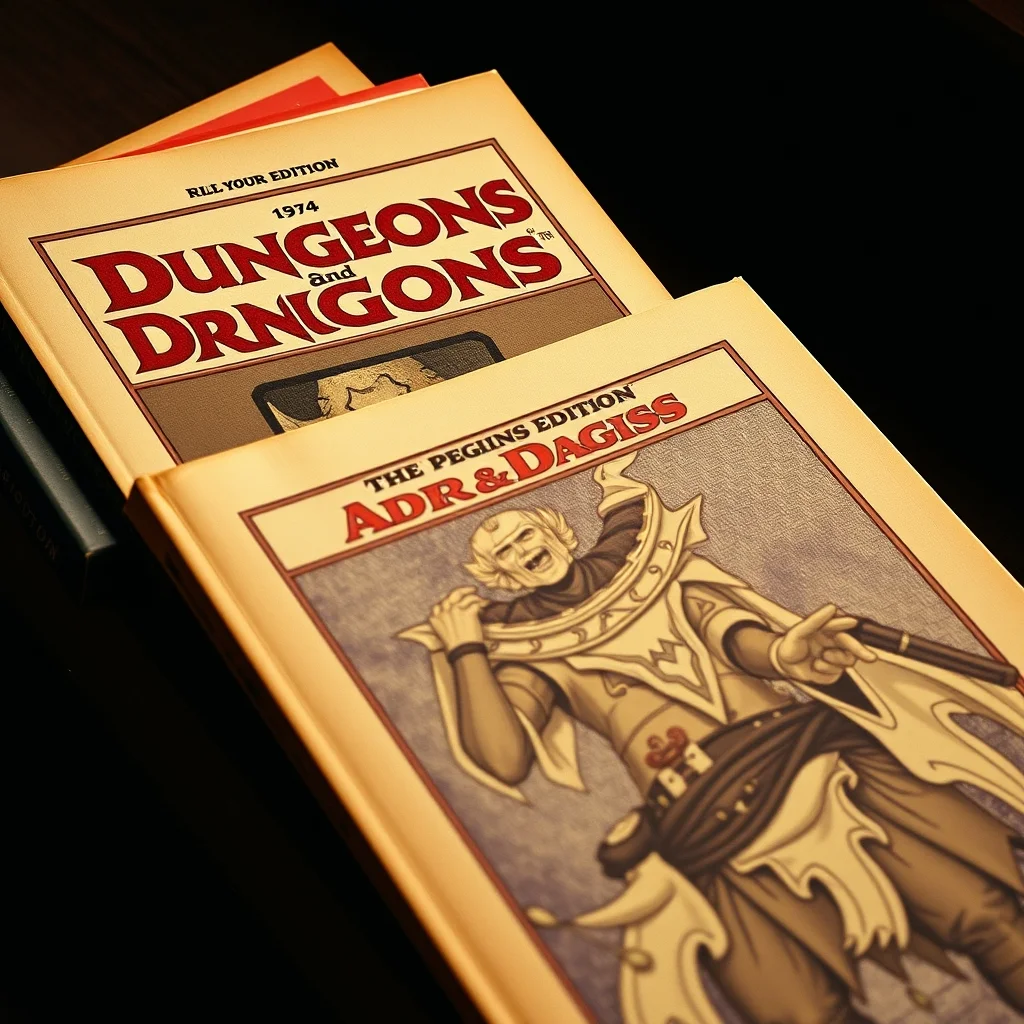
The TSR publishing timeline: what "edition" actually means
The term "edition" is used loosely when discussing vintage D&D, and the ambiguity creates collecting confusion. The formal breakdown:
- Original D&D (OD&D), 1974: The "Little Brown Books" — three digest-size booklets ("Men & Magic," "Monsters & Treasure," "Underworld & Wilderness Adventures") sold in a woodgrain-printed cardboard box. Published by TSR Hobbies (then TSR Wargames). This is the founding document of the RPG medium. Gary Gygax and Dave Arneson are the credited authors.
- Basic D&D, 1977 (Holmes edition): The first "Basic Set" — a single rulebook edited by J. Eric Holmes intended as an introduction to OD&D. Sold in a blue box with a Sutherland cover illustration. Contains rules only through 3rd level; intended to funnel players into OD&D or the forthcoming AD&D.
- Advanced Dungeons & Dragons (AD&D) 1st Edition, 1977–1979: Gygax's systematized and expanded version, published as three core hardcovers: Monster Manual (1977), Player's Handbook (1978), Dungeon Master's Guide (1979). A fourth core book, Deities & Demigods, followed in 1980.
- Basic D&D Moldvay edition, 1981: A full revision of the Holmes Basic Set by Tom Moldvay. Distinct from Holmes in rules and presentation; accompanied by an Expert Set by Dave Cook. Moldvay/Cook is a complete standalone game, not an introduction to AD&D.
- Basic D&D Mentzer edition (BECMI), 1983: Frank Mentzer's revision of the Basic/Expert game, expanded into a five-box series (Basic, Expert, Companion, Master, Immortal). Different from both Holmes and Moldvay despite using the same "Basic D&D" branding.
These are different games with different rules, not the same game in different print runs. A 1977 Holmes Basic Set, a 1981 Moldvay Basic Set, and a 1983 Mentzer Basic Set are entirely distinct products.
Original D&D (OD&D) 1974: woodgrain box identification
The 1974 OD&D set is the most valuable item in vintage RPG collecting. Several production details identify early from later production:
The woodgrain box (1974–1975)
The earliest printings of OD&D came in a box with a woodgrain-printed exterior — literally the same brown woodgrain pattern used on game boxes of the era. The woodgrain box is not labeled "Dungeons & Dragons" on the top surface — only on the end flap. The three booklets inside use a consistent brown-and-white layout.
Key identification markers for the first and second printings (woodgrain era):
- Booklet covers: plain brown with black text, no illustration on covers
- "Men & Magic" booklet: credits Gygax and Arneson on the title page
- The word "Original" does not appear on woodgrain production — that retronym came later
- Price on box flap: $10.00 for very earliest production (verify against known reference)
- Interior font: a typewriter-style typeface, not commercial typesetting
The tan box (1975–1977)
Subsequent printings moved to a tan-colored box with an illustration of a warrior fighting a balrog-like creature (often called the "Balrog box"). The content is largely the same but the production shifted to more commercial typesetting in later printings. The tan box is more common than the woodgrain; it is still collectible but does not command the woodgrain premium.
The supplements (1975–1977)
Four supplements were published for OD&D: Greyhawk (1975), Blackmoor (1975), Eldritch Wizardry (1976), and Gods, Demi-Gods & Heroes (1976). These were sold separately in the same booklet format as the core three. Supplement I: Greyhawk is typically the most sought supplement, as it introduced thieves, critical hit/miss tables, and spell additions that became D&D standards. First printings of supplements have the same typewriter-style typesetting as the woodgrain core set.
AD&D 1st Edition: printing identification markers
The three AD&D 1st Edition core books went through multiple printings between 1977 and 1989. The markers that differentiate first from later printings:
Monster Manual (1977)
The first AD&D book published. First printing (1977) has a distinct cover: David Sutherland's illo of monsters clustered around a warrior. Interior: Sutherland and other TSR house artists throughout. The first printing has no ISBN on the back cover — ISBNs were added in a later printing. Look for the printer's code on the copyright page: early TSR books used a format like "1st Printing, [month] [year]" or a number code. The Monster Manual first printing colophon reads "First Printing, December 1977." Later printings change the colophon text.
Player's Handbook (1978)
Dave Trampier cover art (the Wizard) is the most recognizable vintage D&D image and appears on the first printing. The first printing (June 1978) has specific indicators:
- Cover: Trampier's color painting of a magic-user, no border
- Copyright page: "First Printing, June 1978"
- Interior: the "Appendix A: Dungeon Random Generation" tables appear in the first printing but were removed in some later printings (restored in others — verify against reference)
- No ISBN on very earliest production
Later printings used a revised Erol Otus cover and eventually a revised Clyde Caldwell painting, making the cover art the fastest identifier of approximate print era.
Dungeon Master's Guide (1979)
David Sutherland cover (a demon-figure). First printing (August 1979) colophon reads accordingly. The DMG went through the most content revisions of the three core books — errata and clarifications were incorporated into subsequent printings. The first printing contains several passages later revised or removed. For collector interest, first printing is preferred; for play use, the content differences are modest.
Deities & Demigods (1980)
First printing includes the Cthulhu Mythos and Melnibonéan Mythos sections, licensed from Chaosium and Michael Moorcock respectively. These sections were removed in the third and subsequent printings after a licensing dispute was not renewed. The presence of these two sections is the definitive identifier of a first or second printing. First and second printing copies command substantial premiums over later printings, which are common. A seller listing D&D without specifying Cthulhu presence: ask before bidding.
Module identification: the TSR code system
TSR published adventure modules with alphanumeric codes that indicate series and sequence. For the Basic and Expert D&D lines:
| Code | Module | Author | First publication |
|---|---|---|---|
| B1 | In Search of the Unknown | Mike Carr | 1978 (included with Holmes Basic Set) |
| B2 | The Keep on the Borderlands | Gary Gygax | 1979 (included with Holmes, then later Basic Sets) |
| X1 | The Isle of Dread | Moldvay / Cook | 1981 (included with Expert Set) |
| S1 | Tomb of Horrors | Gary Gygax | 1978 (Gen Con tournament module) |
| G1 | Steading of the Hill Giant Chief | Gary Gygax | 1978 (tournament module, first in G series) |
Module B1 and B2 printing identification
Both B1 and B2 were included with the Holmes Basic Set in early production runs, then sold separately. This creates an identification issue: B1 and B2 included with the Holmes set have a different cover than standalone releases. The Holmes-set versions of B1 and B2 have a plain cover with a center illustration and no border; standalone releases have a border and different fonts. The Holmes-included versions are slightly earlier than standalone releases and are identifiable by their inclusion with the set (confirmed by a number code on the module itself that a experienced collector would recognize).
For B2 specifically, the module went through multiple printings as it was bundled with successive Basic Set editions. Early Holmes-set printings, later Moldvay-set printings, and standalone printings each have distinct cover art and production details. The earliest B2 printing (with Holmes set, 1979) is the most collectible.
Module S1: Tomb of Horrors
S1 was originally a tournament module at Gen Con 1975, distributed in limited photocopy form. The 1978 published version is not the original Gen Con distribution and does not circulate in original form. The 1978 first printing included a separate illustration booklet and a folded map; modules missing the illustration booklet or map are incomplete and should be priced accordingly. The illustration booklet shows numbered scenes corresponding to module text — it was specifically designed for convention play without a DM needing to sketch the scenes.
What the TSR stock number tells you
TSR printed a product stock number (TSR #XXXX) on most of their publications, typically on the back cover or cover page. These numbers can be cross-referenced against published product lists to confirm publication date and distinguish between printings for some items. The numbering is not always consistent — some products were renumbered across printings — but for the core AD&D books the stock numbers are stable identifiers used by serious collectors.
Additionally, many TSR products have a printer's code on the copyright page in the format "XXX XXX [year]" — a production run identifier. These codes are documented in collector reference works (primarily online databases at sites dedicated to this purpose) and allow fairly precise print run dating for most major TSR productions from the late 1970s through mid-1980s.
The honest buying checklist for vintage TSR material
- Confirm copyright page / colophon for printing number and date
- For OD&D: confirm box type (woodgrain vs tan) and check that all three booklets are present
- For Deities & Demigods: confirm Cthulhu/Melnibonéan chapter presence in table of contents
- For modules: confirm whether illustration booklet and maps are present
- Check for name writing or stamps on interior pages (common in used game books; reduces collector value)
- Confirm spine condition — AD&D hardcovers are prone to spine splitting at the hinge
- Water damage: check for wavy pages or tide-line staining visible from the page edges
Search eBay for vintage TSR D&D
 Holmes Basic Set
Confirm blue Sutherland cover and presence of module B1 or B2 in listings showing the full set contents.
Holmes Basic Set
Confirm blue Sutherland cover and presence of module B1 or B2 in listings showing the full set contents.
 AD&D 1st Ed. PHB
Trampier wizard cover = first printing. Ask for photo of colophon to confirm "June 1978" printing date.
AD&D 1st Ed. PHB
Trampier wizard cover = first printing. Ask for photo of colophon to confirm "June 1978" printing date.
 Module B2
Confirm standalone vs Holmes-set printing. Map and all interior pages present is the key completeness check.
Module B2
Confirm standalone vs Holmes-set printing. Map and all interior pages present is the key completeness check.
 Gygax era books
Broad search. Filter 1974–1985 for core Gygax-era production. Verify condition of hardcover spines before bidding.
Gygax era books
Broad search. Filter 1974–1985 for core Gygax-era production. Verify condition of hardcover spines before bidding.
 Dragon Magazine early issues
Issues 1–50 command premiums. Issue 1 (June 1976) is the most valuable single issue; specify issue number clearly.
Dragon Magazine early issues
Issues 1–50 command premiums. Issue 1 (June 1976) is the most valuable single issue; specify issue number clearly.