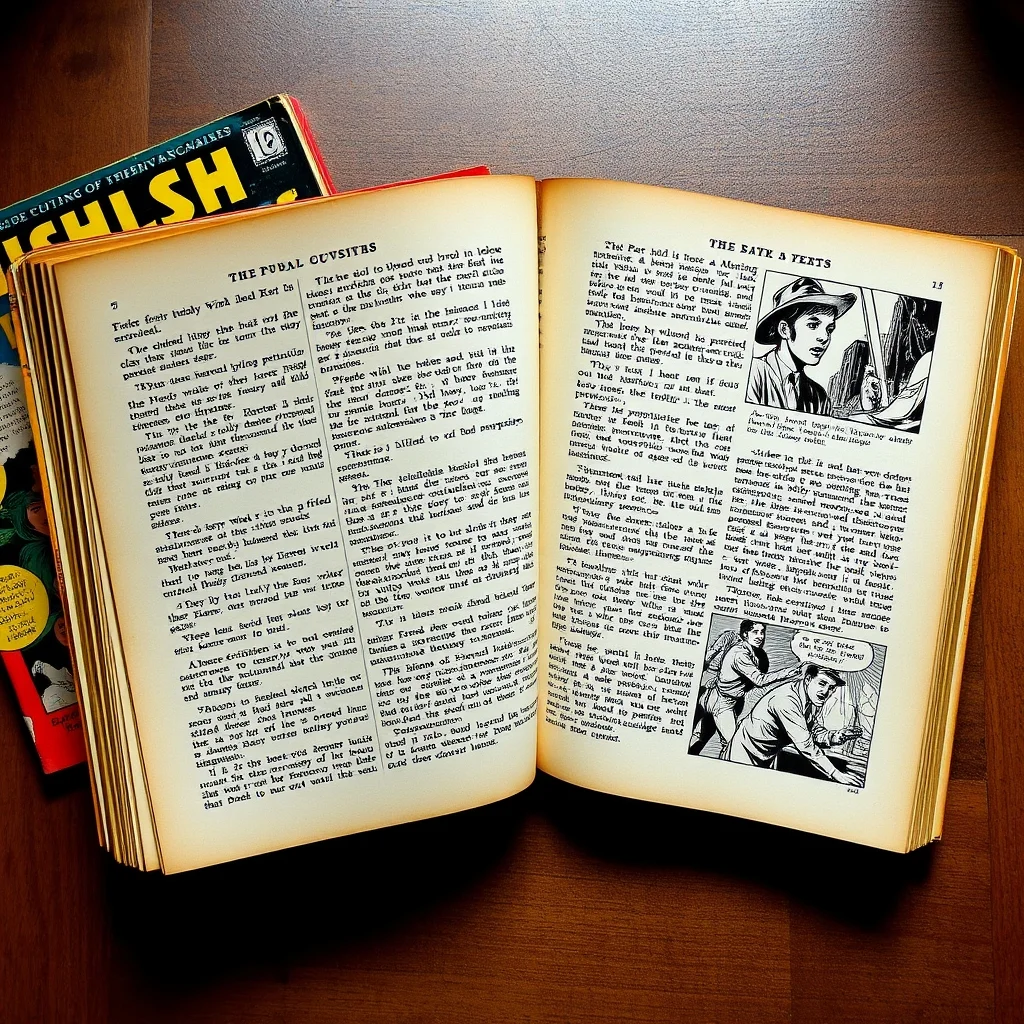
Why pulp paper ages the way it does
Pulp magazines are printed on groundwood paper — mechanical-process newsprint-grade stock. The wood-pulp process leaves lignin in the paper, and lignin oxidizes over time, producing the characteristic yellowing and eventual brittleness of old pulps. This is not a solvable problem, only a manageable one. Proper storage slows degradation; poor storage (humidity, UV light, acid contact) accelerates it dramatically.
By contrast, "slick" magazines (Life, The Saturday Evening Post) were printed on coated stock with better paper quality. Many pulps were also printed with water-based inks on rough, uncoated stock, which means cover art soaks into rather than sitting on the paper — color depth and cover condition are directly tied to original production quality and storage history.
Condition grading for pulps
No single third-party grading standard dominates pulp collecting the way CGC dominates comics. Most pulp collectors and dealers use a modified Fine/Very Good/Good/Poor scale with descriptive language for specific defects. The Overstreet Comic Book Price Guide includes a pulp grading guide that many dealers reference, though pulp-specific variations apply.
| Grade | Description | Typical survival rate |
|---|---|---|
| Fine (F) | Minimal spine stress, bright cover, no spine roll, tight binding, supple pages | Rare for pre-1940 issues |
| Very Good (VG) | Light spine stress, moderate yellowing, minor spine roll, cover bright with small handling marks | Common ceiling for well-stored examples |
| Good (G) | Noticeable wear, spine roll present, moderate browning, possible small tears or soiling | Most common survival grade |
| Fair | Heavy wear, significant spine roll or damage, brittle pages, cover separation possible | Very common for early 1920s–1930s issues |
| Poor | Severely damaged, missing pieces, near-complete brittleness | Reading copy only; display value minimal |
Spine roll: what it means and whether it's reversible
Spine roll is the tendency of a pulp spine to curve concave due to how the magazine was stored. Issues stored standing vertically in stacks or leaning against other objects often develop pronounced spine roll as the outer cover and spine layers dry and contract at different rates than the interior paper.
Moderate spine roll can sometimes be reduced by careful humidification and flat storage under moderate pressure. Severe spine roll that has been present for decades is typically permanent — the paper fibers have set in the curved position. When evaluating a purchase, lay the magazine flat on a table: a book with severe spine roll will rock or show visible curvature even when lying flat.
Brittleness: the critical long-term factor
Brittleness is the true functional limit of a pulp's survival. A brittle pulp — one where pages crack or chip at edges when flexed — cannot be read or handled without further deterioration. Brittleness is irreversible; it can only be slowed with archival storage.
The flex test: carefully fold back a corner of an interior page at the gutter. A supple page returns to position; a brittle page cracks or chips. Be cautious — this test should only be performed at inside margins where evidence is hidden. Most honest sellers will describe brittleness; most eBay photos cannot reveal it.
Weird Tales: the key issues
Weird Tales ran from March 1923 to September 1954 under various publishers. It is the single most collected horror and dark fantasy pulp title, primarily because it published H.P. Lovecraft, Robert E. Howard (creator of Conan), and Clark Ashton Smith extensively.
H.P. Lovecraft issues
Lovecraft's most important magazine appearances include Weird Tales May–July 1927 (serialized "The Case of Charles Dexter Ward"), October 1927 ("The Colour Out of Space"), and October 1928 ("The Call of Cthulhu"). These issues carry significant premiums above standard run copies. The August 1923 issue contains "Dagon," among his earliest WT appearances.
Robert E. Howard / Conan issues
The first Conan the Barbarian story appeared in Weird Tales December 1932 ("The Phoenix on the Sword"). The full run of Conan stories through 1936 are collected issues. Howard's earlier Kull and El Borak stories appeared from the late 1920s onward. Any issue with a cover by Margaret Brundage depicting a Howard character commands additional collector interest for cover art alone.
Margaret Brundage covers
Brundage produced the iconic painted pastel covers for Weird Tales from 1932 to 1945. Her covers are one of the primary drivers of WT collecting independent of content. Issues with Brundage covers in Very Good or better condition (bright colors, no significant fading) are particularly sought.
Shopping for vintage pulp magazines? Browse current eBay listings → (we earn a small commission; your price is unchanged).
Amazing Stories and the science fiction pulps
Amazing Stories was founded by Hugo Gernsback in April 1926 and is considered the first dedicated science fiction magazine. Early issues (1926–1929) featured cover art by Frank R. Paul in a distinctive mechanical-futurist style that is widely reproduced and collected. The magazine ran in various forms for decades; the Gernsback era through roughly 1936 is most prized.
Other significant SF pulps include Astounding Science Fiction (later Analog), which published Isaac Asimov, Robert A. Heinlein, and A.E. van Vogt in the early 1940s. John W. Campbell's editorial tenure at Astounding (beginning 1937) is considered the Golden Age of science fiction, and issues from this period with first appearances of major works are key issues.
The Magazine of Fantasy and Science Fiction (F&SF, beginning 1949) and Galaxy Science Fiction (beginning 1950) are mid-century SF titles with strong collector markets, particularly for early issues with significant authors.
Foxing, tanning, and cover color
Foxing — brown or reddish spots caused by mold or iron impurities reacting with moisture — is common on older pulps. Light foxing on interior pages is usually acceptable; foxing on the cover significantly reduces visual appeal and collector value. Foxing is not reversible by amateur methods; some paper conservators can reduce it, but the cost typically exceeds the value of all but the most significant issues.
Cover tanning (overall browning of cover paper) versus cover brightness is one of the most important visual grade factors. A cover that has tanned from cream to mid-brown has lost its original presentation regardless of other conditions. Bright original colors are rare and command premiums accordingly.
Buying lots vs single issues
Pulp lots offer potential value but require careful due diligence. Estate lots especially can include remarkable survivals from original owners who stored them well. Before bidding on a lot:
- Request photos of at least a few interior pages — not just covers.
- Ask whether any issues show brittleness or active mold.
- Check whether any issues are identified by title and date — unlisted issues in a lot may be the most or least valuable, and vague listings often indicate the seller doesn't know what they have.
- Account for shipping weight — pulps are heavy and fragile. Damage in transit is a real risk; ask about packing method.
Storage for long-term preservation
Pulps benefit from archival polypropylene bags with acid-free backer boards, stored upright with adequate support or flat in acid-free boxes. Temperature stability matters more than absolute coolness — fluctuating humidity accelerates brittleness faster than consistent moderate humidity. Acid migration from cheap cardboard boxes, rubber bands, or newspaper can cause visible damage within a few years. Separate pulps from any acid-contaminated materials if you acquire a lot that's been stored poorly.
Search eBay for vintage pulp magazines
 Weird Tales magazine vintage
Check issue date and ask about brittleness before purchasing Lovecraft or Howard issues.
Weird Tales magazine vintage
Check issue date and ask about brittleness before purchasing Lovecraft or Howard issues.
 Amazing Stories pulp
Early Gernsback-era issues with Frank R. Paul covers are the most collected.
Amazing Stories pulp
Early Gernsback-era issues with Frank R. Paul covers are the most collected.
 Vintage SF pulp
Astounding, Galaxy, F&SF — key issues from Campbell's Golden Age tenure.
Vintage SF pulp
Astounding, Galaxy, F&SF — key issues from Campbell's Golden Age tenure.