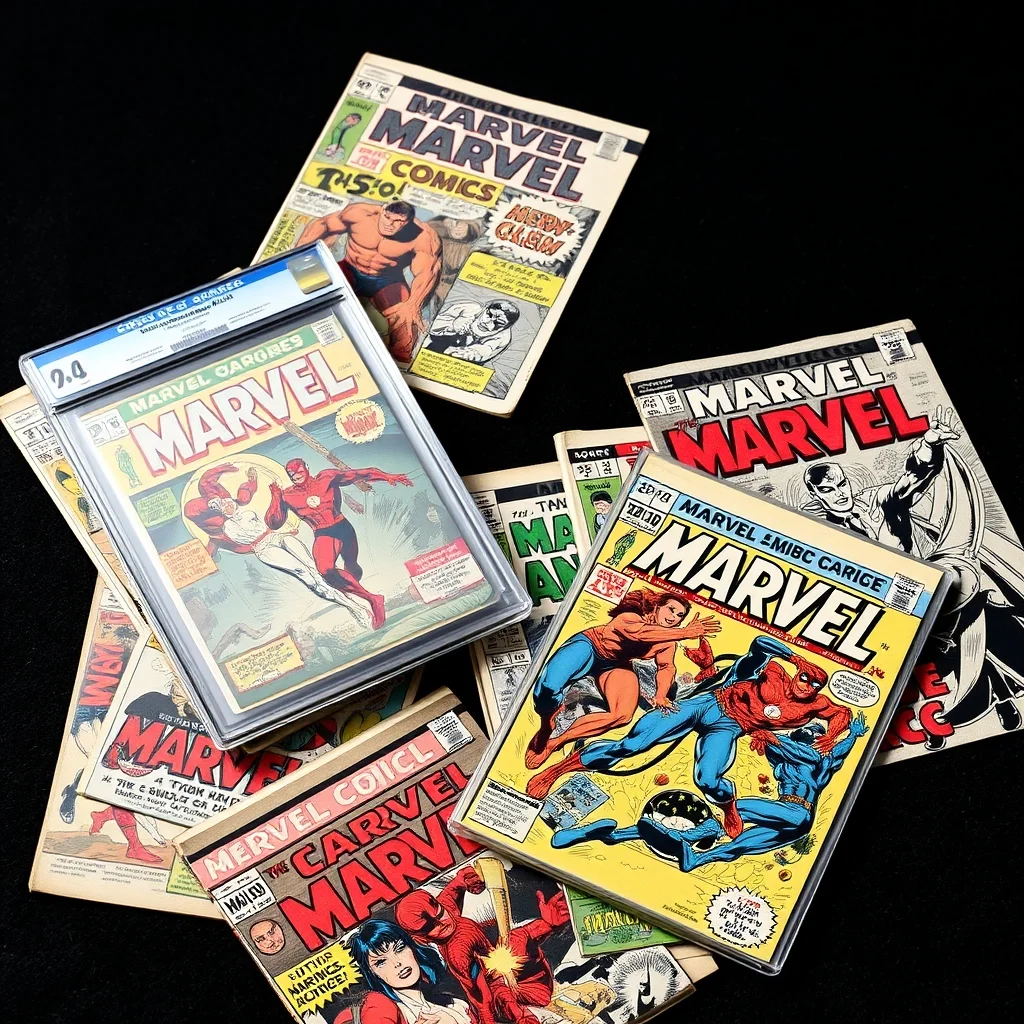
The CGC grading scale: 0.5 to 10.0
Comics Guaranty LLC (CGC), founded in 2000, established the dominant third-party grading standard for comic books. The scale runs from 0.5 (Poor) to 10.0 (Gem Mint) in defined increments. Understanding where grades fall and what differentiates them is the foundation of buying and selling intelligently.
| Grade | Label | Key characteristics |
|---|---|---|
| 10.0 | Gem Mint | Perfect. Virtually no copies earn this grade; population reports are tiny even for modern issues. |
| 9.8 | Near Mint/Mint | Nearly perfect — tiny corner blunts or minimal spine stress at most. The benchmark for modern key values. |
| 9.6 | Near Mint+ | Minor corner blunts, one or two stress lines. Strong eye appeal. |
| 9.4 | Near Mint | Small spine ticks, minor blunts possible. Still very strong presentation. |
| 9.0–9.2 | Very Fine/Near Mint | Light stress lines, minor corner wear. Common ceiling for vintage Silver Age raw copies. |
| 8.0–8.5 | Very Fine | Moderate spine stress, corner blunts. Presentable but clearly used. |
| 6.0–7.5 | Fine range | Noticeable creases, possible small tear. Readable with moderate defects. |
| 4.0–5.5 | Very Good range | Significant wear, spine roll possible. Common grade for Golden Age survivors. |
| 1.0–3.5 | Fair–Good range | Heavy use, missing pieces possible. Value is largely about the issue, not condition. |
| 0.5 | Poor | Heavily damaged or incomplete. Mostly placeholder copies. |
Golden Age, Silver Age, Bronze Age: the definitions
Comic book eras are defined by key publication events and cultural shifts, not exact calendar years. Collectors and dealers use these boundaries consistently enough that they affect pricing, but you will see minor variation in sources.
Golden Age: approximately 1938–1956
The Golden Age begins with Action Comics #1 (June 1938, the first Superman appearance) and extends through roughly 1956. Books from this period are scarce, fragile, and affected by World War II paper drives that destroyed enormous quantities of inventory. Most surviving Golden Age copies grade below 5.0. High-grade examples (8.0+) are exceptional rarities even for common issues.
Silver Age: approximately 1956–1970
The Silver Age opens with Showcase #4 (October 1956, the first appearance of the Barry Allen Flash), which restarted superhero publishing after the post-war lull. It runs through approximately 1970. This era contains the most sought-after first appearances: Amazing Fantasy #15 (Spider-Man), Fantastic Four #1, X-Men #1, Hulk #1, and hundreds more. Silver Age books are more survivable than Golden Age but still predominantly in mid-grade for raw copies.
Bronze Age: approximately 1970–1985
The Bronze Age is loosely defined as the period following the Comics Code Authority's relaxation and the rise of more socially conscious storytelling. Print runs were generally higher than Silver Age, which means higher-grade raw copies exist in greater numbers. Key Bronze Age issues include Giant-Size X-Men #1, Incredible Hulk #181 (first Wolverine), and Amazing Spider-Man #129 (first Punisher).
Copper and Modern Ages
The Copper Age (roughly 1985–1991) and Modern Age (1991 onward) are less consistently defined. Modern Age books are typically not scarce in high grades — many were preserved in collector quantities from the speculator boom of the early 1990s, making 9.8 grades relatively common and depressing prices for most issues.
What makes a key issue
A "key" issue is any comic with a significant first appearance, first cover appearance, origin story, major plot event, or historical importance that creates collector demand above a standard run copy. Not all keys are created equal.
First appearances dominate the key issue market. The hierarchy generally runs: first full appearance of a character > first cameo appearance > first cover appearance > origin issue > significant story event. For example, Incredible Hulk #181 is Wolverine's first full appearance; Incredible Hulk #180 contains a cameo (last-panel partial appearance). Both are keys, but #181 commands a significantly higher premium.
The CGC census population report matters for keys. A key issue with very few copies graded at 9.6 or higher is scarcer in high grade than the total number of copies might suggest. Always check cgccomics.com census before paying a premium for a high-grade raw copy — population data tells you how rare that grade actually is for that specific issue.
Shopping for vintage comics? Browse current eBay listings → (we earn a small commission; your price is unchanged).
Understanding restoration: what it means and why it matters
Restoration is any repair or enhancement to a comic book that goes beyond normal cleaning. This includes: color touch (adding ink to worn areas), tear seals (adhesive fills), spine splits repaired, staple replacement, trimming (cutting edges to make them look cleaner), and pressing (applying heat/pressure to remove creases).
CGC labels restoration with a purple "Restored" label as opposed to the standard blue "Universal" label. A restored book typically sells for 50–80% less than an equivalent unrestored copy at the same apparent visual grade, because restoration does not genuinely improve a book's condition — it masks defects. A CGC 8.0 Restored copy of a key issue is worth far less than a CGC 5.0 unrestored copy of the same issue in most cases.
Detecting restoration on raw books
Before purchasing raw vintage books at higher grade points, examine for:
- Color touch: Examine the cover under bright raking light or a UV/blacklight. Touched areas often fluoresce differently than original printed ink. Color touch typically appears as slightly different sheen or texture.
- Trimming: Measure the book against standard dimensions. Standard Silver Age comics are approximately 10.375 × 7.625 inches. A book that measures notably smaller has likely been trimmed. Squared-off corners that look "too clean" for an otherwise worn book are a warning sign.
- Tear seals and fills: Run a finger gently along the cover and spine. Adhesive fills have a slightly different surface feel and may appear glossy relative to surrounding areas.
- Staple replacement: Original staples show age-appropriate tarnish. Bright, shiny staples on an otherwise aged book suggest replacement. Check whether staple holes align and whether there is additional puncture evidence.
- Pressing: This is the hardest to detect — pressing is a non-additive technique that can be legitimate (removing handling creases) or used to mask defects. CGC notes pressing as "conserved" on a green label if done professionally and disclosed. Undisclosed pressing on raw books is common and difficult to detect without experience.
Pedigree collections
Pedigree collections are groups of comics traced to a single original owner or collection that displayed exceptional preservation. CGC recognizes specific pedigrees — the most prominent include the Edgar Church/Mile High collection (Golden Age, Colorado), the Allentown collection, the Twin Cities collection, and the Bethlehem collection.
A pedigree designation on a CGC slab is noted on the label. Pedigree copies of Golden Age books often grade significantly higher than typical surviving copies of the same issue because original owners stored them carefully before the collector market existed. Premium for pedigree designation varies; on key issues, a pedigree label can add substantial value over a non-pedigree copy at the same grade.
Buying raw versus slabbed
Slabbed (CGC/CBCS-encapsulated) books offer certainty: you know the grade, restoration status, and census population. You pay a premium for that certainty, both in the cost of grading and in the market price of slabbed versus raw copies at equivalent apparent grade.
Raw books offer potential value — a raw book that grades higher than the seller assessed, or that has no restoration, can be acquired below slab price. The risk is the reverse: paying raw-near-mint price for a book that grades 7.5 with undisclosed restoration. The skill gap between casual buyers and experienced graders is real and expensive.
For keys above a few hundred dollars in value, submitting a raw book to CGC before purchase (through a dealer who will sell contingent on grade) or purchasing slabbed is the lower-risk path. For common Silver/Bronze Age run copies, buying raw in bulk lots and enjoying them is perfectly reasonable.
Practical buying checklist
- Verify CGC cert numbers against cgccomics.com census (cert fraud, including swapped slabs, exists).
- Check census population at your target grade — some "common" Silver Age keys are surprisingly scarce at 9.4+.
- For raw books over ~$100: blacklight the cover, check dimensions, examine staples.
- Understand the restored label discount before assuming restoration "doesn't matter" on a book you love.
- eBay's completed listings are the most honest real-market price reference — not asking prices, completed sales.
 CGC graded comic
 Silver Age comic book
 Bronze Age key comic