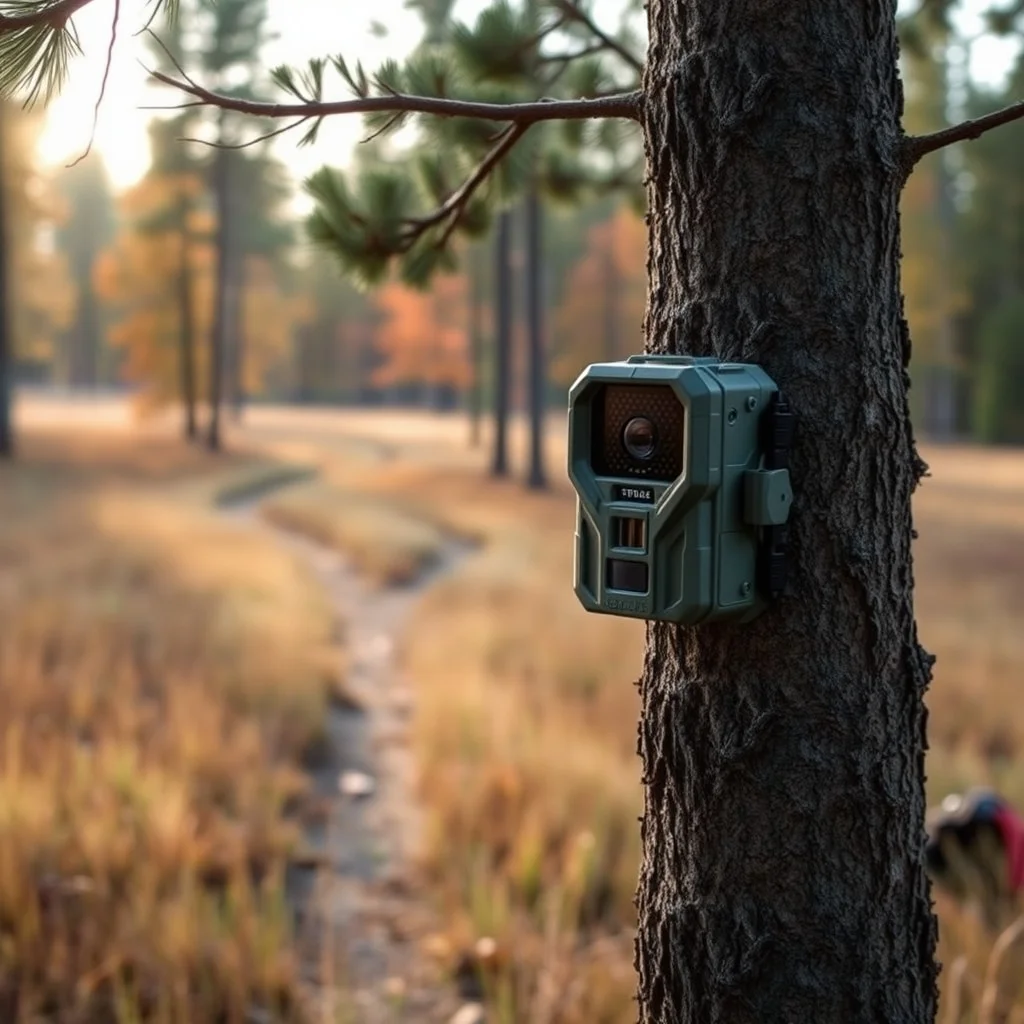
Trigger speed and detection zone: the spec that matters most
Every trail camera spec sheet lists trigger speed — the time from motion detection to the first image captured. Most modern cameras are somewhere between 0.2 and 1.0 seconds, and marketers emphasize the faster numbers aggressively. But trigger speed without detection zone is a meaningless figure.
Here is why: a detection zone is a cone-shaped field in front of the PIR (passive infrared) sensor. That cone has both a range (how far out it detects heat + motion) and a width (how wide the detection arc is at a given distance). A camera with a 90-foot detection range and a 45-degree cone covers a wide swath of trail. A camera with a 30-foot narrow cone covers a much tighter area.
If an animal enters the wide 45-degree cone 60 feet away and walks toward the camera, you have several seconds to capture it regardless of whether the trigger fires in 0.3s or 0.8s. If the animal crosses a narrow cone at an angle, even a 0.2s trigger may miss it because the animal crosses the zone in under a second.
What trigger speed actually affects
Fast trigger speed (0.2–0.3s) matters in specific situations: crossings where deer or other game move through the frame quickly at an angle, or when you're trying to capture the lead animal of a group rather than the last one. It also matters for fast-moving small game like foxes or coyotes in predator setups.
For most deer hunting applications at a natural food source or scrape, a 0.5–0.8s trigger is entirely adequate. Save money here and spend it elsewhere in the spec sheet if budget is limited.
Detection range: what the spec actually means
Manufacturers list detection ranges like "80 feet" or "100 feet" — these numbers are measured under standardized conditions that may not match your setup. Typically, the maximum detection range is tested with a warm human-sized target moving perpendicular to the camera on a cool night. Real-world detection range drops in these circumstances:
- Hot weather — when ambient temperature is close to body temperature, the PIR sensor struggles to distinguish the heat signature. A camera rated at 80 feet in October may effectively be 40–50 feet in August heat.
- Target moving toward or away from camera — PIR sensors detect heat differential and motion together. An animal walking directly toward the camera (changing temperature slowly relative to the sensor) is harder to detect than one crossing the field.
- Dense vegetation — brush between the sensor and the animal scatters and absorbs heat, reducing effective range.
A practical approach: set detection range expectations at 60–70% of the rated spec for normal daytime summer use, and closer to 80–90% of rated spec for cooler-season nighttime use.
Megapixels: where the marketing math misleads
Trail camera megapixel ratings often include "digital interpolation" — the camera captures at a lower native resolution and the processor upscales the image. A camera rated at 24MP may have a native sensor resolution of 8MP or 12MP. The interpolated image is larger in file size but contains no additional detail compared to a true native-resolution shot.
For practical purposes, 8–12MP native resolution is enough to identify deer species, antler configuration, and number of points. 16MP+ is useful if you plan to crop heavily to count antler points at range. The megapixel race above roughly 12MP native is largely a marketing exercise for the trail camera category.
More useful questions than megapixel count:
- What is the image sensor size? Larger sensors capture more light; night images are better. This spec is rarely advertised but occasionally found in detailed reviews.
- What is the flash illumination distance at night? The camera may have a rated detection range of 80 feet, but if the IR flash only illuminates to 50 feet, nighttime images beyond 50 feet will be underexposed.
- Does the camera time-stamp correctly? Many budget cameras have poor real-time clock accuracy that drifts weeks off over a season.
Flash type: white flash vs low-glow vs no-glow
Trail cameras use one of three illumination methods for nighttime captures, and the choice has real consequences for both image quality and animal behavior.
White flash (incandescent or white LED)
Produces full-color nighttime images. The flash is visible — a bright burst of white light when the camera triggers. This alerts animals and any humans who might be watching for cameras. White flash cameras are increasingly uncommon in serious hunting applications because the alert risk is high, but they produce the best-quality nighttime color images and are sometimes used for property security.
Low-glow infrared (850nm)
Emits infrared light invisible to human eyes in normal lighting but produces a faint reddish glow visible to alert animals at close range — and visible to human eyes in the dark if you're looking for it. Night images are black-and-white but well-illuminated at typical distances (30–50 feet). This is the most common choice for deer hunting: the slight glow risk is low in practice, and the image quality is noticeably better than no-glow.
No-glow infrared (940nm)
Completely invisible to both human and animal eyes. The downside is that 940nm IR output is less efficient than 850nm, meaning the flash illuminates a shorter effective distance for the same power draw, and night images are somewhat darker. Better battery life impact per flash, but reduced image brightness and range. Best choice for high-pressure properties where camera detection is a concern, theft-prone areas, or when targeting spooky mature deer.
| Flash type | Visibility | Night image quality | Best use |
|---|---|---|---|
| White flash | Fully visible | Full color, excellent | Security, non-wildlife use |
| Low-glow 850nm | Faint red glow | B&W, well-lit | Most hunting applications |
| No-glow 940nm | Invisible | B&W, darker | High-pressure land, theft risk |
SD card vs cellular: the real cost comparison
Cellular trail cameras send images to a connected app via LTE every time they trigger. The images appear on your phone without a site visit. Standard SD cameras store images locally; you retrieve them when you pull the card.
Shopping for trail cameras? Browse current eBay listings → (we earn a small commission; your price is unchanged).
The honest cost comparison requires including the data plan. Most cellular trail camera manufacturers sell proprietary data plans ranging from roughly $5–15/month per camera, depending on image count thresholds and resolution. A single cellular camera can cost $80–160/year in data costs on top of the camera price. At four cameras, that's $320–640/year in recurring costs for the data plans alone.
When cellular makes sense
- You're actively scouting during season and need real-time intel on buck movement
- Your property is remote enough that pulling cards burns significant drive time
- You want to monitor a specific entry trail and adjust stand placement based on current conditions
- Security application — cellular cameras can serve as remote monitoring devices
When SD makes more sense
- You check cameras at regular intervals (weekly or biweekly) and don't need real-time data
- You're running 4+ cameras — the data plan costs add up quickly
- You're in an area with poor LTE coverage, which makes cellular unreliable
- Battery longevity is a priority — cellular cameras consume significantly more power per trigger
Battery life: the spec no one advertises clearly
Trail camera manufacturers quote battery life in "days" or "months" under idealized conditions — low trigger frequency, no cellular transmission, no video. Real-world battery life depends heavily on trigger frequency, temperature, and whether cellular is active.
Practical rules of thumb:
- A high-traffic location that triggers 30–50 times per day will drain batteries in 2–4 weeks for most cameras
- Cold weather (below 20°F / -6°C) significantly reduces AA alkaline battery performance; lithium batteries maintain capacity much better in cold
- Cellular cameras with frequent triggers may need weekly battery changes at busy locations
- Solar panels are most effective as supplements — they reduce the pace of drain, not eliminate it on cloudy days or in heavy canopy
For long-duration deployments, 12V external battery packs (connected via the external power port many cameras include) are the most reliable solution. A 12V 12Ah sealed lead-acid battery can power a moderately active camera for 3–6 months depending on conditions.
Video vs photo: a practical decision
Most trail cameras offer both photo and video modes. Video gives you behavioral context — you can watch how a buck behaves, confirm it's the same deer across multiple events, and see how it uses a location. The trade-off is file size (a 20-second video clip is 20–30× the size of a photo) and battery consumption.
For initial scouting of a new property, video mode helps you understand animal movement patterns. For in-season camera checks where you want to identify every buck that visits a location, photo mode is more efficient — lower file size, longer battery life, and easier to review quickly. Many hunters use video for September inventory work and switch to photo burst mode for October through season.
Placement that makes specs matter less
The highest-leverage factor in trail camera success is placement, not specs. A mid-priced camera placed correctly outperforms an expensive camera placed poorly. Practical placement rules:
- Height: 3–4 feet off the ground at a slight downward angle captures full-body shots reliably. Higher placement to reduce theft risk introduces more sky background, which can confuse the PIR trigger.
- Sun angle: East-facing cameras get direct morning sun in the lens; west-facing get afternoon sun. Both cause false triggers and washed-out images. Orient cameras north or south when possible to reduce direct sun exposure.
- Distance to target: For scrapes and mock scrapes, 15–25 feet gives full-body shots with room to capture the whole animal. For trail crossings, 20–40 feet is typical.
- Vegetation: Clear brush from the detection zone within 10 feet of the camera — waving branches in wind are the leading cause of false triggers and wasted battery.
Trail cameras worth looking at on eBay
We earn a small commission on qualifying sales; your price is unchanged. Full disclosure.
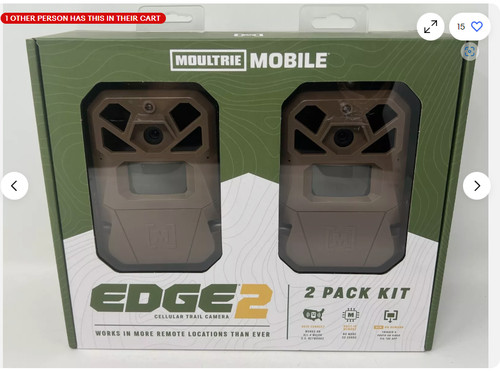 Cellular trail cameraReal-time images to your phone via LTE. Best for active scouting during season.View on eBay →
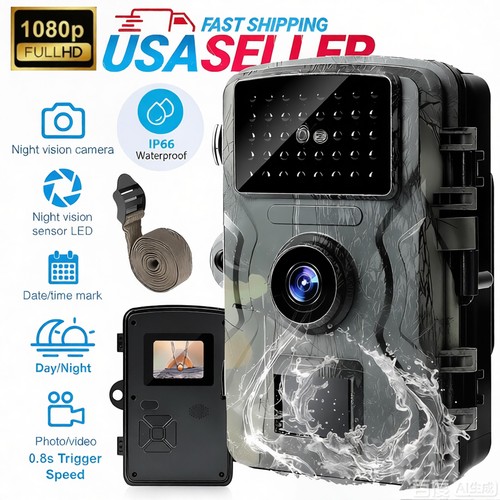 Trail camera night vision850nm low-glow IR for well-lit B&W night images at standard range.View on eBay →
Game cameraSD card, no monthly fees. Longer battery life. Practical for most setups.View on eBay →
Trail camera night vision850nm low-glow IR for well-lit B&W night images at standard range.View on eBay →
Game cameraSD card, no monthly fees. Longer battery life. Practical for most setups.View on eBay →
 No glow trail camera940nm invisible flash for high-pressure land and spooky mature deer.View on eBay →