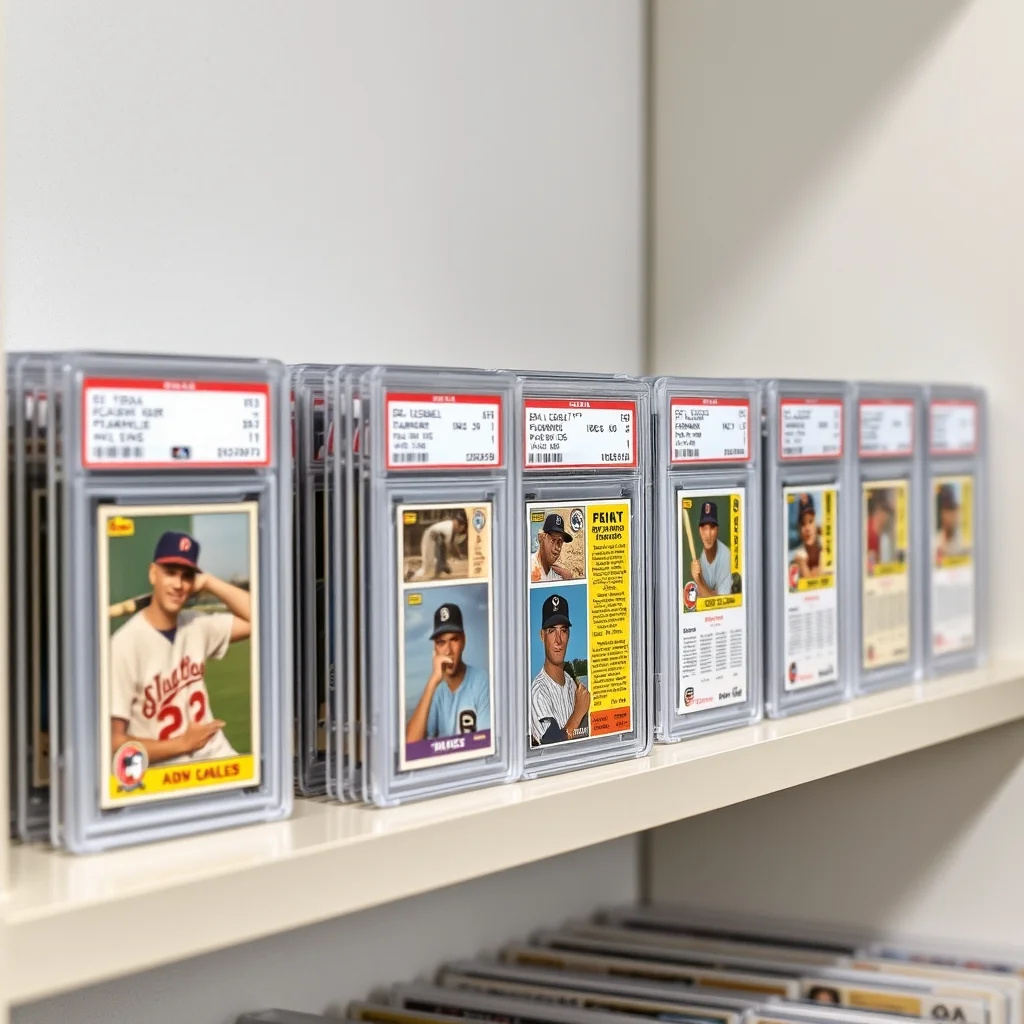
The T206 set: tobacco cards and why they matter
The T206 White Border set was produced from 1909 to 1911 by the American Tobacco Company and distributed in cigarette packs. It contains 524 subjects (players and managers) across 16 different tobacco back brands. T206 is the most collected pre-war baseball card set, primarily because it's large enough to build, old enough to be genuinely scarce in high grades, and contains the Honus Wagner card that is effectively the most famous card in existence.
The Wagner T206 (produced in very limited quantities before Wagner reportedly demanded its withdrawal) is not a practical collecting target for most buyers. The rest of the set — including Ty Cobb, Christy Mathewson, and Cy Young variations — represents accessible collecting with meaningful depth.
Identifying genuine T206 cards
Genuine T206 cards measure approximately 1.437 × 2.562 inches. The front features a lithographed player portrait on a white border. The back identifies the tobacco brand and contains a brief player biography. Common backs include Sweet Caporal, Piedmont, Polar Bear, and Sovereign. Some backs are significantly rarer than others for the same player — the Old Mill and Uzit backs are particularly scarce and command significant premiums above the same player on a common back.
T206 cards are frequently trimmed and resubmitted. PSA uses authentication procedures including measuring dimensions. A card that grades 7 but measures narrower than standard dimensions would be rejected or graded as altered. When buying raw T206, measure before paying a premium.
The 1952 Topps set
The 1952 Topps baseball card set (#1–407) was Topps' first nationally distributed full-color set and established the modern baseball card format. It is anchored by card #311, Mickey Mantle's second-year Topps card, which is broadly considered the most important post-war baseball card.
High series scarcity
The 1952 Topps set is divided into series. Cards numbered 311–407 (the "high series") are significantly scarcer than the low-number cards, because Topps reportedly dumped unsold high-series inventory into the ocean at the end of the production run. This is often cited as the origin of the high-series scarcity, though the precise circumstances are debated. Regardless of origin, PSA population data confirms that high-series 1952 Topps cards grade dramatically lower in raw population and high-grade survival than low-series cards.
For a set collector, this means low-series cards in grade 4–6 are findable at moderate cost; high-series cards in equivalent grades are meaningfully more expensive per card, and certain high-series stars (Mantle, Robinson, Mays at #261) require significant budget at any grade.
PSA vs SGC: grading scale comparison
Professional Sports Authenticator (PSA) and Sportscard Guaranty Corporation (SGC) are the two dominant third-party graders for vintage cards. Both use 1–10 scales, but there are meaningful differences in how they apply grades and in market perception of their slabs.
| Grade | PSA label | SGC label | Typical condition |
|---|---|---|---|
| 10 | Gem Mint | Pristine | Perfect in all respects |
| 9 | Mint | Mint | Strong corners, well-centered, minimal surface issues |
| 8 | Near Mint–Mint | Near Mint–Mint | Slight corner wear or very minor centering off |
| 7 | Near Mint | Near Mint | Light wear on corners, minor print defects acceptable |
| 6 | Excellent–Mint | Excellent–Mint | Moderate corner wear, centering within 70/30 |
| 5 | Excellent | Excellent | Heavier corner wear, possible light crease |
| 4 | Very Good–Excellent | Very Good–Excellent | Heavy corner rounding, moderate centering issues |
| 3 | Very Good | Very Good | Very heavy wear, possible stains, significant centering off |
| 2 | Good | Good | Rounded corners, creases, significant surface issues |
| 1 | Poor / Authentic | Poor | Major damage; authenticated as genuine but heavily damaged |
Centering: the math that caps your grade
Centering is the ratio of border width on opposite sides of the card. PSA and SGC both express centering as a ratio — for example, 60/40 means one border is 60% of the available space, the other 40%. Grading standards vary slightly by era and grade level, but general thresholds are:
- PSA 9/10: Typically requires 60/40 or better left-to-right and top-to-bottom.
- PSA 8: Generally allows up to 65/35.
- PSA 7: Generally allows up to 70/30.
- PSA 6 and below: Progressively wider centering tolerances, though severe miscuts cap grades regardless.
Centering is the single most common reason a card that appears visually strong grades lower than expected. A T206 with bright color, clean surface, and sharp corners that is 75/25 off-center will grade significantly lower than its surface condition alone would suggest.
Shopping for vintage sports cards? Browse current eBay listings → (we earn a small commission; your price is unchanged).
Corner wear: how to assess it
Corners are graded on a scale from sharp (90-degree point intact) to severely rounded (original corner geometry lost). PSA uses a 1–4 corner designation in their grading notes for some grades. For practical assessment:
- Sharp corners: Original 90-degree geometry intact under magnification. Required for grades 8+.
- Fuzzy corners: Minor fiber separation at corner tip, point still visible. Consistent with grade 7.
- Light rounding: Corner point beginning to round. Consistent with grade 5–6.
- Heavy rounding: Corner significantly rounded, original geometry lost. Consistent with grade 3–4.
- Very heavy rounding/wear through: Corner essentially gone. Grade 2 or below.
For pre-war cards (T206, E series, M series), corners are typically softer due to age and printing methods — graders apply appropriate era standards. A T206 with "fuzzy" corners may grade 7 where a 1970s Topps with identical corners might grade 8.
Rookie card identification
The concept of a "true" or "recognized" rookie card is more specific than simply a first-year card. Beckett and major graders use criteria that generally require: the card was issued as part of a licensed, nationally distributed set; the player is depicted in their MLB uniform (not a draft or minor league designation); and the card was not produced as an insert or short-print in a way that prevents it from qualifying as a "base" issue.
For vintage players, rookie card identification is usually well-established. Mickey Mantle's recognized rookie card is 1951 Bowman #253. For players from the Topps era (1952 onward), the recognized rookie is typically their first Topps base card. Complications arise with players who appeared in multiple sets in the same year — some collectors consider only one of several first-year cards as the "true" rookie based on print date or national distribution.
Population reports and their meaning
PSA and SGC both publish population reports showing how many copies of each card have been graded at each grade level. For high-value cards, population data directly affects market price. A card graded PSA 8 in a set where 500 PSA 8 copies exist is worth less than a card graded PSA 8 in a set where only 12 PSA 8 copies exist — supply at grade is as important as the grade itself.
Check population before paying a significant premium for a high-grade slab. A "PSA 9" that has 1,000 PSA 9 copies is not scarce. A "PSA 5" with only 3 copies at that grade in an era where most copies came back grade 2–3 represents meaningful scarcity. Population reports are available free at psacard.com/pop and sgccard.com.
Search eBay for vintage sports cards
 T206 baseball card
Measure dimensions and check card backs — some backs add significant premium.
T206 baseball card
Measure dimensions and check card backs — some backs add significant premium.
 1952 Topps baseball card
High series (#311–407) meaningfully scarcer than low series. Centering caps grades.
1952 Topps baseball card
High series (#311–407) meaningfully scarcer than low series. Centering caps grades.
 PSA graded vintage card
Verify cert at psacard.com and check population before paying grade premium.
PSA graded vintage card
Verify cert at psacard.com and check population before paying grade premium.