The kit, in order
- The machine. See which one for what you sew and the buying guide.
- Needles for the cloth you will use. The tree below uses Schmetz types.
- Extra bobbins in the type your machine takes. The store sells bobbins by brand. Check your manual for the type yours takes.
- Thread. Cheap, linty thread sheds into the tension area; the store's care guide says to avoid it (see care schedule).
- A seam ripper and scissors. Basic tools; this item is our opinion, not a sourced claim.
- Presser feet for your first jobs. The store lists zipper, button and buttonhole, rolled hem and others by type, and by brand.
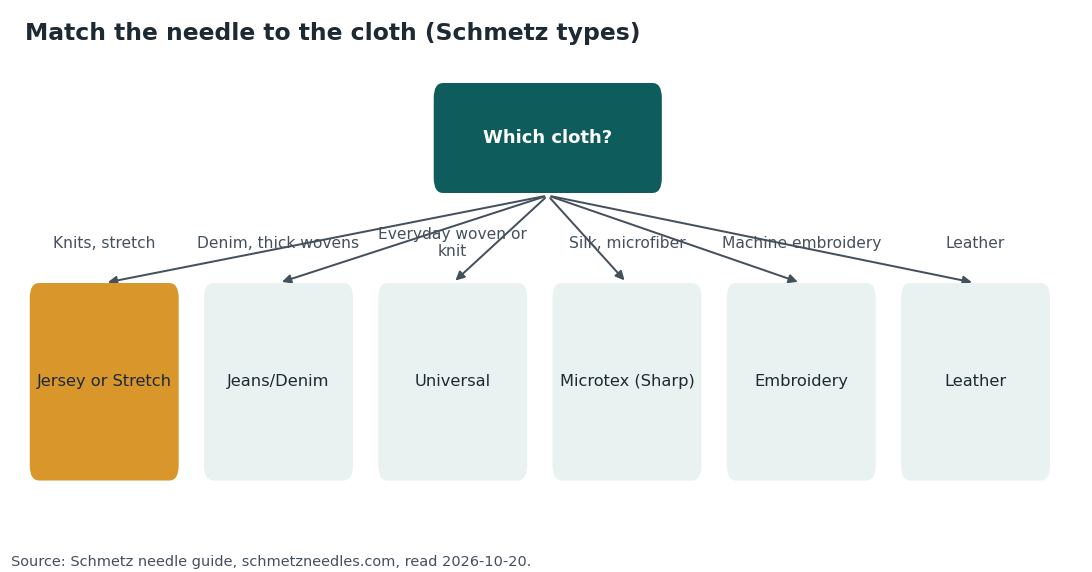
What Schmetz says each needle is for
| Type | Schmetz description |
|---|---|
| Universal | "Slightly rounded point"; for woven and knit fabrics. |
| Jersey (Ball Point) | "Medium ball point"; for knits and stretch fabrics without damaging the knit fibers. |
| Stretch | "Medium ball point, special eye and scarf"; for elastic materials, to help prevent skipped stitches. |
| Jeans/Denim | "Medium ball point and reinforced blade"; denim and similar thick woven cloth. |
| Microtex (Sharp) | "Very slim acute point"; microfibers, silk, foils and coated cloth, precise topstitching and quilt piecing. |
| Embroidery | "Light ball point, wide eye and groove"; protects rayon, polyester and other specialty threads from friction. |
| Leather | "Cutting point"; leather and heavy synthetics. Not for knit or woven fabrics. |
Schmetz says size is set by blade diameter: "size 75 is .75mm." Its page does not explain the second number in a pair like 80/12. When to change: Schmetz lists worn or damaged needles as a cause of broken or shredded thread, skipped or uneven stitches, puckering and popping sounds. The store's care guide says to replace the needle "every 8-10 hours of sewing or at the start of each new project." That is the store's rule of thumb; your machine manual rules.
What the sources do not say
- Schmetz describes only its own needles. We did not compare makers.
- No source we read says how many needles a beginner should buy. A few of the type you use most is our opinion, not a sourced figure.
- We give no prices.
The simpler option
You do not need a whole notions aisle. A needle that fits the cloth, a spare bobbin and decent thread cover most first projects. If stitches skip, read the needle guide before buying anything.
Needles first
The store lists needles by type, including Universal, Ballpoint, Jeans and Denim, Stretch and Embroidery. Our reason to click: you can match the needle type in the figure to its category.
We earn a small commission on qualifying sales, and 90% of it goes to charity (you can pick which); your price is unchanged. Full disclosure.
Sources
- SCHMETZ needle guide, read 2026-10-20.
- SewingMachinesPlus collections page: sewingmachinesplus.com/collections (store page, shown as text so it is not a link), read 2026-10-20.
- SewingMachinesPlus "Sewing Machine Maintenance: Easy Home Care Guide" (dated 2026-08-08): sewingmachinesplus.com/blogs/news/sewing-machine-maintenance (store page, shown as text so it is not a link), read 2026-10-20.