Buoyancy fine control: breath, BCD, and trim — the honest hierarchy

Most buoyancy problems aren't BCD problems. They're trim problems or overweighting problems or breathing problems. The BCD is the last thing to adjust, not the first.
Why buoyancy is the master skill
Every other underwater skill — photography, navigation, fish ID, wreck penetration, cave diving — is easier when your buoyancy is automatic. And every one of them is degraded or made dangerous when your buoyancy isn't. A diver who has to actively think about buoyancy while photographing a nudibranch is doing two cognitively demanding tasks simultaneously. A diver with automatic buoyancy does one: photograph.
The reason buoyancy is hard is that it's a system of three interacting variables: breath, BCD volume, and body position. Each one affects the others. Changing one without understanding the current state of the others produces results that feel random. Many divers who describe themselves as "bad at buoyancy" are actually just managing the variables out of order — reaching for the BCD inflator when they should be breathing, or breathing when they should be changing trim angle.
The correct mental model is a hierarchy: trim is the foundation, breath is the fine control, and BCD is the coarse adjustment. Learn them in reverse order of influence — establish the right trim first, set the BCD roughly right, then use breath for everything moment-to-moment.
Trim: the prerequisite everything else depends on
Trim is the angle your body makes in the water. In ideal horizontal trim, you're as close to level as possible — horizontal spine, fins at or slightly above hip level, head roughly in line with your body. In this position, you present the smallest cross-section to the water in front of you (reducing drag), your kicks push you forward rather than up or down, and changes in breathing are expressed as vertical movement rather than tipping fore or aft.
Poor trim is usually the real reason divers can't hold depth. A diver in a feet-low, head-high position is constantly kicking to stay level, and every kick pushes them up. They then dump air from the BCD to compensate. Then they sink a little, kick harder, rise again, dump more air. The whole chaotic cycle is caused by trim — fix the trim and the BCD chasing stops.
Trim is controlled by where your weight is placed and where your BCD volume is positioned. Weight belt weight sitting on the hips drives your lower body down (feet-low position). Moving weight to the tank band or weight pockets integrated into the BCD higher up shifts the balance. The goal is that with neutral buoyancy achieved, you float level without any muscular effort. Experiment with weight placement on every new setup, in a pool or controlled environment, before a real dive.
Tank position also matters. A tank mounted high on the BCD pushes the weight and volume toward your head, which can tip you head-down. A tank mounted low shifts balance toward your feet. The standard recommendation is to position the tank so the first stage is at ear level, but this varies by body composition and BCD design. Test your specific combination rather than assuming any position is correct.
Overweighting: the most common reason buoyancy is hard
The single most common reason divers can't control buoyancy is that they're wearing too much weight. An overweighted diver compensates by inflating the BCD to stay at depth. Now the BCD contains a large air volume that changes significantly with depth — compress it at 10 meters, it expands as you ascend; expand it at 10 meters, you're fighting to go down. The buoyancy swings are large because the starting point (excess weight + excess BCD air) is far from the ideal (correct weight + minimal BCD air).
Properly weighted, a diver at the end of a dive — near-empty tank, at 5 meters for a safety stop — should be neutral on breath and require minimal or no BCD inflation to hold depth. The standard weighting check: at the surface with a near-empty tank, holding a normal breath, you should float at eye level with no kicking. If you float higher, you're underweighted for that equipment combination. If you sink immediately, you're overweighted.
Salt vs. fresh water changes this by about 3–5% of body weight in buoyancy difference. Wetsuit thickness changes it significantly — a 7mm wetsuit at depth is less buoyant than at the surface because neoprene compresses under pressure. Divers moving from a 3mm to a 7mm suit typically need 4–8 more pounds of weight. Divers moving from salt to fresh water need 4–6 fewer pounds.
Breath: the fine control
At neutral buoyancy with good trim, breath is your moment-to-moment depth control. Inhale slowly and fully, and you'll rise gently. Exhale slowly and completely, and you'll sink. The effect is not instantaneous — there's a 1–3 second lag as your lungs expand or contract and the buoyancy change takes effect. New divers try to correct too fast, see no immediate result, correct further, and then overcorrect when the delayed effect arrives. The result is the buoyancy oscillation (bouncing up and down) that characterizes divers who haven't learned to use breath control.
The key is using small, slow changes and waiting for the result before adjusting further. If you're rising slightly, begin a slow exhale and hold the exhale briefly. If that's enough, resume a relaxed breathing pattern. If you're still rising, a brief dump from the BCD overcomes a momentary change that breath can't fully correct. But start with breath, not the BCD. The BCD inflator is not a fine instrument — even a short press delivers several hundred milliliters of air, which is a coarse adjustment.
Breath also interacts with anxiety. Stressed divers breathe faster and shallower. Shallow breathing fills the chest less fully and reduces the buoyancy effect of breath. It also consumes air more quickly. Divers who become anxious about buoyancy breathe in a way that makes buoyancy harder to control — the anxiety is self-reinforcing. Deliberately slowing and deepening your breathing is both a buoyancy tool and an anxiety management tool underwater.
BCD: coarse adjustment, not fine control
The BCD's job is to establish approximate neutral buoyancy at a given depth. Once you've set the BCD roughly right at the depth you intend to spend most of your dive, you should leave it alone and use breath for everything. The BCD inflator is for large changes: you've descended to a new depth and need to add lift to stay level, you've ascended significantly and need to dump air as the BCD expands with reduced pressure, or you've lost neutral buoyancy after a large weight or environmental change.
The reason not to use the BCD for fine control is that BCD volume is pressure-dependent. At 10 meters (2 ATA), the same volume of air in the BCD is compressed to half its surface-pressure volume. At 20 meters (3 ATA), to one-third. As you ascend, that air expands. A BCD set just right at 20 meters will be significantly more buoyant at 10 meters if you haven't dumped some of the air. Divers who constantly adjust the BCD are constantly fighting this effect — add air to stay down, ascend slightly, BCD expands, add drag, accidentally reach shallower water, BCD expands more. The chain of events that sends untrained divers rocketing to the surface almost always starts with a BCD that has too much air in it at depth.
The dump valve is as important as the inflator. Reaching back to the shoulder dump or the lower-left dump while holding an upright position to vent air while ascending is a fundamental skill. Practice it in a pool until it's automatic. An emergency ascent is not the time to locate your dump valve for the first time.
Buoyancy at different depths: the pressure game
As you descend, the water pressure compresses your wetsuit, your BCD air volume, and your lungs. Your wetsuit compresses significantly — a 7mm suit at 30 meters has substantially less insulation and less buoyancy than at the surface. Many divers are properly weighted at 5 meters but negatively buoyant at 25 meters because the wetsuit's buoyancy contribution has compressed away. Add a small amount of air to the BCD as you descend to compensate. This is not a correction for overweighting — it's expected physics.
The converse: as you ascend, air in the BCD expands. If you've been adding air throughout your descent, you'll need to dump it throughout your ascent. The habit should be: as soon as you feel yourself becoming lighter during ascent, find the dump valve. Don't wait until the BCD is obviously overfull — dump small amounts frequently during ascent rather than large dumps occasionally.
At a safety stop at 5 meters, you typically need minimal BCD air if your weighting is correct. The safety stop depth is where the compressibility variables are at their minimum, which is why the weighting check is done here. If you need significant BCD inflation to hold a 5-meter safety stop with an almost-empty tank, you're underweighted and will have trouble on future dives.
Practicing buoyancy systematically
The most effective buoyancy practice is structured pool work before open water. In a pool, without the environmental distractions and visibility limits of open water, you can focus entirely on the variables.
- Hover test: At 3–4 meters in a pool, establish neutral buoyancy and take your hands off the bottom. Hold still for 60 seconds without touching anything. Use only breath. Any fins kick means your trim is off.
- Fin pivot: Lie face down just off the bottom. Take a slow deep breath. You should rise. Exhale slowly. You should sink back. If you don't move, check your weighting and BCD.
- Descend to 10 meters, hover for 2 minutes, ascend: Do this using only breath for depth control once you're set at approximately neutral. Practice slow, deliberate breathing and delayed correction. The goal is to complete the profile without touching the BCD inflator or dump.
In open water, the buoyancy skills that reveal themselves as hard are usually holding a constant depth while moving horizontally (swimming at a fixed depth requires fin kick and breath to work together) and maintaining buoyancy while doing something else — taking notes, adjusting gear, interacting with a buddy. Practice the secondary task in a pool at controlled depth before trying it on a real dive.
The gear that's actually part of buoyancy control
The BCD itself matters more than most divers acknowledge. A jacket-style BCD places air volume around the diver's torso and under the arms, which can push arms up and create an upright position that fights good trim. A backplate-and-wing setup places all the air volume behind the diver's back, which supports a flatter horizontal trim naturally. Technical and experienced recreational divers often prefer backplate-and-wing specifically for the trim benefit, not for the gear capacity or technical features.
A well-fitted BCD that doesn't bunch or shift when inflated is also easier to control than one that moves around. A BCD that rides up when inflated is changing your trim every time you add air — another variable you don't need. Fit your BCD in a pool before taking it on a dive trip and verify that inflation doesn't substantially change your trim or restrict your movement.
Gear for buoyancy and skills work
Honest eBay picks. We earn a small commission on qualifying purchases — here's how that works.
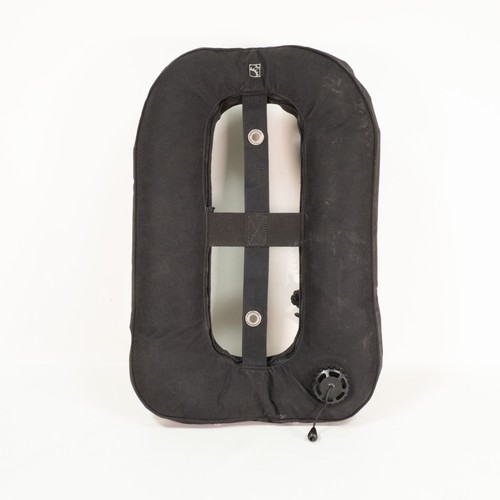 BCD (backplate + wing)
Better trim than jacket-style. Air behind the body rather than around it. Hollis, Apeks, and Scubapro all make accessible options.
BCD (backplate + wing)
Better trim than jacket-style. Air behind the body rather than around it. Hollis, Apeks, and Scubapro all make accessible options.
 Scuba weight system
Integrated BCD weights at hip level vs trim weights at the tank band let you adjust placement for trim. Use small weight increments (1 lb) for fine weighting.
Scuba weight system
Integrated BCD weights at hip level vs trim weights at the tank band let you adjust placement for trim. Use small weight increments (1 lb) for fine weighting.
 Surface marker buoy (SMB)
Deploying an SMB from depth while hovering is a buoyancy practice exercise — it requires neutral buoyancy to deploy without sinking or surfacing.
Surface marker buoy (SMB)
Deploying an SMB from depth while hovering is a buoyancy practice exercise — it requires neutral buoyancy to deploy without sinking or surfacing.
 7mm wetsuit (full)
Thicker wetsuits need more lead and show compression effects more strongly at depth. Bare, Cressi, and Henderson have consistent sizing. Measure your wetsuit compression before diving.
7mm wetsuit (full)
Thicker wetsuits need more lead and show compression effects more strongly at depth. Bare, Cressi, and Henderson have consistent sizing. Measure your wetsuit compression before diving.