Guides
Practical spec breakdowns — core types, face materials, weight ranges, and what skill level actually demands from a paddle.
Why this page exists
Pickleball paddle marketing is relentlessly vague: "power and control," "premium carbon fiber," "tournament approved." Almost none of it tells you what a polymer core actually does differently than a nomex core, or why a 7.8 oz paddle might suit you better than a 8.4 oz one.
The specs are simple once explained. Core thickness controls the sweet spot size and feel. Face material governs spin and feedback. Weight determines arm fatigue at volume. Grip circumference is about wrist comfort and security. Those four variables plus your current skill level are the entire decision.
Pickleball gear worth searching on eBay
Paddles, balls, nets, and sets from current listings. We earn a small commission on qualifying sales; your price is unchanged. Full disclosure.
 Graphite pickleball paddle
Thin graphite face layer for a crisp, responsive feel. Popular in the intermediate-to-advanced range. Look for 16mm core thickness for the most forgiving sweet spot.
View on eBay →
Graphite pickleball paddle
Thin graphite face layer for a crisp, responsive feel. Popular in the intermediate-to-advanced range. Look for 16mm core thickness for the most forgiving sweet spot.
View on eBay →
 Pickleball paddle set (2-pack)
Two matching paddles, usually with balls included. Great for learning with a partner. Sets often use composite faces — a practical starting point before you know your preference.
View on eBay →
Pickleball paddle set (2-pack)
Two matching paddles, usually with balls included. Great for learning with a partner. Sets often use composite faces — a practical starting point before you know your preference.
View on eBay →
 Outdoor pickleball balls
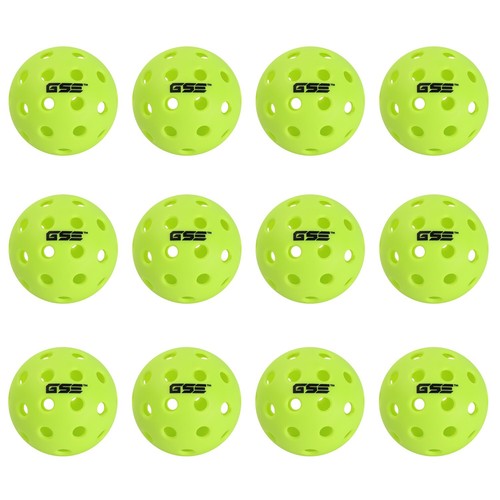
Outdoor balls have 40 smaller holes for wind resistance and a harder plastic shell. They fly faster than indoor balls. USAPA-approved balls are required for sanctioned play.
View on eBay →
Outdoor pickleball balls
Outdoor balls have 40 smaller holes for wind resistance and a harder plastic shell. They fly faster than indoor balls. USAPA-approved balls are required for sanctioned play.
View on eBay →
 Carbon fiber pickleball paddle
Raw carbon fiber (T700, T800 grades) offers exceptional spin texture and stiffness. Currently the face material of choice at the competitive level. Inspect for "raw" vs "coated" carbon.
View on eBay →
Carbon fiber pickleball paddle
Raw carbon fiber (T700, T800 grades) offers exceptional spin texture and stiffness. Currently the face material of choice at the competitive level. Inspect for "raw" vs "coated" carbon.
View on eBay →
 Portable pickleball net
Regulation height is 36" at the sidelines, 34" at center. A pop-up portable net sets up in under two minutes on any flat surface. Look for steel center strap for proper sag control.
View on eBay →
Portable pickleball net
Regulation height is 36" at the sidelines, 34" at center. A pop-up portable net sets up in under two minutes on any flat surface. Look for steel center strap for proper sag control.
View on eBay →