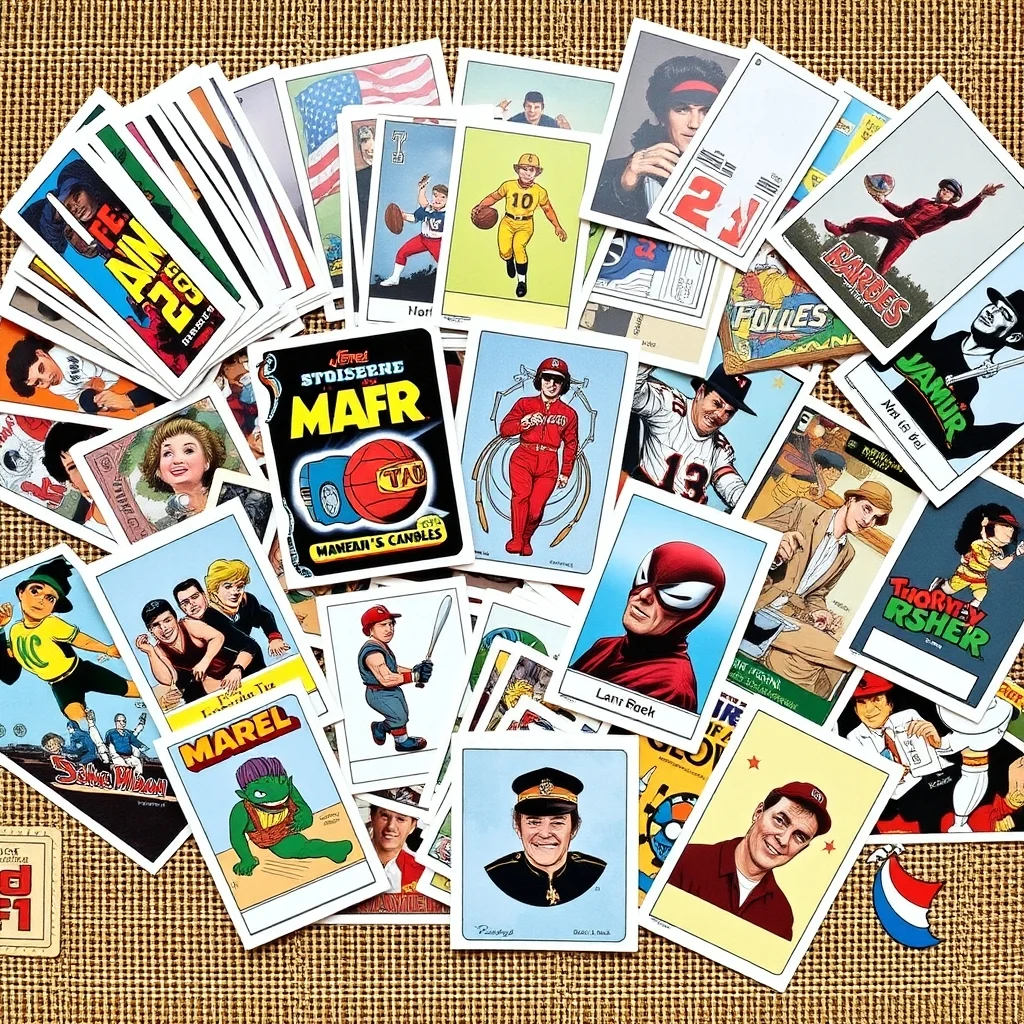
Garbage Pail Kids: Original Series structure and variations
Topps released Garbage Pail Kids in 15 Original Series sets (OS1–OS15) from 1985 to 1988. Each card features a character with two names — an "a" name and a "b" name — printed on cards with identical front art but different backs. Understanding this structure is fundamental: a "complete set" of OS1 typically means one of each number (1a or 1b, 2a or 2b, etc.), not one of every variation — though variation completionists pursue different goals.
OS1 printing variations
OS1 (the first series) has the most documented printing variations and the highest premiums. The most important distinction is the 1st printing versus subsequent printings. Key identifiers:
- 1st printing: No copyright text on the card front below the image. The backs use specific puzzle backing designs. Some OS1 1st print cards are significantly rarer than later prints of the same image.
- 2nd and later printings: Copyright text (© Topps Chewing Gum Inc. year) added to card front below the image area.
- Puzzle variation: OS1 backs feature puzzle pieces from different puzzle designs. The number of puzzle back designs changed across print runs.
For OS1 specifically, cards #1a/b through #8a/b were produced in the first and second series test markets before national distribution. These "test issue" cards are harder to find in high grades because fewer were preserved from limited regional distributions.
Series identification beyond OS1
| Series | Year | Card numbers | Notable |
|---|---|---|---|
| OS1 | 1985 | 1–82 (a/b) | Most printing variations; highest premiums |
| OS2 | 1985 | 83–164 (a/b) | Strong demand; first nationwide print run |
| OS3 | 1985–86 | 165–246 (a/b) | Transition from regional to national |
| OS4–OS8 | 1986 | 247–494 (a/b) | Standard print runs, lower premiums per card |
| OS9–OS15 | 1986–88 | 495–754 (a/b) | Declining distribution as fad peaked; some scarcer |
Wacky Packages: series, die-cuts, and what matters
Topps produced the original Wacky Packages run as sticker cards from 1967 to 1977 (with a brief 1980 revival and modern continuations). The most collected era is the 1973–1977 run, which produced 30 series of sticker sheets with spoof label art.
Die-cut vs non-die-cut
Early Wacky Packages series (Series 1–3, 1973) were produced in both die-cut versions (individual stickers cut to the shape of the label they parody) and non-die-cut versions (rectangular sticker). The die-cut versions are typically harder to find in unpeeled condition because the irregular shape made them more prone to edge damage. For set completionists, the question is whether you're collecting die-cut or non-die-cut variants — both versions exist for some series.
Wrappers and checklists
Original Wacky Packages series were sold in wax packs with printed wrappers. Wrapper variations (different color backgrounds, different series numbering) are collected separately from the sticker cards themselves. Series checklists appeared on card backs and themselves vary by printing. A "complete series" by strict definitions includes the checklist card, which is sometimes missing from lots because it wasn't a sticker image and was occasionally discarded.
Shopping for non-sport cards? Browse current eBay listings → (we earn a small commission; your price is unchanged).
Movie and TV card sets: what "complete" means
Non-sport movie and TV tie-in sets have been produced since at least the 1950s. Topps dominates this category with major film tie-in sets for Star Wars (1977), Raiders of the Lost Ark, Close Encounters of the Third Kind, Superman, and many others. The structure of these sets creates complications for completionists.
Base set, stickers, and inserts
A typical Topps movie set from the late 1970s to 1980s consists of: a base card set (the numbered card set, typically 66–132 cards for film sets), a sticker subset (typically numbered separately, often 11–22 stickers), and sometimes puzzle pieces or special inserts. "Complete set" can mean base cards only, base plus stickers, or base plus stickers plus all inserts — and sellers are inconsistent about which they mean.
For Star Wars (1977), the full set is Series 1–5 (blue, red, yellow, green, orange borders), each with 66 cards and 11 stickers, for 330 cards and 55 stickers total, plus a checklist. Many sellers list "Star Wars complete set" meaning Series 1 only, or all series base cards without stickers.
Key non-sport sets with strong collector markets
- Mars Attacks (Topps, 1962): 55 cards depicting alien invasion. One of the most valuable non-sport sets; high-grade individual cards command significant premiums. The final cards in the set (#54, #55) are meaningfully scarcer than early numbers.
- Outer Limits (Topps, 1964): 50 cards based on the TV series. Strong horror-science fiction collector demand.
- Civil War News (Topps, 1962): 88 cards. Historically strong demand from Civil War collectors and non-sport collectors both.
- Star Wars (Topps, 1977–80): Multiple series with wrapper variations (Series 1 exists with multiple wrapper colors across print runs).
- Alien (Topps, 1979): 84 cards plus stickers. More graphic than typical contemporary sets — some cards were allegedly pulled from production, creating minor variations in complete sets.
Grading non-sport cards: condition factors specific to this category
Non-sport cards from the 1950s–1980s face the same corner wear and centering issues as sports cards, plus category-specific factors:
Wax stains
Cards packed in wax packs occasionally develop wax transfer stains on the card backs. Minor wax residue is typically accepted by graders; significant staining that affects the card surface or image reduces grade. On cards with puzzle-back designs (GPK, some Topps sets), wax staining on the back is graded as surface damage.
Sticker cards: peeled vs intact
For any set that includes sticker cards (GPK, Wacky Packages, Star Wars sticker subsets), whether the sticker has been peeled is immediately evident and completely non-reversible. Graders will not assign standard grades to peeled stickers. Intact (unpeeled) sticker cards in high grades command meaningful premiums over equivalent graded base cards because fewer survived un-peeled.
Print quality variation
Non-sport cards from the 1960s–1970s often show significant print quality variation within the same series — misregistration, color bleed, and ink density variation are common. Graders account for era-appropriate print characteristics, but extreme examples reduce grade regardless of paper condition. Checking print quality on raw cards before purchase is worthwhile for high-value issues.
Practical checklist for buying non-sport cards
- For GPK: specify OS series number, a/b name, and ask whether the seller knows the print run if OS1.
- For Wacky Packages: confirm die-cut or non-die-cut, and whether checklists are included in claimed complete series.
- For movie/TV sets: request card count against a published checklist — "complete" is frequently miscounted, especially for sets with separate sticker subsets.
- For sticker cards in any set: confirm unpeeled status before paying graded-equivalent prices.
- For lots: ask for back photos of a sample — wax staining, print defects, and writing on backs don't appear in front-only photos.
Search eBay for non-sport cards
 Garbage Pail Kids vintage
Specify OS1 or OS2 and whether you want a-name, b-name, or both in your search.
Garbage Pail Kids vintage
Specify OS1 or OS2 and whether you want a-name, b-name, or both in your search.
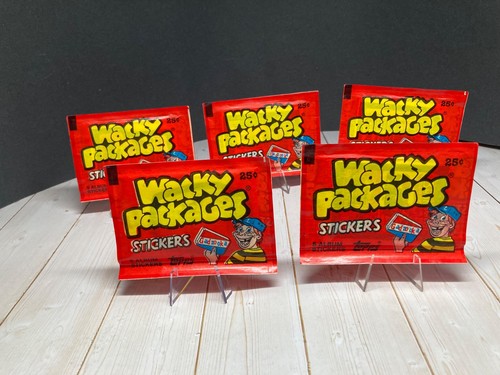 Wacky Packages vintage
1973–1977 original run. Confirm die-cut status before paying full-set prices.
Wacky Packages vintage
1973–1977 original run. Confirm die-cut status before paying full-set prices.
 Movie trading cards vintage
Verify base + sticker count against set checklist — "complete" is often wrong.
Movie trading cards vintage
Verify base + sticker count against set checklist — "complete" is often wrong.