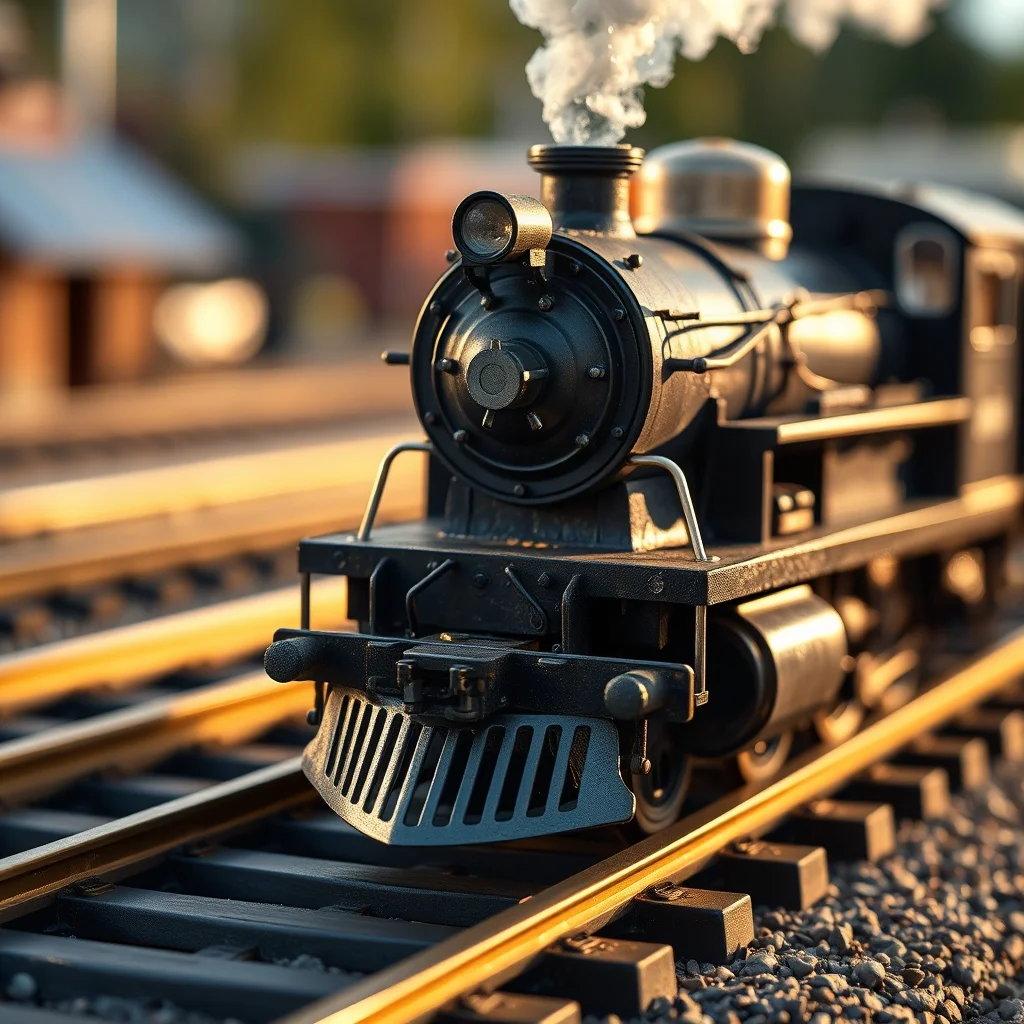
HO scale basics: what 1:87 means in practice
HO scale models are built at 1:87 ratio — one inch on the model represents 87 inches (roughly 7.25 feet) of prototype. Track gauge is 16.5 mm between rails, representing the standard 4 ft 8.5 in gauge used on most North American and European railroads. The gauge has been standardized since the NMRA (National Model Railroad Association) codified it in the 1930s, which is why a 1950s Athearn boxcar and a 2024 Walthers freight car will both fit on the same track.
HO is the dominant scale in North America and Europe for adult hobbyists. N scale (1:160) has a dedicated following for large layouts in small spaces. O scale (1:48, Lionel's traditional home) is larger and more expensive. For most buyers choosing a scale for the first time, HO offers the widest selection of locomotives, rolling stock, structures, and scenic materials at the most competitive prices.
The three major domestic manufacturers: real differences
Athearn
Athearn has produced HO equipment since 1947 and is arguably the most recognized name in American HO. Their product line divides into distinct quality tiers that are worth understanding before buying used equipment:
- Blue Box (1947–present, budget tier): The "shake the box" Athearn kits and ready-to-run (RTR) releases. Simple mechanism, can-motor or open-frame motor depending on era, flat-bottom fuel tanks, basic detail. Extremely robust and easy to repair. Decoder sockets on Blue Box locomotives vary — earlier releases often have no socket; later releases may have an NMRA 8-pin socket.
- Roundhouse (acquired 1979): Somewhat more detailed than Blue Box, covering specific prototype subjects. Mechanism quality similar to Blue Box era. Now absorbed into standard Athearn line.
- Genesis (1993–present, premium tier): Athearn's collector grade. Typically includes factory-installed or DCC-ready decoder socket (usually 21-pin or Next18 on recent releases), five-pole or coreless motors, all-wheel drive, and production-run road numbers verified against prototype rosters. Genesis diesels are among the most widely run locomotives on club layouts.
Athearn was acquired by Horizon Hobby in 2004. Current Genesis releases are produced overseas (typically China) but maintain specification control. The Heritage series (introduced around 2010) bridges Genesis and Blue Box in price.
Bachmann
Bachmann has been a mass-market HO supplier since the 1960s and has evolved significantly. Their current line tiers:
- HO Train Sets / Bachmann Plus: Entry-level, good for beginners, plastic trucks with limited wheel detail. Older train set locomotives often have simple DC only motors with no decoder socket.
- Spectrum: Bachmann's collector grade, comparable to Athearn Genesis. Spectrum releases typically include five-pole motors, metal wheel sets, and DCC-ready (usually 8-pin) sockets. Spectrum steam locomotives have been particularly well-regarded for prototype accuracy on specific subjects (K4 Pacific, 2-8-0 Consolidation).
- Bachmann Trains with E-Z App / Sound Value: Recent mid-tier releases with factory-installed sound decoders at lower price points than Genesis or Spectrum.
Walthers
Walthers occupies a different position — they are primarily a distributor and catalog house that also produces their own equipment under several house labels. Their production lines:
- Proto 2000 / Proto HO (now Walthers Proto): The highest-quality Walthers house production. Proto 2000 releases from the late 1990s through the 2000s are sought on the secondary market for their all-wheel drive, flywheel-equipped motors, and prototype fidelity on subjects like the EMD GP15-1, GP20, and various steam classes.
- Mainline: Mid-tier Walthers house brand. Good detail for the price; standard NMRA decoder socket.
- Trainline: Budget tier, comparable to Bachmann entry-level. Simple mechanism.
| Brand / Tier | Motor type (typical) | DCC socket | Secondary market |
|---|---|---|---|
| Athearn Blue Box | Open-frame or can | None / 8-pin (varies by year) | Very deep; parts available |
| Athearn Genesis | 5-pole or coreless | 21-pin or Next18 | Deep; strong resale |
| Bachmann Spectrum | 5-pole | 8-pin NMRA | Moderate; subject-specific |
| Walthers Proto 2000 | 5-pole with flywheel | 8-pin NMRA | Moderate; some subjects scarce |
| Bachmann/Walthers budget | Simple 3-pole | None or 8-pin | Low resale; parts difficult |
DCC vs DC: what the abbreviations mean and why it matters for buying used
DC (Direct Current) is the older standard. A DC layout sends variable voltage to the entire track; speed is controlled by voltage level. All locomotives on a DC loop run at the same voltage simultaneously — you cannot independently control two trains on the same electrical block without additional cab control wiring.
DCC (Digital Command Control) is the current standard for serious layouts. A DCC command station sends a constant voltage (typically 12–18V depending on scale) with a digital signal encoded on it. Each locomotive has a small decoder board that reads the signal and responds to its assigned address. You can run ten locomotives on the same track, controlling them completely independently, with individual throttle, direction, lighting, and sound functions.
DCC decoder sockets: what to look for
If you're buying used HO equipment intending to run DCC, the presence of a decoder socket matters:
- No socket (DC only): Common on pre-1990s equipment and budget recent production. Can be DCC-hardwired with a "drop-in" decoder if the mechanism has space, but requires soldering. Some mechanisms simply don't have room for any decoder board.
- 8-pin NMRA plug (NEM 652): The standard socket for most late 1990s through 2010s equipment. An 8-pin decoder plugs directly in. A "DCC-ready" locomotive ships with an 8-pin DC plug (a jumper that bypasses the socket) — remove the jumper and install a decoder.
- 21-pin (NEM 660): Common on European-specification and premium domestic equipment since roughly 2005. Larger connector allows more functions. Incompatible with 8-pin decoders without an adapter board.
- Next18 (NEM 662): Smaller modern connector used in tight-fitting locomotives. Increasingly common on recent Genesis and Kato releases.
- PluX connectors: Less common in North American equipment; more typical on Roco and Fleischmann imports.
Vintage HO: Tyco, Marx, and Lionel HO era identification
The 1960s through 1980s produced a wave of budget HO equipment that is worth understanding separately from current production:
Tyco
Tyco (originally Mantua, acquired by Tyco in 1970, later by Mattel, then by Spectrum/Bachmann in 1993) produced budget HO gear throughout this period. The Tyco "pancake motor" is the most identifiable feature of their locomotive production — a flat, horizontally-mounted motor with a large flywheel on a horizontal shaft. This motor is unmistakable once you've seen it and is mechanically distinct from the vertical-shaft can motors used in better-quality equipment. Tyco locomotives run adequately on DC but cannot practically accept decoders due to motor design and space constraints. Tyco rolling stock (boxcars, hoppers, flat cars) is more useful on a modern layout than their locomotives; the trucks use NMRA-standard horn-hook couplers and roll adequately.
Marx HO
Marx produced HO in the 1960s and early 1970s. Marx HO is rarer and less commonly collected than their O-gauge line. Quality was entry-level; Marx HO locomotives typically used friction-drive or very basic motor mechanisms. The plastic molding quality is cruder than contemporary Athearn or Tyco. Marx HO is primarily of curiosity interest rather than operational value.
Lionel HO (1957–1966)
Lionel's HO production was a business diversification during a period when O-gauge sales were declining. Lionel HO is entirely different from their classic O-gauge line in mechanism, scale, and operation. Lionel HO locomotives used a horizontal motor with a worm gear drive similar to Athearn Blue Box, which was actually a competitive mechanism for the era. The running quality of Lionel HO steam in particular has been noted by collectors as better than contemporary Tyco. Identifying Lionel HO: look for the Lionel logo cast or printed on the chassis, and a road name drawn from late 1950s rosters (New York Central, Pennsylvania Railroad, Santa Fe). Post-1966 Lionel HO does not exist — Lionel exited the HO market entirely.
Track gauge identification and compatibility
All standard HO equipment runs on 16.5 mm gauge track. Identify HO track by measuring between the inside edges of the two rails with calipers. Common HO track systems:
- Atlas Snap-Track / True Track: Sectional track with molded plastic roadbed (True Track) or plain rail (Snap-Track). Very common, widely available.
- Bachmann E-Z Track: Similar to Atlas True Track; snap-together roadbed track popular in starter sets.
- Kato Unitrack: Higher quality sectional track with pre-ballasted roadbed; cleaner rail-to-rail electrical contact. Common on club and permanent layouts.
- Code 100 vs Code 83 vs Code 55: Rail height in thousandths of an inch. Code 100 (0.100") is the older, taller standard — all HO equipment runs on it. Code 83 (0.083") is closer to prototype scale; most modern equipment runs on it. Code 55 (0.055") requires very fine wheel flanges and is used primarily for maximum realism N-scale-style layouts; not all HO equipment is compatible.
If you're buying used track, confirm the code. Code 100 and Code 83 cannot be mixed on the same run without a transition rail joiner. Equipment with deep flanges (common on older Tyco and Marx rolling stock) may pick the spike heads on Code 55 track and derail.
What to check when buying used HO locomotives
Used HO equipment on eBay and at train shows ranges from nearly new to completely non-running. The items to assess:
- Motor brush condition: Open-frame motors (common on older Athearn Blue Box, Tyco, Lionel) have carbon brushes that wear. If a locomotive runs erratically at low speed or only in one direction, worn brushes are the likely cause. Replacement brushes are available for most Athearn motors; specify motor date code when ordering.
- Worm gear and drive shaft: Hairline cracks in plastic worm gears are a common failure mode on Athearn Blue Box. Run the locomotive on clean track — a clicking or grinding sound at constant speed typically indicates a cracked or worn worm. Athearn sells replacement gears and complete mechanism kits.
- Wheel pickup cleanliness: Dirty or oxidized wheel treads cause intermittent running. This is usually remedied with a quick clean using isopropyl alcohol on a track-cleaning car or cotton pad. Not a fault with the locomotive itself.
- Coupler style: Older equipment uses horn-hook couplers (the NMRA horn-hook standard from the 1940s). Current production uses Kadee-compatible knuckle couplers. The two types do not mate with each other. Converting horn-hook equipment to Kadee #5 or equivalent is straightforward on most rolling stock; locomotive coupler conversions vary by model.
The honest buying verdict
For a running HO layout, current Genesis or Walthers Proto equipment offers the best combination of reliability, detail, and decoder compatibility — but prices reflect that. For building a budget starter layout or running a mixed freight train without sound, Blue Box Athearn and Bachmann Spectrum offer excellent value used. Vintage Tyco and Marx are collectible curiosities rather than practical runners unless you're building a period-correct 1970s layout aesthetic. Lionel HO is a short-window collectible for Lionel brand enthusiasts specifically.
Whatever you buy used: confirm the mechanism runs before listing it as operational, check coupler type so you're not mixing systems, and verify decoder socket type if DCC operation is the goal. A locomotive with no socket and no room for one is a pure DC runner — fine on a simple oval, but a limitation on any modern layout.
Search eBay for HO scale equipment
 Athearn HO locomotive
Blue Box, Roundhouse, and Genesis. Filter by "DCC" in title to find decoder-equipped runs.
Athearn HO locomotive
Blue Box, Roundhouse, and Genesis. Filter by "DCC" in title to find decoder-equipped runs.
 Bachmann HO train set
Spectrum and Plus tiers. Starter sets include power pack, track, and 1–2 locomotives.
Bachmann HO train set
Spectrum and Plus tiers. Starter sets include power pack, track, and 1–2 locomotives.
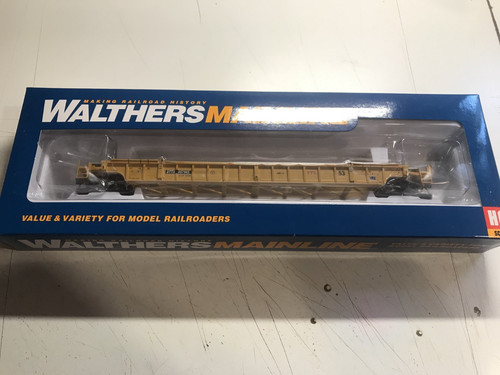 Walthers HO freight cars
Proto and Mainline rolling stock. Check knuckle vs horn-hook coupler type in listing photos.
Walthers HO freight cars
Proto and Mainline rolling stock. Check knuckle vs horn-hook coupler type in listing photos.
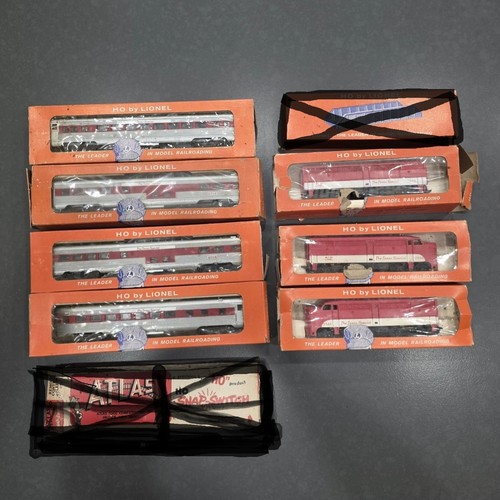 Vintage Lionel HO
1957–1966 production. Look for original box to confirm era; post-1966 Lionel HO doesn't exist.
Vintage Lionel HO
1957–1966 production. Look for original box to confirm era; post-1966 Lionel HO doesn't exist.
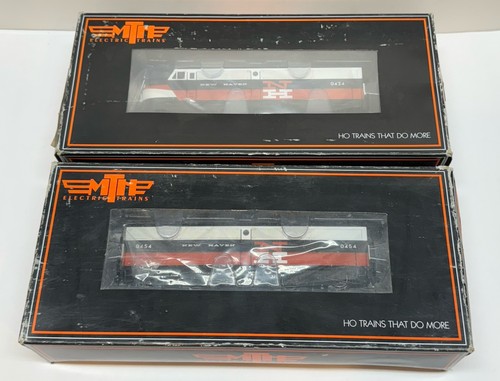 MTH HO scale
DCS-equipped sound locomotives. Secondary market deepened post-2022 MTH closure.
MTH HO scale
DCS-equipped sound locomotives. Secondary market deepened post-2022 MTH closure.