Why edition identification matters for value
The first three Magic: The Gathering print runs — Alpha, Beta, and Unlimited, all released in 1993 — contain the same card pool. A Black Lotus printed in Alpha has the same text as one printed in Unlimited. The difference in market value between them is not functional; it is historical, scarcity-driven, and condition-dependent. Understanding the physical markers that distinguish the editions is the prerequisite for buying or selling any early Magic card accurately.
The stakes are significant. An Alpha Black Lotus in Near Mint condition typically sells for many times the price of an Unlimited copy in equivalent condition. Misidentifying the edition — or buying from a seller who has — is one of the most common expensive mistakes in the vintage Magic market.
Alpha, Beta, Unlimited: the three visual identification markers
Rounded corners vs square corners
The single most reliable identifier: Alpha cards have more heavily rounded corners than all subsequent Magic prints. The corner radius on Alpha is noticeably larger — sometimes described as "tombstone" corners. Beta and Unlimited cards have corners that are still rounded, but closer to the corner radius used on standard playing cards. If you pick up a card and the corners look aggressively round compared to any other Magic card you own, you are likely looking at Alpha.
This is a factory difference, not a wear or damage indicator. Some Alpha collectors and graders do allow for the possibility that condition-related corner wear can blur this, but pristine examples make the difference obvious.
Black border (Alpha and Beta) vs white border (Unlimited)
Alpha and Beta cards both have black card borders. Unlimited prints the same card pool with white borders. This is the fastest filter: if the card has a white border, it is not Alpha or Beta — it is Unlimited or a later white-bordered reprint set (Revised, Fourth Edition, etc.).
Later black-bordered sets exist (Antiquities, Arabian Nights, The Dark, and all expansions through approximately Mirage; foreign-language reprints of base sets also used black borders). So black border alone does not prove Alpha or Beta. The corner radius plus black border together narrow it down considerably.
Print quality and rosette dot pattern
Under magnification, Alpha cards show a slightly different printing characteristic from Beta. The color dots in the CMYK halftone pattern on Alpha cards are typically described as having a slightly larger, less dense rosette pattern — visible under a loupe or jeweler's magnifier at 10×. This marker is used by experienced graders and authenticators and is less accessible to casual buyers, but it is the marker most resistant to forgery.
Additionally, some specific Alpha cards have known printing quirks: the mana symbols and card text on certain Alpha rares have slight alignment differences from Beta printings of the same card. The Alpha Shivan Dragon, for example, has a specific text box positioning that collectors have catalogued.
| Feature | Alpha | Beta | Unlimited |
|---|---|---|---|
| Border color | Black | Black | White |
| Corner radius | Heavily rounded | Standard rounded | Standard rounded |
| Print run size | ~2.6 million cards (≈1,100 cases) | ~7.3 million cards (≈3,000 cases) | ~35 million cards |
| Missing cards | Volcanic Island, Circle of Protection: Black (omitted by error) | Complete base set | Complete base set |
| Card back | Identical to Beta/Unlimited (tournament-legal back) | Identical | Identical |
The Reserved List: what it actually says
The Reserved List is a formal commitment made by Wizards of the Coast (now owned by Hasbro) stating that certain cards will never be reprinted in a functionally identical form in a standard Magic: The Gathering product. The list was originally published in 1996 following community backlash over the Chronicles set, which reprinted cards from Arabian Nights, Antiquities, Legends, and The Dark at reduced prices — collapsing the secondary market value of those originals.
The key phrase is "functionally identical." The Reserved List explicitly permits reprints in formats that are not tournament-legal or that are visually distinct — which is why cards on the list have appeared in products like the From the Vault series (foil, different frame, not tournament-legal in some contexts) and the Collector's Edition (square corners, gold border, explicitly not tournament-legal). None of those constitute a breach of the Reserved List under its own terms.
The Power Nine (Black Lotus, Mox Emerald, Mox Jet, Mox Pearl, Mox Ruby, Mox Sapphire, Time Walk, Ancestral Recall, Timetwister) are all on the Reserved List. Dual lands from the Revised set (Underground Sea, Tundra, Tropical Island, etc.) are also on the Reserved List. These are the two categories that drive most of the vintage card market activity.
What the Reserved List does not guarantee
The Reserved List is a corporate policy, not a legal contract with individual card owners. Wizards of the Coast has the authority to change or rescind it at any time. The list has been modified before — in 2002, the "foil exception" was added; in 2010, the list was quietly trimmed to remove cards from certain sets. The community reaction to any actual reprinting of high-value Reserved List cards would be severe, and that market consequence is probably the strongest practical constraint — not the document itself.
This is not pessimism about the hobby; it is accurate framing for what you are buying when you acquire a Reserved List card. You are buying scarcity that is currently maintained by policy and market dynamics, not by physics or law.
The Power Nine: buying considerations
The Power Nine are the most format-warping cards in Magic history. They are legal only in the Vintage format, which has very low organized play participation. Most buyers of Power Nine cards today are collectors, not competitive players.
Condition and grading
For cards of this value, professional grading by PSA or Beckett is essentially standard practice for any copy above LP (Lightly Played) condition. A PSA 9 Black Lotus in Alpha commands dramatically more than a PSA 7 of the same card — the grade multiplier on high-value Magic cards is steep. Ungraded Power Nine are bought and sold regularly, but buyers apply meaningful condition discounts for uncertainty.
Magic card grading follows a similar scale to sports cards: Gem Mint (PSA 10), Mint (PSA 9), Near Mint-Mint (PSA 8), Near Mint (PSA 7), Excellent-Mint (PSA 6), Excellent (PSA 5), Very Good-Excellent (PSA 4), Very Good (PSA 3), Good (PSA 2), Poor (PSA 1). PSA 10 Alpha Power Nine examples are extraordinarily rare given the print quality of 1993 Magic cards.
Authenticity concerns
High-value vintage Magic cards attract sophisticated forgeries. Modern fakes are significantly better than the crude photocopied cards of the early internet era. The markers collectors use for authentication include:
- The rosette test: Authentic Magic cards use a specific CMYK halftone pattern that under magnification (10× loupe) shows a characteristic rosette dot arrangement. Modern printing can approximate but not perfectly replicate this without having the original printing plates and materials.
- The light test: Holding a card to strong backlight, the blue layer in the card stock should be visible. Authentic WOTC cards have a specific blue-core layer between the front and back faces that is difficult to replicate exactly.
- The bend test: A very slight bend test (used with caution) — authentic Magic cards have a specific stiffness and snap-back characteristic from the card stock. This is destructive to condition and should only be applied to lower-value cards for familiarization.
- Black light (UV) test: Under UV illumination, authentic early Magic cards show specific fluorescence patterns from the card stock and ink. Printed fakes on modern card stock typically show different UV response.
Professional grading companies use additional internal methods including materials testing and comparative database matching. For any Power Nine purchase above a few hundred dollars, grading is worth the cost.
Revised dual lands: the accessible vintage entry point
The ten dual lands from the Revised Edition set (1994) occupy a different position in the market from the Power Nine: they are expensive but not stratospheric, they are heavily played in Legacy and Vintage formats, and condition grading significantly affects their price. Because they are still used in competitive play (Legacy especially), they circulate more than Power Nine cards and are easier to find, authenticate, and sell.
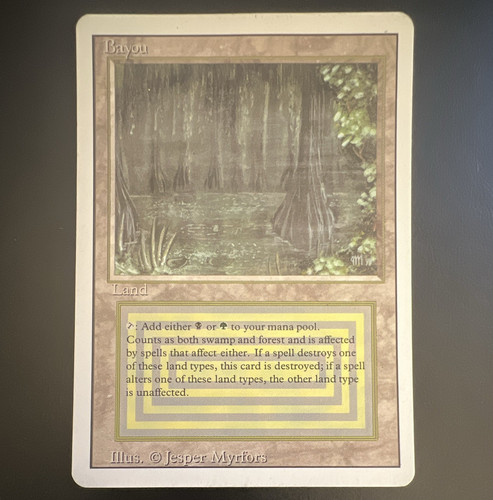
The ten Revised duals are: Tundra (White-Blue), Underground Sea (Blue-Black), Badlands (Black-Red), Taiga (Red-Green), Savannah (Green-White), Scrubland (White-Black), Volcanic Island (Blue-Red), Bayou (Green-Black), Plateau (White-Red), and Tropical Island (Green-Blue). Underground Sea, Volcanic Island, and Tundra typically command the highest prices due to demand from Blue-based Legacy control and combo decks.
Condition grading for duals
Because Revised duals were printed in large quantities and often played heavily in the 1990s, truly Near Mint Revised duals are proportionally rarer than the total print run suggests. The standard community grading scale for Magic cards:
- Near Mint (NM/M): No visible play wear; corners sharp under magnification; card back and face clean. Cards stored in sleeves from near-original purchase.
- Lightly Played (LP): Minor wear on edges or corners; slight scuffing possible; no creases. Most playable duals fall here.
- Moderately Played (MP): Visible wear on edges, corners, and possibly face; may have light creasing. Still tournament-legal in sleeve.
- Heavily Played (HP): Significant wear, creases, possible staining. May affect tournament legality at judge discretion if identifiable through opaque sleeve.
- Damaged (D): Severe wear, tears, or marks that may make the card identifiable; tournament-illegal without a proxy ruling.
Price differences between NM and MP Revised duals are typically 40–70% depending on the specific land and market conditions. Verify grading standards with the specific seller — community standards vary and "NM" from one seller may not match another's.
What drives vintage Magic prices: the honest picture
The vintage Magic market is driven by three overlapping factors: collector demand for historically significant cards, competitive play demand for Reserved List staples (primarily Legacy), and speculator activity. Of these, competitive play demand is the most stable — Legacy players genuinely need dual lands to build decks and will pay for them. Speculator activity creates volatility: cards spike when a new Legacy deck makes a tournament and collapse if the deck falls out of favor or a competing strategy emerges.
The Reserved List provides a supply floor — no new copies of these cards can enter the market from Wizards. But that does not mean prices can only go up. Demand can fall (fewer Legacy players, format bans, changing metagames), and existing copies already in circulation can reach saturation in the market. No investment in collectibles is guaranteed, and the vintage Magic market has seen significant corrections alongside its spectacular runs.
If you are buying vintage Magic cards as a collector who values the historical objects, the investment framing is secondary. If you are buying primarily for financial return, apply the same skepticism you would to any illiquid collectible: you are betting on cultural staying power, continued demand from a game that needs to keep attracting new players, and the sustained willingness of a corporation to maintain the policies that underpin scarcity.
Search eBay for vintage Magic cards
 MTG Alpha Beta Unlimited
Filter by "Coins & Paper Money → Collectible Card Games" for best results. Check seller feedback carefully.
MTG Alpha Beta Unlimited
Filter by "Coins & Paper Money → Collectible Card Games" for best results. Check seller feedback carefully.
 Revised dual lands
High volume; sort by condition. Look for photo of actual card, not stock image.
Revised dual lands
High volume; sort by condition. Look for photo of actual card, not stock image.
 Power Nine
For purchases at this price point, prioritize PSA-graded copies from high-feedback sellers.
Power Nine
For purchases at this price point, prioritize PSA-graded copies from high-feedback sellers.
 Vintage Magic cards
Broad search for pre-1997 cards. Use set filter to narrow: Arabian Nights, Antiquities, Legends.
Vintage Magic cards
Broad search for pre-1997 cards. Use set filter to narrow: Arabian Nights, Antiquities, Legends.
 MTG Foil Mythic Rare
Modern foil Mythics for competitive play. First-print foils often hold premium over reprints.
MTG Foil Mythic Rare
Modern foil Mythics for competitive play. First-print foils often hold premium over reprints.