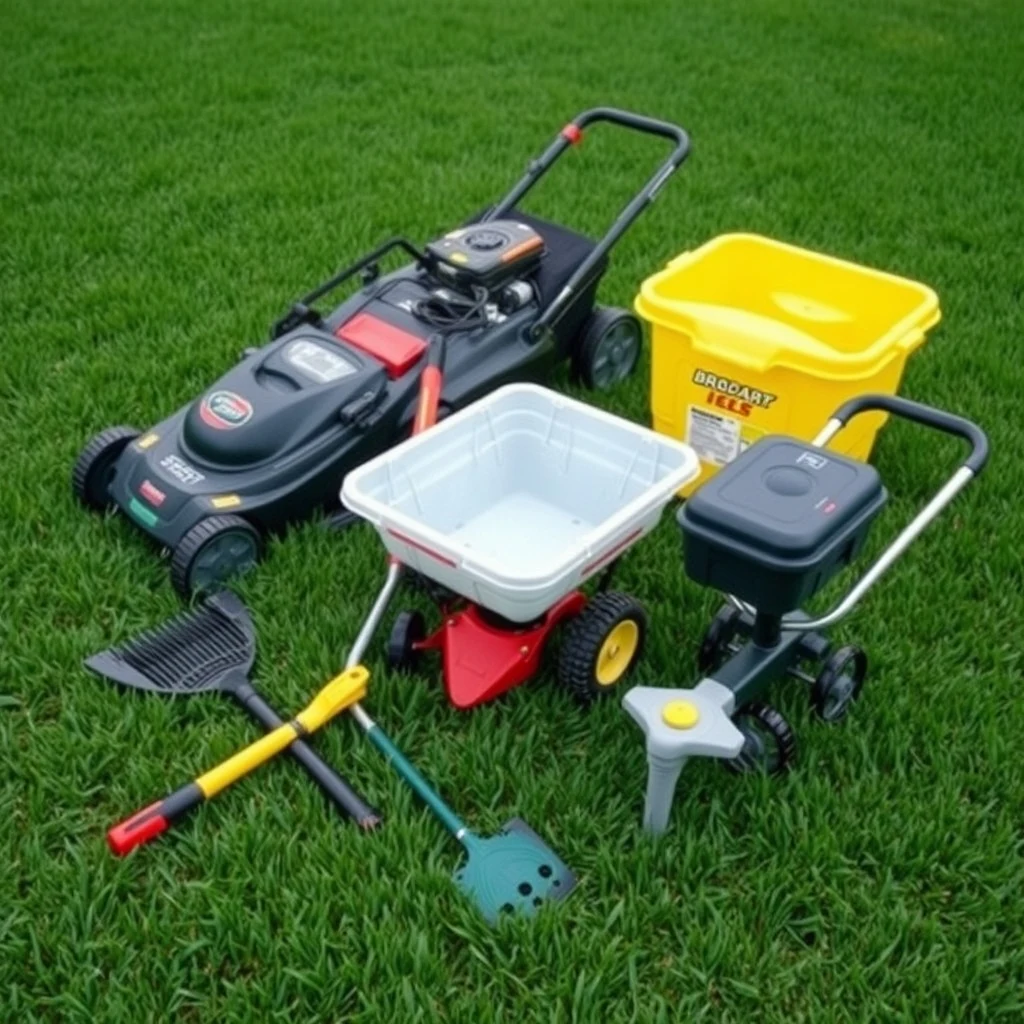
Choosing a mower: match type to yard, not to marketing
Mower type should be driven by yard area, terrain, and the amount of physical effort you want to put in. The four main categories for residential use are push reel mowers, walk-behind rotary mowers (corded, battery, or gas), self-propelled walk-behind mowers, and riding or zero-turn mowers.
Push reel mowers
A push reel mower cuts by a scissor action — the helical reel blade meets a fixed bed knife at the base. This produces a cleaner cut than an impact-based rotary, which is genuinely better for fine turf grasses like bent grass, zoysia, or fine fescue. Reel mowers are practical on flat lots under roughly 5,000 sq ft. If your yard has significant slope, thick grass, or debris, the reel will work against you. They require more frequent mowing because they don't handle tall or thick grass well, and they need periodic blade adjustment that rotary mowers don't require.
Walk-behind rotary mowers
Most residential mowing is done with walk-behind rotary mowers. The key specs are cutting width (typically 18–21 inches for non-self-propelled, 21–22 inches for self-propelled), engine displacement or battery voltage, and deck material. For lots between 5,000 and 15,000 sq ft, a 21-inch walk-behind is efficient. Battery-powered models (typically 40V–80V platforms) have improved substantially — a single charge on a high-capacity battery can handle up to about 1/3 acre on a flat lot, though this varies meaningfully by grass thickness and terrain.
| Mower Type | Best Yard Size | Key Trade-offs |
|---|---|---|
| Push reel | Under 5,000 sq ft, flat | Quiet, zero emissions; struggles with thick/tall grass |
| Battery walk-behind | 5,000–10,000 sq ft | Low noise, no fuel; battery charge limits long sessions |
| Gas walk-behind | 5,000–15,000 sq ft | Unlimited run time; maintenance, emissions, noise |
| Self-propelled | 10,000–20,000 sq ft | Reduces fatigue on slopes; heavier and pricier |
| Riding/zero-turn | Over 20,000 sq ft | Fast on large open lots; overkill for small yards |
Spreaders: broadcast vs drop
A spreader distributes granular material — seed, fertilizer, lime, or ice melt. The two types differ fundamentally in pattern accuracy and speed.
Broadcast (rotary) spreaders
A broadcast spreader throws granules in a wide arc using a spinning plate beneath the hopper. The spread width is typically 8–12 feet. This makes it faster for large areas, but the arc means granules land past the edges of beds, walkways, and driveways unless you're precise about where you walk. Most broadcast spreaders include a deflector shield to block spread on one side when you're working along edges.
Drop spreaders
A drop spreader releases material directly below the hopper in a band matching the hopper width (typically 18–24 inches). This gives precise, predictable placement — no scatter outside your path. The trade-off is that you need overlapping passes, the coverage pattern is narrow so it takes longer, and if your overlap isn't consistent you'll get visible striping in fertilizer application. Drop spreaders are the right choice for small lawns, near flower beds, or when applying weed-and-feed products that you don't want near non-target plants.
Spreader settings
Spreader settings vary by manufacturer and product — there is no universal calibration. Fertilizer bags and seed packages include model-specific settings for major spreader brands, but these are starting points, not guarantees. If you're applying to a new lawn or using a product for the first time, apply at a lower rate than recommended on a test strip and verify distribution before doing the full lawn.
Aerators: core vs spike, and timing
Lawn aeration relieves soil compaction, improves water and nutrient penetration, and reduces thatch. The two tool types address this differently.
Core (plug) aerators
Core aerators use hollow tines to pull plugs of soil out of the ground, leaving holes roughly 3/4 inch wide and 2–3 inches deep. The extracted plugs sit on the surface and break down within a few weeks. This is the more effective approach for compacted soils, particularly clay-heavy or heavily trafficked areas. For most residential lawns, core aeration once a year (or every other year for lightly trafficked lawns) is sufficient.
Spike aerators
Spike aerators push solid tines into the soil without removing material. They create holes but don't address the underlying compaction — in fact, on heavily compacted soil, spike aeration can increase compaction immediately around the tine holes. Spike aerators are better suited for lawns with mild compaction or as a maintenance tool between core aeration sessions.
Timing
For cool-season grasses (fescue, bluegrass, ryegrass), aerate in early fall — typically late August through October. The grass is growing actively, soil temperatures are still warm enough for root recovery, and fall seeding can immediately follow. For warm-season grasses (bermuda, zoysia, centipede), aerate in late spring through early summer when the grass is in active growth.
Shopping for lawn care tools? Browse current eBay listings → (we earn a small commission; your price is unchanged).
Dethatching: when the rake is enough
Thatch is the layer of dead grass stems, roots, and organic matter between the soil surface and the green grass blades. A thin thatch layer (under 1/2 inch) is beneficial — it insulates the soil and holds moisture. When it exceeds about 3/4 inch, it blocks water and nutrients, creates conditions for fungal disease, and harbors pests.
For a thatch layer under 3/4 inch, a manual dethatcher rake (a tined rake with curved tines) handles most residential lawns without the expense or effort of a power dethatcher. Rake vigorously in two directions (perpendicular passes) in early spring for cool-season grasses, or early summer for warm-season types. You'll pull out more material than you expect — this is normal.
If the thatch is deeper than 3/4 inch, a power dethatcher (also called a vertical mower or scarifier) is the faster tool. These are widely available to rent. Running a dethatcher followed by core aeration and overseeding in the same session is one of the most effective lawn renovation approaches.
Oscillating sprinklers: coverage pattern basics
An oscillating sprinkler sweeps a fan-shaped arc back and forth over a roughly rectangular coverage area. Most adjustable models let you set the arc width and oscillation range, which allows you to match the coverage zone to your lawn's shape and avoid watering sidewalks or beds.
The key specs are coverage area (typically stated in square feet, though real-world performance varies with water pressure) and adjustability. At standard household water pressure (roughly 40–60 PSI at the faucet), a mid-range oscillating sprinkler covers about 3,000–4,500 sq ft per position. Account for overlap between positions when calculating how many moves you need to cover your lawn.
One practical detail often overlooked: the arc pattern from an oscillating sprinkler isn't uniform. The ends of the sweep pattern receive slightly more water than the center due to the slower movement at the turn. If you're seeing dry strips, try shortening the arc width so those endpoints land inside your lawn rather than at the edges.
Common mistakes and how to avoid them
- Cutting too short: Most grass types should not be cut below 2.5–3 inches (some warm-season types lower). "Scalping" weakens root systems, increases weed pressure, and stresses the lawn in heat.
- Mowing wet grass: Wet grass clumps, clogs the mower deck, and produces uneven cuts. If you must mow slightly damp, raise the cutting height and mow at half speed.
- Over-spreading fertilizer: More is not better. Excess nitrogen causes rapid top growth at the expense of roots, and can cause fertilizer burn. Follow the application rate on the bag, calibrate your spreader, and split applications (two lighter passes in perpendicular directions) rather than one heavy pass.
- Aerating in drought: Aerate when soil has some moisture so the tines can penetrate effectively. Dry, hard soil limits core depth and makes the work significantly harder.
- Buying oversized equipment: A riding mower on a 5,000 sq ft lot takes more time to get out, clean, and put away than it saves mowing. Match equipment scale to actual yard size.
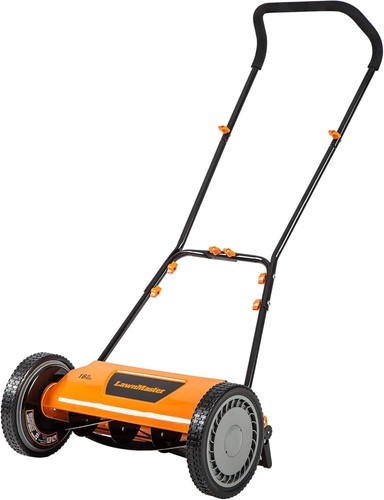 Push reel mower
 Broadcast spreader
 Lawn aerator