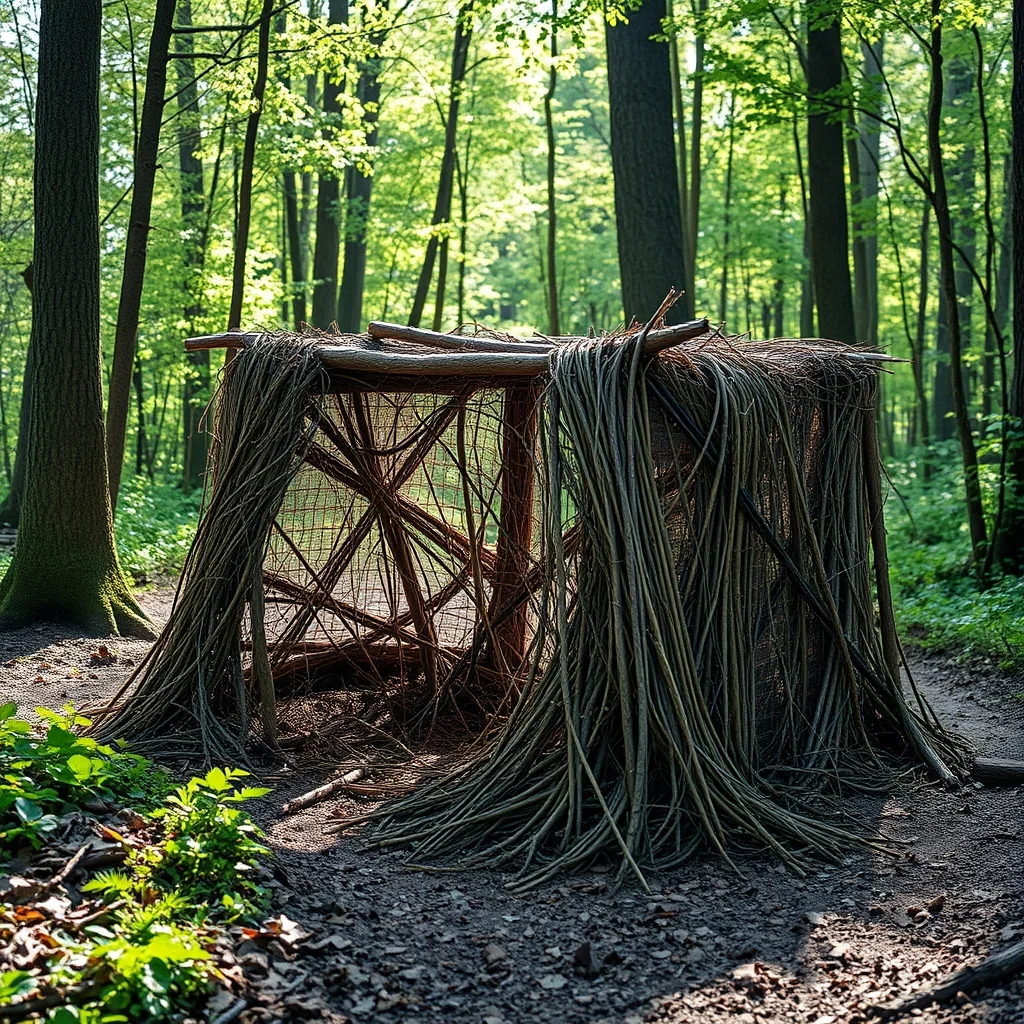
The three blind types and what each solves
Hunting blinds divide into three structural categories, and choosing between them is mostly a question of permanence, species, and terrain rather than price.
Pop-up hub blinds
Hub-frame pop-up blinds use a set of fiberglass or steel poles radiating from a central hub to support a fabric shell. They deploy in under a minute, pack into a bag roughly the size of a hockey bag, and weigh 15–25 lbs for most single-hunter models. Hub design varies: 5-hub and 6-hub frames are more rigid and hold their shape better in wind than 4-hub frames, which can deflect inward. The fabric shell on quality pop-ups is a 150D–600D polyester, with heavier denier indicating more durability and weather resistance.
Pop-ups are the right choice for hunters who scout new properties, hunt multiple locations in a season, or want to reposition based on deer movement. The trade-off is interior space (most one-person pop-ups are 57–66 inches tall when seated — adequate but not spacious) and acoustic noise, which we'll cover under concealment.
Elevated box blinds
Box blinds are rigid-wall structures — typically aluminum frame with fiberglass, plywood, or polypropylene panel walls — mounted on a tripod, post stand, or ladder stand 6–15 feet off the ground. They're the choice for permanent setups: food plots, feeders, and agricultural field edges where you plan to hunt the same location for years. They protect from rain, wind, and cold better than any fabric alternative, and can be heated with a small electric or propane heater.
Box blinds require a separate elevated stand and significant setup labor. Most are not rated for hunting without a proper stand base, and the stands themselves add substantial cost. Entry-level box blind + stand packages typically start around $300–400; better units with insulation and full-surround windows run $600–1,200+.
Elevated platform and ladder blinds
Ladder stand blinds attach a fabric or rigid enclosure to a conventional ladder stand, providing wind break and concealment while retaining the height advantage of a tree stand without requiring a tree. Platform blinds are similar but sit on a free-standing elevated deck. These hybrids offer more setup flexibility than pure box blinds while providing better concealment than open ladder stands.
Hub frame construction: what matters
For pop-up blinds, the hub system is the structural element most likely to fail over time. Look for:
- Hub material: Metal hubs (steel or aluminum) last longer than plastic hubs, which can crack in cold weather. Most mid-range and premium blinds use metal hubs.
- Pole count and diameter: More poles with larger diameter mean better wind resistance. 6-pole systems in 9mm–11mm fiberglass or steel resist lateral pressure much better than 4-pole systems.
- Stake loops and ground anchoring: Quality pop-ups have corner stake loops sewn into the base. In open terrain, anchoring to ground stakes prevents the blind from shifting or blowing over in wind — critical for bowhunting when you cannot move to reposition.
Window and shoot-through options
Window configuration determines shooting angles and is one of the most important practical specs that spec sheets understate. Key window considerations:
Window height from floor
Most pop-ups are designed to be hunted from a low chair or stool with a 12–16-inch seat height. Window sill height typically starts around 24–30 inches from the floor to allow seated shooting. If you plan to hunt from a taller camp chair (seat height 18–22 inches), verify that the window height accommodates your seated eye position — many hunters end up craning over a too-low window sill, which causes noise and movement.
Side windows and rear window
360-degree coverage requires multiple windows. Blinds with a rear window or back panel that opens allow you to shoot in any direction. For rifle hunters, this rarely matters — but for bowhunters, being able to rotate to a deer that circles behind the blind without opening a new window is significant.
Shoot-through mesh
Most modern pop-ups have mesh panels in front of each window opening — fine black mesh that you can shoot a bow or rifle through without opening the window flap. This eliminates movement and sound when an animal approaches. The mesh works by leveraging the same principle as window screen: from the outside in bright light, a dark interior behind mesh is nearly invisible. From inside, the mesh is transparent enough to aim through.
Test the mesh on any blind you're considering by holding it up to light — very coarse mesh passes arrows cleanly but shows more silhouette; very fine mesh is more concealing but can interfere with broadhead flight at extreme angles. Most quality blinds use a 600–800 micron mesh appropriate for both firearms and archery.
How concealment actually works
The mechanism by which a hunting blind works is contrast elimination, not pattern matching. An animal sees the blind primarily as a silhouette — a dark rectangle in an otherwise textured environment. Reducing contrast between the blind and its surroundings is the goal, not perfectly matching the leaf pattern on the fabric to the specific leaves around your stand.
Shopping for hunting blinds? Browse current eBay listings → (we earn a small commission; your price is unchanged).
Interior darkness is the critical variable
A black or very dark interior is the single most important concealment factor for fabric pop-up blinds. When a bright exterior is paired with a dark interior, any gap — around window frames, at the base, between zipper panels — becomes a dark void. Animals don't recognize the dark void as a threat as easily as they recognize the silhouette of a hunter moving inside an illuminated blind. Premium blinds use a blackout interior lining; budget blinds with tan or green interiors sacrifice concealment significantly.
Setup time and brushing in
Deer and other game habituate to new objects in their territory over days to weeks. A new blind placed the morning of opening day near a highly pressured food source may spook deer that walk up to the same blind placed two weeks earlier. The common recommendation is to set ground blinds at least two weeks before hunting them for pressured properties.
Brushing in — weaving natural cut vegetation through the brush straps on the blind exterior — accelerates habituation by making the blind blend with the surrounding edge. Use vegetation that won't wilt and turn brown quickly. Green conifer branches hold color longer than deciduous leaves.
Noise management
Noise is the concealment failure mode that spec sheets don't address at all. Pop-up fabric blinds move against their poles and make brushing and popping sounds in wind. When a deer is 20 yards away and you shift to draw a bow, nylon-on-nylon sleeve sounds carry. Quality blinds use felt or fleece strips at pole contact points, silence the window zippers, and use brushed fabric rather than standard woven nylon for the exterior.
Before hunting a blind, test every zipper, window panel, and floor flap inside your house. Find the noise sources. Felt tape (available at hardware stores) applied to contact points can silence a noisy blind significantly.
Weight and pack size for mobile hunting
If you're hiking to your setup location, blind weight matters directly. Standard single-hunter pop-ups run 15–25 lbs. Ultralight designs using lighter fabric and fewer poles can come in under 12 lbs, but typically sacrifice durability and wind resistance. Two-person blinds run 20–35 lbs and are generally impractical for any significant carry distance.
Pack size matters for transport: most standard blinds pack to a cylinder roughly 12" × 56–60" long. Verify it fits in your truck bed or the space you have available — blinds stored on their sides in the back of a pickup bed during deer season often need to fit under a tonneau cover alongside other gear.
Sizing for weapon type: bowhunting vs firearm
Bowhunters in ground blinds face a constraint that rifle hunters don't: they need to draw and swing without hitting the blind walls or ceiling. Most single-person pop-ups are 57–66 inches tall — adequate for a seated shot straight ahead with a compound bow at moderate draw length, but difficult for longer draw-length archers or shots at steep angles. The common minimum recommendation for bowhunting is a blind with at least 60-inch interior height and full-open side windows.
Rifle and crossbow hunters have fewer constraints. Any blind that provides a clear shooting lane through a window or mesh panel is sufficient for firearm use. Crossbow shooters should verify that the stock length fits within the blind at full draw without the stock contacting the blind wall — a problem more common in smaller, budget blinds.
Hunting blinds worth looking at on eBay
We earn a small commission on qualifying sales; your price is unchanged. Full disclosure.
 Pop up hunting blindHub-frame, deploys in under 60 seconds. The mobile hunter's standard.View on eBay →
 Ground blind huntingGround-level concealment, no climbing required. Good for bowhunters.View on eBay →
 Box deer blindRigid-wall elevated box for permanent setups. Better weather protection.View on eBay →
2 person hunting blindExtra width for hunting with a youth hunter or partner.View on eBay →
Box deer blindRigid-wall elevated box for permanent setups. Better weather protection.View on eBay →
2 person hunting blindExtra width for hunting with a youth hunter or partner.View on eBay →