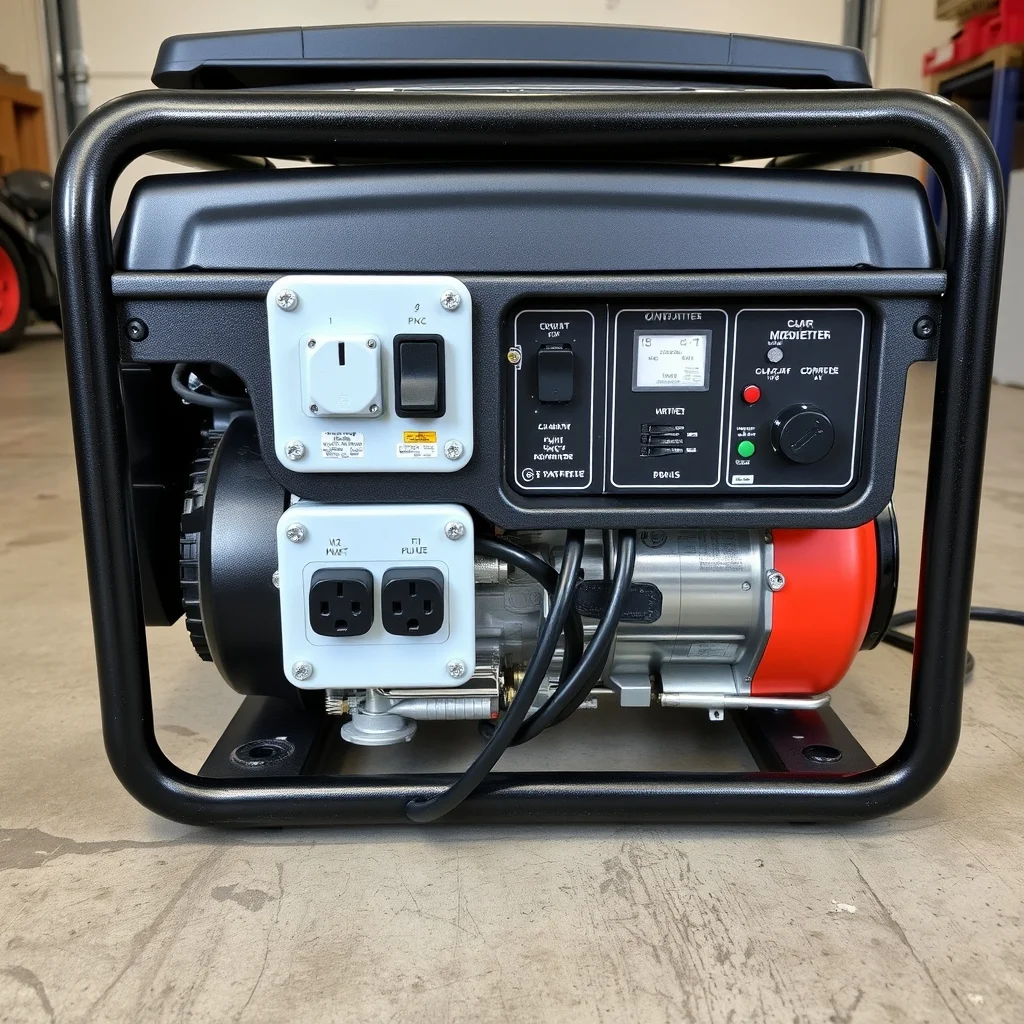
Running watts vs starting (peak) watts: the spec that catches buyers off guard
Every generator listing shows two watt figures: running watts (also called rated watts) and starting watts (also called peak or surge watts). Running watts is what the generator can sustain continuously. Starting watts is a brief surge — typically lasting less than one second — that the generator can produce to help motors overcome the high current draw at startup.
The critical mistake: sizing a generator based on running watts without accounting for the starting surge of your largest motor-driven appliance. A refrigerator that runs at 150W draws 4–6× that (600–900W) for a fraction of a second at compressor startup. A sump pump rated 1/2 HP running at 800W may surge to 1,600–2,000W at startup. A window AC unit rated 900W running may surge to 2,700W.
If your generator's starting watt capacity doesn't exceed the surge demand of your largest motor load, the generator will either stall or produce a voltage sag that trips its overload protection. You end up with a generator that refuses to start your refrigerator despite the refrigerator using only a fraction of the generator's rated running capacity.
| Appliance | Running watts | Starting watts (surge) |
|---|---|---|
| Refrigerator (full-size) | 100–200W | 700–1,200W |
| Sump pump (1/2 HP) | 800W | 1,300–2,000W |
| Window AC (8,000 BTU) | 900–1,200W | 2,500–3,000W |
| Well pump (1/2 HP) | 900W | 1,500–2,500W |
| Chest freezer | 100–200W | 500–800W |
| LED lighting (10 × 10W) | 100W | 100W (no surge) |
When calculating total load, add the running watts of all simultaneous loads, then add the starting watt surge of the single largest motor you'll start. The generator's starting watt rating must exceed this peak. The generator's running watt rating must exceed the sum of all sustained loads.
Inverter vs conventional generators: the power quality difference
Conventional (open-frame) generators run the engine at a fixed speed — typically 3,600 RPM for a 60 Hz output. At partial loads, they run at the same speed as at full load, consuming more fuel than necessary and producing more noise. The AC output is a reasonable sine wave approximation but with some harmonic distortion — tolerable for power tools and simple appliances, but potentially problematic for sensitive electronics.
Inverter generators use a different process: the engine produces raw AC, which is converted to DC, then electronically inverted back to a clean, stable AC sine wave. The engine speed varies with load — quieter and more fuel-efficient at partial loads. The output is "clean power" with very low total harmonic distortion (THD), typically under 3%, versus conventional generators that may run 5–25% THD depending on design.
For running power tools, a sump pump, and incandescent lights: conventional generators are fine and offer substantially more wattage per dollar. For running laptops, CPAP machines, televisions, variable-speed appliances, or any device with a microprocessor-controlled power supply: inverter power is meaningfully safer and more compatible. Higher THD can cause overheating, premature failure, or degraded performance in sensitive electronics.
Shopping for generators? Browse current eBay listings → (we earn a small commission; your price is unchanged).
Dual fuel: gasoline vs propane tradeoffs
Dual-fuel generators run on either gasoline or propane (LP) through a selector switch, with no hardware modification needed between fuels. The practical advantages of dual-fuel capability are significant for emergency preparedness.
Gasoline produces slightly more power than propane in most generators — typically 10–15% more wattage on gas than on propane at the same throttle setting. However, gasoline degrades over 30–60 days without ethanol-treated stabilizers, and even stabilized gas should be cycled every 12 months. For a generator stored for emergency use, gasoline in the tank is a maintenance liability.
Propane stores indefinitely in sealed tanks without degradation. A 20 lb propane tank (the standard BBQ grill size) holds roughly 4.7 gallons equivalent and can run a mid-sized dual-fuel generator for 3–8 hours depending on load. The tradeoff is that propane tanks may not be readily available during a widespread regional emergency when gas stations are also out, whereas gasoline can be siphoned from a vehicle in a true emergency.
Noise levels: what dBA numbers mean in practice
Generator noise is rated in decibels (dBA) measured at a specific distance, typically 7 meters (23 feet). The scale is logarithmic: 70 dBA is roughly twice as loud as 60 dBA, not 17% louder.
- 51–58 dBA: Quiet inverter generators at partial load. Comparable to a normal conversation at 3 feet. Workable for overnight operation in a suburban setting.
- 60–65 dBA: Mid-range inverter generators at full load, or quiet conventional generators. Comparable to an air conditioner or dishwasher at 10 feet.
- 70–78 dBA: Conventional open-frame generators. Comparable to a vacuum cleaner or busy restaurant. Difficult to have a conversation nearby.
Check local ordinances — many municipalities prohibit generator operation above certain noise levels during nighttime hours, typically 65–70 dBA measured at the property line.
Transfer switches: safely connecting a generator to your home
Running appliances directly off extension cords plugged into a generator is safe for temporary use. Connecting a generator to your home's electrical system to power fixed appliances (sump pump, furnace fan, built-in lighting) requires a transfer switch — and connecting without one is dangerous, potentially illegal, and can electrocute utility workers.
A manual transfer switch (MTS) connects between your main panel and selected circuits. When the power goes out, you manually switch those circuits from grid to generator. An automatic transfer switch (ATS) detects power loss and switches automatically, often within seconds. ATS units are more expensive and typically used with permanently installed standby generators.
Transfer switch installation must be performed by a licensed electrician in most jurisdictions. Budget $500–$1,500+ for a manual transfer switch installation including labor. The alternative for those not ready for a permanent installation is a generator interlock kit, which is a simpler mechanical device installed in your existing panel — cheaper but still requiring a licensed electrician in most areas.
CO safety: the non-negotiable
Portable generators produce carbon monoxide (CO) in exhaust. CO is colorless, odorless, and can incapacitate and kill faster than you can react. Every year people die from running generators in attached garages, basements, or near open windows. The safe distance is at least 20 feet from any opening (door, window, vent) and never indoors under any circumstances, including garages with doors open.
Install battery-operated or battery-backup CO detectors on every level of your home. Do not rely on smart/WiFi CO detectors that may not function during a power outage. CO detectors with a digital display that shows the CO level in ppm (not just an alarm threshold) give you more information during an event.
Search eBay for generators and accessories
 Inverter Generator
Clean power for sensitive electronics. Fuel-efficient at partial loads. Quieter than conventional.
Inverter Generator
Clean power for sensitive electronics. Fuel-efficient at partial loads. Quieter than conventional.
 Dual Fuel Generator
Gas or propane. Propane stores indefinitely — better for long-term emergency preparedness.
Dual Fuel Generator
Gas or propane. Propane stores indefinitely — better for long-term emergency preparedness.
 Portable Generator
Higher watts per dollar than inverter. Best for power tools and non-sensitive loads.
Portable Generator
Higher watts per dollar than inverter. Best for power tools and non-sensitive loads.
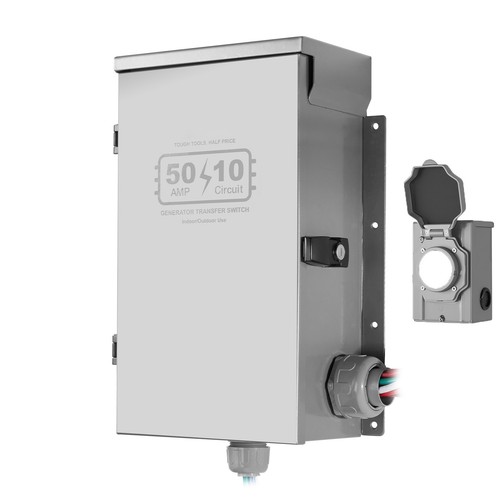 Transfer Switch
Required for safely powering home circuits. Professional installation required in most areas.
Transfer Switch
Required for safely powering home circuits. Professional installation required in most areas.
 Quiet Inverter Generator
Under 58 dBA at partial load. Best for overnight use and noise-sensitive neighborhoods.
Quiet Inverter Generator
Under 58 dBA at partial load. Best for overnight use and noise-sensitive neighborhoods.