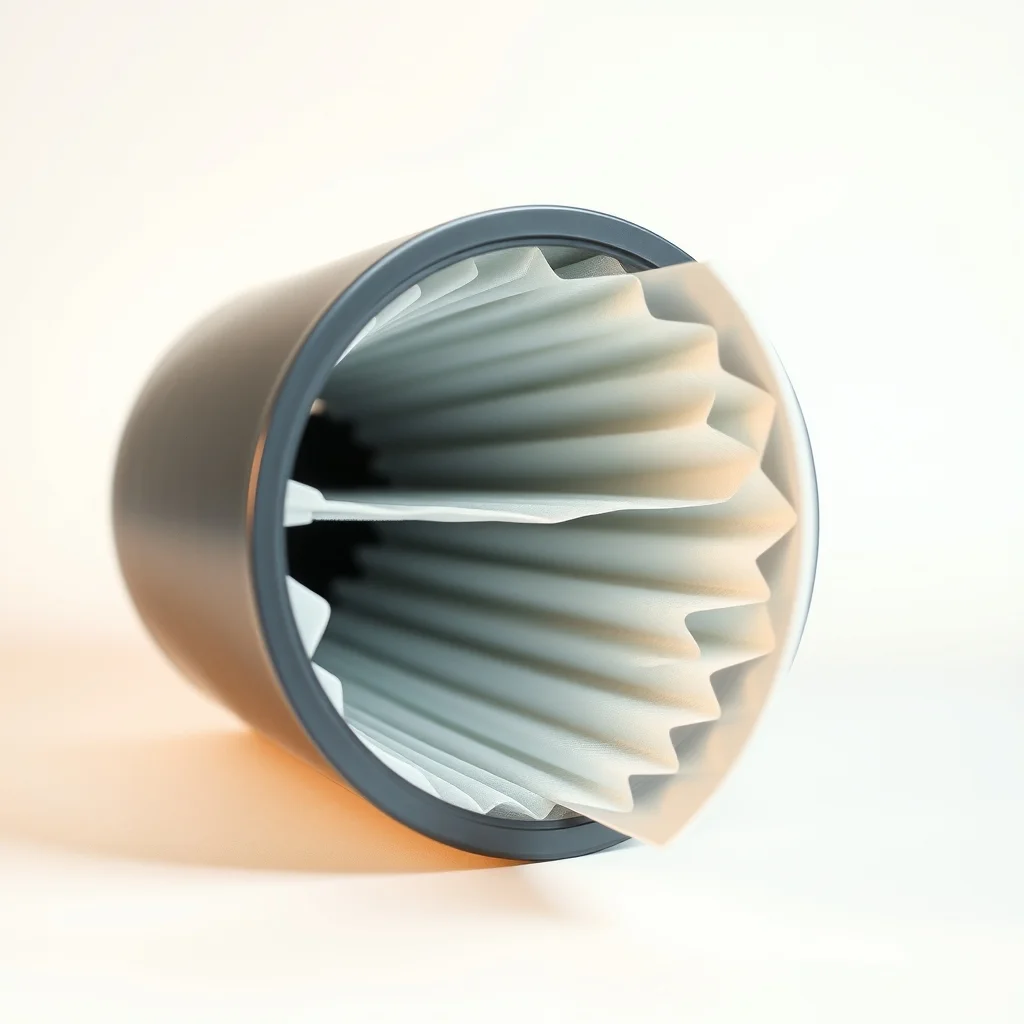
True HEPA vs HEPA-type: the most important distinction
HEPA stands for High Efficiency Particulate Air. A filter meeting the true HEPA standard — specifically H13 or H14 by European classification — captures at least 99.97% of airborne particles at 0.3 microns. That particle size is the most penetrating particle size (MPPS), meaning it is the hardest for filters to catch. At larger and smaller sizes, capture rates are actually higher.
The problem is that "HEPA-type," "HEPA-style," and "HEPA-like" are marketing terms with no regulatory standard attached. These filters typically capture 85–99% of particles, which sounds close but can miss a meaningful share of the allergens, PM2.5 particulates, and smoke particles you are trying to remove.
CADR: the number that actually sizes the unit to your room
Clean Air Delivery Rate (CADR) is the Association of Home Appliance Manufacturers (AHAM) voluntary rating that measures how much clean air a purifier delivers per minute, measured in cubic feet per minute (CFM). It is tested for three particle types: tobacco smoke, dust, and pollen. The smoke CADR is typically the lowest of the three and the most demanding — use it as your baseline.
The standard sizing formula is: divide your room's square footage by 1.5 to get the minimum CADR you need for approximately 4–5 air changes per hour (ACH) at an 8-foot ceiling. For a 300 sq ft bedroom, that is a CADR of roughly 200 CFM. For a 500 sq ft living room, aim for 330 CFM or above.
| Room Size (sq ft) | Min CADR (CFM) | Typical Use |
|---|---|---|
| 150–200 | 100–130 | Small bedroom, home office |
| 250–350 | 165–235 | Master bedroom, large office |
| 400–500 | 265–335 | Open-plan living room |
| 600–800 | 400–535 | Large open areas, basement |
One important caveat: CADR is measured at the highest fan speed. Running a unit on its quiet or sleep setting may cut effective CADR by 40–60%. If you plan to run it overnight on low, either buy a unit with a higher headline CADR or accept reduced effectiveness at night.
Filter cost over time: often the biggest expense
A $80 air purifier can easily cost $150–200 per year in replacement filters at OEM pricing, while a $250 unit with available aftermarket filters might run $40–60 per year. Before buying, search for replacement filter prices and availability for the specific model.
Most true HEPA filters last 6–12 months under normal use, though some manufacturers recommend 3-month replacements to drive repeat sales. The actual filter degradation depends on your air quality and how many hours per day the unit runs. A filter indicator light is useful but is usually time-based, not particle-load-based.
Shopping for air purifiers? Browse current eBay listings → (we earn a small commission; your price is unchanged).
Carbon filter considerations for odors and gases
True HEPA filters capture particles — they do nothing for gases, VOCs, or odors. For pet smells, cooking odors, or wildfire smoke gases, you need an activated carbon stage in addition to HEPA. The weight of the carbon matters more than the surface area claim: look for units with at least 1–2 lbs of activated carbon for meaningful gas-phase filtration. Thin carbon mats of a few ounces exhaust within weeks in high-odor environments.
Noise levels: the spec that matters for bedrooms
Air purifier noise is rated in decibels (dB). Context: 30 dB is similar to a quiet library, 40 dB is a quiet conversation, and 50 dB is a moderate office environment. For sleeping, most people find anything above 40 dB disruptive.
Manufacturers typically list noise at both minimum and maximum speeds. The minimum speed figure is what matters for overnight use. Units rated at 25–35 dB on low are genuinely quiet. Those rated 40 dB on low will be noticeable in a silent room at night.
Fan design also matters. Tower-style units with large, slow-moving fans tend to be quieter at equivalent CADR than compact units with smaller, faster fans — the aerodynamics scale favorably with fan diameter.
Features worth paying for — and ones that are not
Worth the premium
- Auto mode with PM2.5 sensor: A built-in particle sensor that ramps fan speed when air quality degrades is genuinely useful, particularly if you live somewhere with occasional wildfire smoke or high pollen.
- 360-degree inlet: Air drawn from all sides rather than the front only reaches the filter more efficiently, improving effective CADR relative to the rated maximum.
- Washable pre-filter: A pre-filter that captures larger particles (hair, dust, visible debris) extends the life of the expensive HEPA filter underneath it. Washable versions mean you are not buying pre-filters as consumables.
Rarely worth the premium
- UV-C lights: Marketed as killing bacteria and viruses, but the dwell time needed for meaningful UV inactivation (typically seconds of direct exposure) does not match the airflow rates in consumer units. The HEPA filter provides the actual particle capture.
- Ionizers and plasma generators: These produce ozone as a byproduct, which is a lung irritant. The California Air Resources Board (CARB) certifies air purifiers that meet ozone emission limits — it is worth checking for CARB certification if you are considering a unit with an ionization stage.
- Wi-Fi and app control: Convenient but usually adds cost without improving filtration. The physical controls and auto mode handle most use cases.
Common buying mistakes
The most frequent mistake is buying a unit sized for the stated "room size" on the box rather than calculating CADR for actual square footage. Manufacturers often inflate coverage claims. A unit "rated for 500 sq ft" may achieve that with only 2 ACH — half the recommended minimum for meaningful air cleaning. Calculate from CADR, not room size claims.
The second mistake is buying a unit without checking filter availability and pricing. Some brands use proprietary filter shapes that are expensive and only available from the manufacturer. Within 18 months, the cumulative filter cost can double the unit's purchase price.
Third: placing the unit in a corner or against a wall significantly reduces effective airflow. For best performance, position the purifier at least 18 inches from walls and furniture, preferably in the middle third of the room or near the primary pollution source.
Choosing for specific use cases
Allergies and asthma
Prioritize true HEPA with high CADR for the room, and run continuously rather than intermittently. The EPA recommends 4–5 ACH for allergy relief — calculate the CADR needed for your space and do not downsize. A unit that runs at medium speed is better than a barely adequate unit running at maximum.
Pet owners
Pet dander is typically 5–100 microns — well within HEPA capture range — but the ongoing load is high. More critical for most pet owners is odor control, which requires substantial activated carbon. Look for units that list carbon weight rather than just "activated carbon layer."
Wildfire smoke
During smoke events, you want maximum CADR running continuously. A DIY Corsi-Rosenthal box (a box fan with four standard MERV-13 furnace filters taped around it) can be assembled for roughly $50–80 and delivers substantial CADR. It is worth knowing this option exists if you are in a high-smoke-risk region and need capacity quickly.
Air purifiers on eBay
We earn a small commission on qualifying sales; your price is unchanged. Full disclosure.
 HEPA Air Purifier
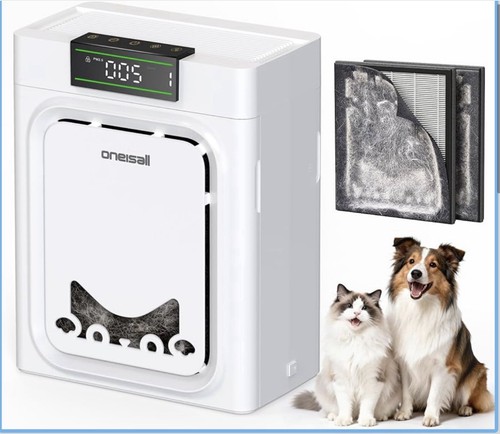 Pet Air Purifier