Size and frame
All figures are from the specification tables on the store's product pages, read 2026-11-01, as the maker states them.
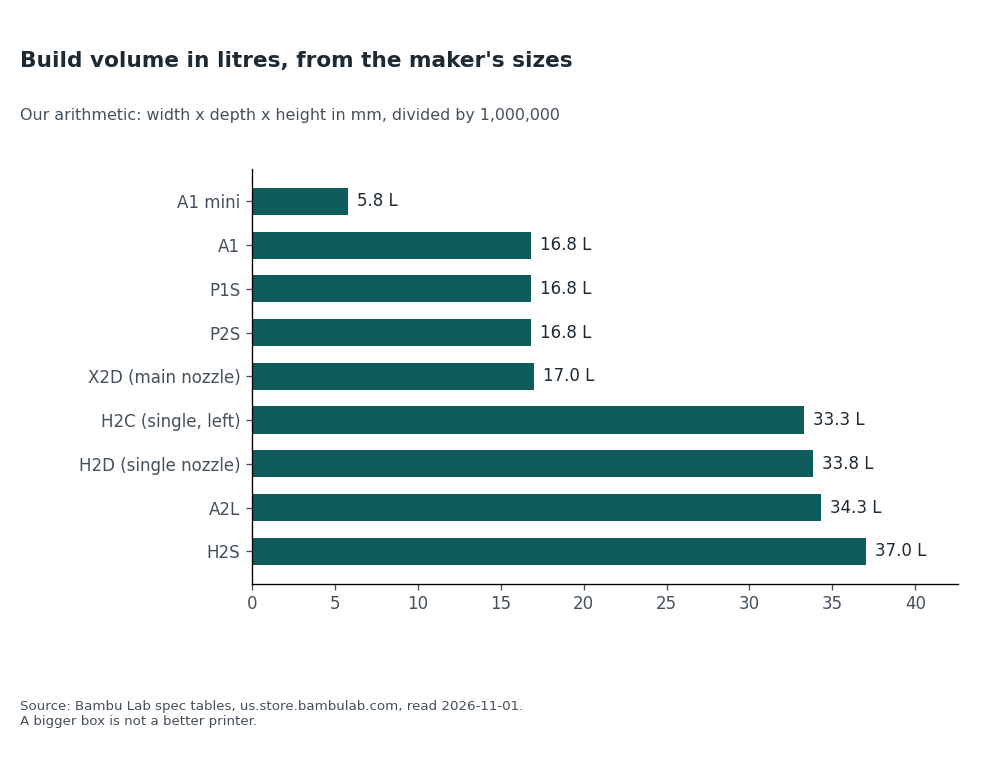
| Printer | Build volume (W × D × H, mm) | Frame and enclosure wording | Active chamber heating |
|---|---|---|---|
| A1 mini | 180 × 180 × 180 | Not stated on the page we read. FAQ: prints materials that "don't require an enclosure" | Not stated |
| A1 | 256 × 256 × 256 | FAQ calls it an "open-frame design" | Not stated |
| A2L | 330 × 320 × 325 | Chassis aluminum and steel, outer frame plastic. No enclosure wording on the page we read | Not stated |
| P1S | 256 × 256 × 256 | "Enclosed (Plastic & Glass)" | Not stated |
| P2S | 256 × 256 × 256 | "Fully Enclosed Chamber" | FAQ: "The P2S does not have an active chamber heating function" |
| X2D | Main nozzle 256 × 256 × 260. Auxiliary nozzle 235.5 × 256 × 256 | Outer frame plastic, glass and metal | Supported. Page text says 65 °C |
| H2S | 340 × 320 × 340 | Aluminum, steel, plastic and glass | Supported. Page text says 65 °C |
| H2D | Single nozzle 325 × 320 × 325. Dual nozzle 300 × 320 × 325 | Aluminum, steel, plastic and glass | Supported. Page text says 65 °C |
| H2C | Single nozzle left 325 × 320 × 320, right 305 × 320 × 325. Dual nozzle 300 × 320 × 325 | Aluminum, steel, plastic and glass. Store heading: enclosed | Supported. Page text says 65 °C |
Temperatures and listed materials
These are the maker's lists. We left out speed and acceleration. The maker says its figures come from its own testing (see our reading of the pages).
| Printer | Max nozzle / bed (°C) | Materials the maker lists |
|---|---|---|
| A1 mini | 300 / 80 | Ideal: PLA, PETG, TPU, PVA. Not recommended: ABS, ASA, PC, PA, PET, carbon and glass fibre reinforced |
| A1 | 300 / 100 | Same two groups as the A1 mini |
| A2L | 300 / 80 | PLA, PETG, TPU, PVA suitable. PLA-CF and PETG-CF suitable with a hardened steel nozzle |
| P1S | 300 / 100 | Ideal: PLA, PETG, TPU, PVA, PET, ABS, ASA. Capable: PA, PC |
| P2S | 300 / 110 | PLA, PETG, ABS, ASA, TPU, PVA, PET, PA, PC, support materials, and carbon or glass fibre grades such as PLA-CF, PA6-CF, PAHT-CF |
| X2D | 300 / 120 | Main hotend: PLA, PETG, ABS, ASA, TPU, PET, PA, PC, PVA, support materials, and reinforced grades |
| H2S, H2D, H2C | 350 / 120 | PLA, PETG, TPU, PVA, BVOH, ABS, ASA, PC, PA, PET, PPS and carbon or glass fibre reinforced grades |
The store lists 0.4 mm as the included nozzle on the A1 mini, A1, P1S, P2S, X2D, H2D and H2S. The A2L and H2C tables we read name no included diameter. The maker lists 0.2, 0.4, 0.6 and 0.8 mm as supported on the lines whose tables give a supported range.
How to use the table without a spec-sheet brain
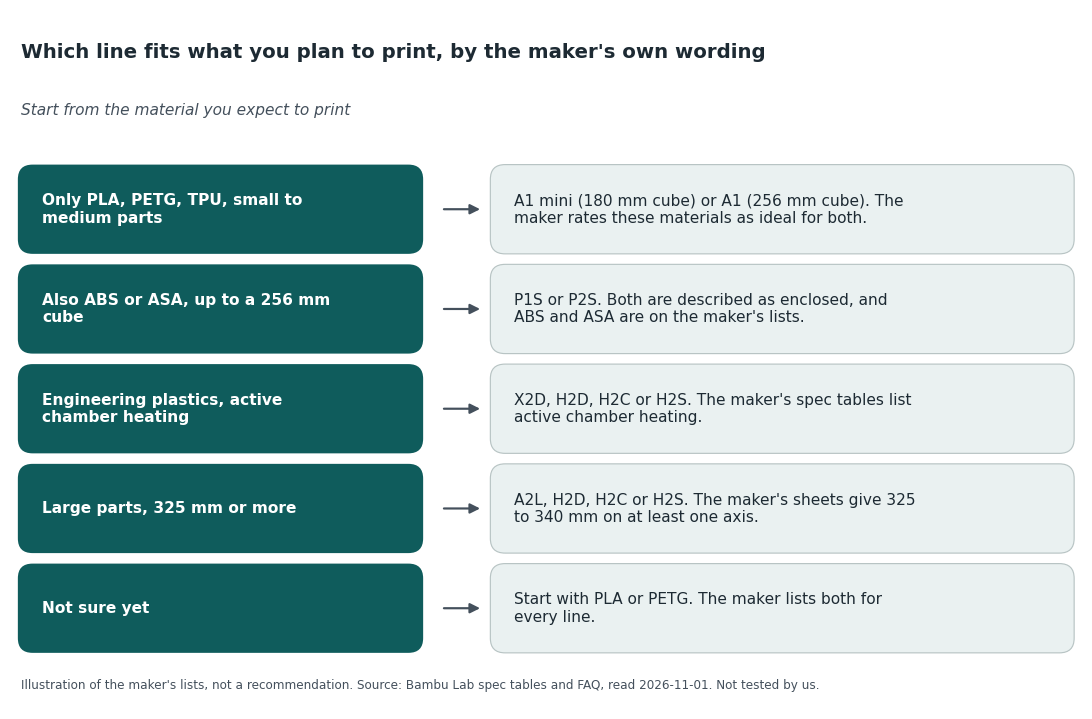
- Biggest part. Measure the largest thing you want to print. If it fits in a 180 mm cube, you do not need the size you are paying for in the bigger lines.
- Which plastic. PLA and PETG appear on every row. ABS and ASA appear as ideal or listed only on the enclosed lines and the X2D and H2 rows. Our filament types guide says when each one is worth it.
- Chamber heating. It matters for engineering plastics. If you do not know what you will print yet, you are not buying it for a reason.
- Multi-colour later. The A1 mini and A1 take the AMS lite. The P, X and H2 lines take the AMS 2 Pro or AMS HT. The A2L Combo ships with an AMS lite, and the wiki also lists the A2L with the AMS 2 Pro. See the filament guide.
What the sources do not say
- Whether any line is quiet enough for a bedroom, or how well it prints. We found no such figure we would repeat.
- Which line has fewer first-week problems. The maker publishes troubleshooting guides for each, not rates. See the first-week guide.
- How the lines compare to other makers. We did not read rival spec sheets for this page.
- Blank cells above mean the page we read did not state it, not that the printer lacks it.
The simpler option
If your largest part is under 180 mm and you only want PLA or PETG, the smaller A-series fits it, and the money saved can go to filament and a spare nozzle. If you are not sure you will keep printing, a used printer or a local print shop tests the interest first. Our first-printer guide has the wider comparison.
The maker's page for each model
Our reason to click: each card opens that model's own page, where the spec table, box list and FAQ quoted above sit together.
We earn a small commission on qualifying sales, and 90% of it goes to charity (you can pick which); your price is unchanged. Full disclosure.
Sources
- Bambu Lab US store product pages and specification tables for A1 mini, A1, A2L, P1S, P2S, X2D, H2S, H2D and H2C: us.store.bambulab.com/en/products/..., read 2026-11-01.
- P2S FAQ, A1 FAQ and A1 mini FAQ on the same pages, read 2026-11-01.