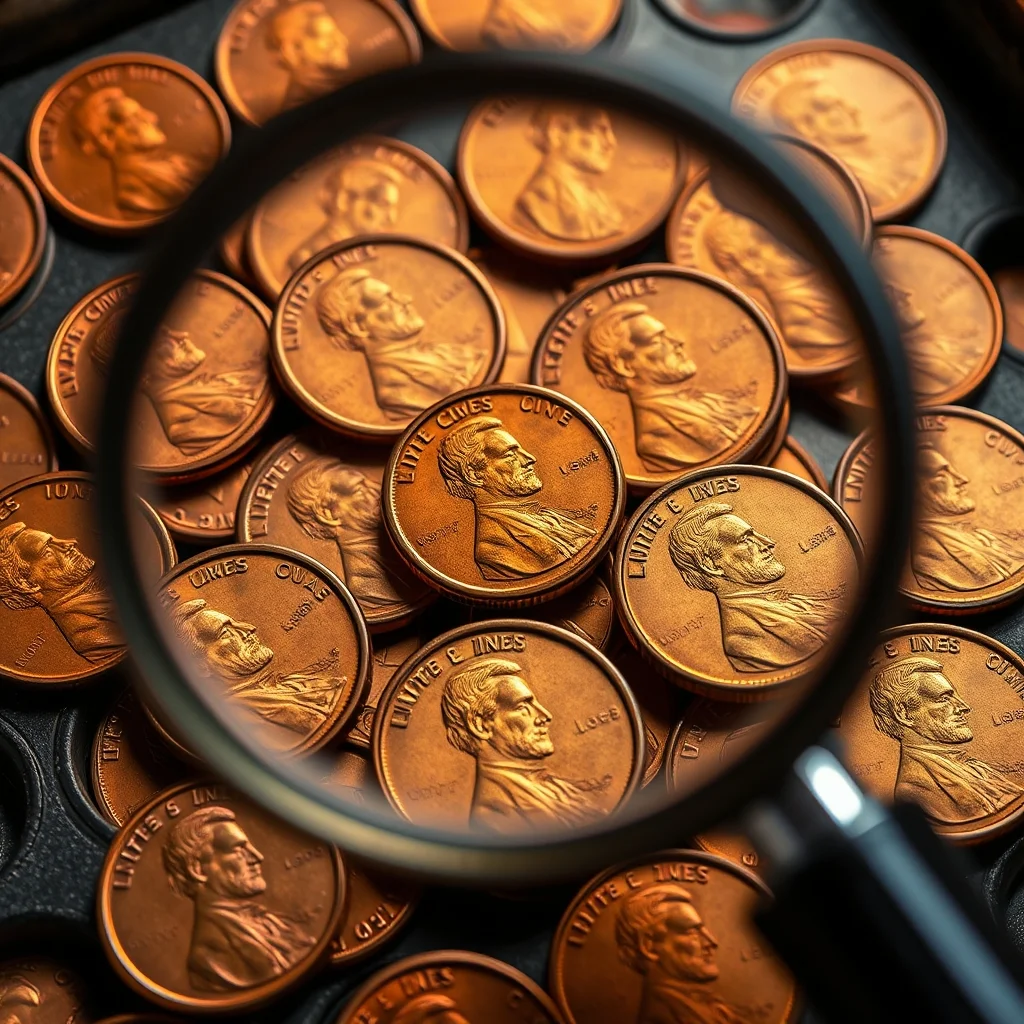
Background: the Lincoln wheat cent series
The Lincoln cent was introduced in 1909, replacing the Indian Head cent. Designed by Victor David Brenner, the obverse shows Lincoln's portrait and the reverse features two stalks of wheat flanking the inscriptions ONE CENT and UNITED STATES OF AMERICA — giving the coin its "wheat cent" nickname. The wheat reverse was replaced in 1959 by the Lincoln Memorial design.
Coins were produced at three facilities: Philadelphia (no mint mark), Denver (D mint mark, below the date), and San Francisco (S mint mark, below the date). San Francisco generally produced smaller mintages, which is why S-mint coins tend to be scarcer in high grade and sometimes in any grade.
For the full series from 1909 to 1958, most dates are common in circulated grades — worth a cent or a few cents plus a modest premium for nice examples. The key dates stand apart because of low original mintage, mid-run controversies, or dramatic manufacturing errors.
The five key dates
1909-S VDB
The most famous wheat cent. When the Lincoln cent launched in 1909, designer Victor David Brenner placed his initials "VDB" prominently at the bottom of the reverse, between the wheat stalks. Public criticism of the prominent placement led the Mint to remove the initials partway through the year's production. Philadelphia had already produced 27 million coins with "VDB" before the removal; San Francisco, with its smaller production run, produced only about 484,000 "VDB" coins before the change.
How to identify it: Look at the reverse bottom edge, between the wheat stalks and ONE CENT. "V.D.B." should appear as small raised letters. On the obverse, look below the date for a small "S" mint mark. Both must be present. A 1909-VDB coin without the "S" (from Philadelphia) is a much more common coin — still collectible, but worth far less.
Authentication: This is the most counterfeited date in the series. The most common fraud is removing the mint mark from a genuine 1909-S VDB to sell as the scarcer coin is unlikely to be encountered, but adding an "S" mint mark to a common 1909-P VDB is the fraud to watch for. Under magnification, a legitimate "S" mint mark has crisp, even edges consistent with how the die was cut. Added or altered mint marks often show uneven edges, tool marks, or slightly different metal color. For any significant purchase, insist on a PCGS or NGC graded and authenticated example.
1914-D
The lowest-mintage Denver cent in the 1910s, and the second most counterfeited wheat cent. The 1914-D's low production (under 1.2 million) means genuine examples in any circulated grade are worth significantly more than face value, and high-grade examples are rare.
How to identify it: Obverse: the date reads 1914. Directly below the date, in the space between the date and the rim, is a "D" mint mark. It should be small and cleanly struck.
Authentication: The 1914-D is frequently faked by adding a "D" mint mark to common 1914-P cents, or by altering the date on a 1944-D cent (changing the "4" to "1"). The date alteration fraud is detectable by examining the "1" under magnification — on a genuine 1914-D, the "1" numeral's serifs and proportions are consistent with other 1910s Lincoln cents; on an altered 1944-D, the numbers won't match. For the added mint mark fraud, look for the same signs as with the 1909-S VDB: inconsistent metal, tool marks, uneven edges. Third-party grading is strongly recommended before any significant purchase.
1922 No D (Plain)
In 1922, only the Denver Mint produced Lincoln cents — Philadelphia and San Francisco produced none. The 1922-D is itself a semi-key in the series. But the truly scarce variety is the "1922 No D" — coins struck from heavily worn dies where the "D" mint mark was weak or completely absent. The Mint used obverse dies past their useful life; some became so worn that the "D" either struck very faintly (weak D) or not at all (No D, also called "plain").
How to identify it: The obverse shows 1922 and no mint mark in the space below the date, OR an extremely faint remnant of a "D" that's barely visible. Critically: this is not the same as a coin where someone removed a "D" — it's a weak die striking where the "D" was never strongly impressed. Genuine examples show the coin's other design details as weakly struck as well (Lincoln's hair, TRUST), consistent with a worn die. A coin where only the "D" is missing but other details are sharp suggests alteration.
Die varieties: There are multiple recognized die pairings for this issue. The "strong No D" — where the missing mint mark is paired with a reverse showing strong strike — is the most valuable. Coin reference resources like PCGS CoinFacts document the die pairings; look up the specific variety before attributing a coin. Third-party grading with variety attribution is essential for significant specimens.
1931-S
The Depression-era low-mintage key. In 1931, the Mint significantly reduced coinage across all facilities as the economic depression hit circulation demand. The San Francisco 1931 output — around 866,000 cents — was the lowest for any Lincoln cent since 1909, making it the defining low-mintage date of the second half of the series.
How to identify it: Obverse date reads 1931. Small "S" mint mark below the date. No authentication red flags — unlike the 1909-S VDB and 1914-D, the 1931-S is not commonly counterfeited because the coin is valuable but not at the price point that justifies sophisticated fraud.
What to watch for: The 1931 Philadelphia cent (no mint mark, mintage around 19 million) and the 1931-D (mintage around 4 million, semi-key) are both far more common. Verify the "S" mint mark is present. In nice circulated grades (VF through AU), the 1931-S is a straightforward key date — verify the date and mint mark, assess the grade, and compare to published value guides like PCGS CoinFacts or NGC's pricing data.
1955 Doubled Die Obverse
The most visually dramatic die error in mainstream US coinage. The 1955 doubled die was caused by a misalignment between hub impressions during the die creation process — the working die received two hub impressions that were slightly rotated relative to each other. The resulting coins show strong, obvious doubling of every element on the obverse: the date, LIBERTY, IN GOD WE TRUST, and Lincoln's portrait.
Importantly, this doubling is visible to the naked eye on a well-struck example. You don't need magnification to spot a genuine 1955 doubled die; the doubling is that pronounced. This distinguishes it from minor machine doubling or strike doubling, which requires magnification to see and which has no numismatic premium.
How to identify it: Look at the date (1955) under normal viewing — you should see two distinct impressions of each numeral, slightly offset. Look at LIBERTY — the letters should each appear doubled, with two distinct letter forms offset to the lower right. Look at IN GOD WE TRUST — same strong doubling throughout. If you need a loupe to see the doubling, it is not the 1955 doubled die.
Machine doubling vs. die doubling: Machine doubling (also called strike doubling or shelf doubling) appears as a flat, shelf-like extension on one side of design elements. It has no collector premium. True die doubling shows fully rounded, fully formed secondary design elements that look like a shadow or ghost of the primary element. The 1955 DDO shows the latter, dramatically.
Authentication: Altered dates (changing a 1945 or similar to 1955 to fake the right year for a common doubled die) are rare. More common is sellers presenting minor machine-doubling coins as if they were the 1955 DDO — a genuine honest mistake by inexperienced sellers as much as fraud. PCGS and NGC both attribute and grade the 1955 DDO with specific variety designation; for a significant purchase, authentication is worth the cost.
Grading basics: what the letters mean
Wheat cents are graded on the Sheldon 70-point scale, with letter designations for grade ranges:
| Grade | Sheldon points | What it means in hand |
|---|---|---|
| Poor/Fair (P/F) | 1 | Date and type identifiable; barely. |
| About Good (AG) | 3 | Date visible, heavy wear, design outline only. |
| Good (G) | 4–6 | Outline of design clear, all lettering readable, high points worn smooth. |
| Very Good (VG) | 8–10 | Some major design features showing, LIBERTY readable, some hair detail on Lincoln visible. |
| Fine (F) | 12–15 | Moderate wear, all design elements clear. Hair lines above Lincoln's ear visible but merged. |
| Very Fine (VF) | 20–35 | Moderate to light wear. Hair detail shows but still flat at the highest points. Cheekbone wear visible. |
| Extremely Fine (EF/XF) | 40–45 | Light wear on highest points only. Lincoln's cheekbone and hair over ear show slight wear; all details sharp. |
| About Uncirculated (AU) | 50–58 | Trace wear on the highest points only. Full luster visible in fields except where worn. Hard to distinguish from MS without a loupe. |
| Mint State (MS) | 60–70 | No wear. Differences between MS-60 and MS-65 are about surface marks (bag marks, contact marks) and luster quality, not wear. |
For the key dates, the difference in value between grades is dramatic. A 1909-S VDB in G-4 is worth significantly more than one in AG-3, and one in VF-20 is worth multiples of one in F-12. Grading is not guesswork — study PCGS CoinFacts or visit the American Numismatic Association's resources for illustrated grading guides specific to Lincoln cents. The investment in learning to grade accurately pays for itself quickly.
Mint marks: where to look and what they mean
On Lincoln wheat cents, the mint mark is on the obverse, directly below the date. A small "D" = Denver; a small "S" = San Francisco; no mint mark = Philadelphia. The placement can be tricky on heavily circulated coins where the area below the date is worn. Use a 5x to 10x loupe in good raking light — hold the coin so light hits the surface at a low angle to maximize the shadow relief of any shallow mint mark.
Mint marks are punched into working dies by hand during the wheat cent era (before 1965 when hub-punching became more common). This means the mint mark placement, size, and angle can vary slightly between coins of the same date — this is normal and expected for genuine coins.
Where to verify and learn more
For authoritative mintage figures, die variety attribution, and value data:
- PCGS CoinFacts (pcgs.com) — primary reference for US coin specifications, mintages, population reports (how many each grade has been certified), and value charts by grade. Mintage figures on PCGS represent Mint records and are well-sourced.
- NGC Coin Explorer (ngccoin.com) — comparable coverage; useful to check both databases.
- American Numismatic Association (money.org) — grading guides, educational resources, and access to the ANA's reference library.
- Cherrypickers' Guide to Rare Die Varieties (Fivaz and Stanton) — the definitive reference for die varieties including the 1955 DDO, 1922 No D varieties, and others.
Search eBay for wheat cents
 1909-S VDB penny
The key date. Insist on PCGS/NGC graded for any significant purchase.
1909-S VDB penny
The key date. Insist on PCGS/NGC graded for any significant purchase.
 1955 doubled die penny
Visible to naked eye. Machine doubling coins have no premium — check for full letter forms.
1955 doubled die penny
Visible to naked eye. Machine doubling coins have no premium — check for full letter forms.
 Wheat pennies lot
Unsorted bulk lots for pulling keys and filling date sets.
Wheat pennies lot
Unsorted bulk lots for pulling keys and filling date sets.
 1914-D wheat cent
Frequently faked. Third-party grading strongly recommended.
1914-D wheat cent
Frequently faked. Third-party grading strongly recommended.