What Actually Happens Inside a Mechanical Movement Over Time
A mechanical watch movement is a collection of small metal parts rotating against each other thousands of times per day. The entire system runs on two things: precision tolerances and lubrication. When the lubricants degrade — which they always eventually do — friction increases, accuracy suffers, and wear accelerates. That's the core problem a service addresses.
Modern watch lubricants are synthetic oils and greases engineered for specific parts of the movement. The pallet fork and escape wheel get a tiny amount of oil that handles the high-frequency impact of the escapement. The mainspring gets a grease. The keyless works (the crown and setting mechanism) get a different compound. None of these lubricants last forever, and different lubricants in different parts of the movement degrade at different rates.
The other thing that happens over time is the accumulation of microscopic wear particles and environmental contamination. Even a sealed case isn't perfectly airtight over decades. Dust and moisture get in. Metal particles from normal wear become abrasive. The oil itself oxidizes and thickens, eventually turning into a gummy residue that does more harm than no lubrication at all.
The "Every Five Years" Rule: Where It Comes From and When It's Wrong
Most watch manufacturers recommend service every three to five years. This recommendation dates from an era when lubricant technology was less advanced. Older synthetic oils from the mid-twentieth century did break down faster than what's used today.
Modern lubricants — particularly those from the last twenty to thirty years — are demonstrably more durable. Independent watchmakers and collectors have documented movements running accurately for ten to fifteen years on original service lubricants. This doesn't mean you should wait fifteen years on every watch, but it means the five-year rule isn't universal law.
The more accurate framework is this: a watch that is running accurately, winding smoothly, and setting without resistance is not urgently in need of service, regardless of when it was last serviced. A watch that is misbehaving — losing significant time, stopping unexpectedly, feeling rough on the crown — needs service regardless of when it was last done.
Symptoms That Mean Service Now
These are the indicators that mean don't wait:
- Large, consistent rate variation: All mechanical watches run with some variation — typically within ±10 to ±30 seconds per day depending on the movement and its quality. If your watch is losing or gaining more than 30–40 seconds per day consistently, especially if this has gotten worse over time, the escapement is likely running dry or the mainspring is compromised. Get it serviced.
- Rate that varies dramatically by position: A small difference between dial-up and crown-down running is normal. A large difference (more than a minute per day between positions) suggests the balance wheel staff or pivots are worn, or the movement is contaminated.
- Crown that is stiff, scratchy, or hard to wind: The keyless works — the parts that transfer crown rotation to winding the mainspring — are usually one of the first areas to show lubrication failure. A stiff crown is a mechanical symptom, not just annoyance. Forcing it risks stripping the ratchet wheel or damaging the winding stem.
- Watch stopping unexpectedly while wound: A fully wound watch that stops randomly suggests a contaminated mainspring, a coil of the mainspring binding, or interference somewhere in the gear train. Not a "wait and see" situation.
- Rotor that grinds, scrapes, or feels rough on an automatic: The automatic winding mechanism has its own set of ball bearings and pivots. A grinding rotor is losing lubricant or has contamination in the bearing. It doesn't affect timekeeping directly, but it accelerates wear.
- Visible condensation inside the crystal: Water has gotten in. This is urgent. Moisture corrodes steel parts and ruins lubricants quickly. Even if the watch is still running, get it to a watchmaker immediately.
When It's Fine to Wait
Here is the honest countervailing list — situations where pushing the service interval is reasonable:
- The watch is running within ±15 seconds per day and has been stable in that range.
- The crown winds smoothly with no resistance or scratchiness.
- The caseback is not showing moisture or corrosion.
- The watch was last serviced with modern lubricants (post-2000) and is under ten years from last service.
- The watch is a display piece that runs infrequently rather than a daily wearer.
A watch that sits in a collection and is worn occasionally uses its lubricants very slowly. The actual concern for display pieces is lubricant oxidation over time — which happens independently of how much the watch runs — not mechanical wear. Even so, occasional gentle winding and use is better than long static storage.
What a Full Service Actually Includes
A full mechanical watch service — sometimes called a "complete overhaul" — involves disassembling the movement to its individual parts, ultrasonically cleaning every component, inspecting for wear, replacing parts that are worn beyond spec, reassembling with fresh lubricants at each friction point, timing and regulating, and then casing the movement back up with a fresh gasket.
The gasket replacement is important and often omitted in partial service work. Gaskets — the rubber or polymer rings that seal the crown, caseback, and crystal against moisture — degrade over time. A service that doesn't replace the gasket is not restoring the watch's water resistance to its original rating.
Parts That Usually Get Replaced
- Mainspring: Less often than you'd think. Unless it's broken or severely set (deformed from permanent tension), the mainspring usually survives a service. A good watchmaker inspects it and replaces only if necessary.
- Gaskets: Always replaced in a proper service.
- Shock jewel springs: Tiny parts. Occasionally knocked loose during disassembly, replaced if so.
- Worn pivots: Rare, but when found in vintage movements, this is where a service gets expensive fast — re-pivoting requires skilled work.
- Crystal: Not part of a service unless cracked or severely scratched. You'll pay extra for this.
Service Costs: Honest Ranges
What you'll pay depends on the movement's complexity, its manufacturer, and where you take it.
- Simple manual-wind movement (ETA 2801, Unitas, similar): $150–$250 at an independent watchmaker.
- Standard automatic movement (ETA 2824, Miyota 8215, similar): $200–$350.
- Higher-end movement or brand-name manufacturer service: $400–$800. Authorized service centers for major Swiss brands charge significant premiums.
- Complicated movements (chronograph, perpetual calendar, tourbillon): $600 and up. Sometimes far up. A watch with multiple complications may cost more to service than its current market value.
- Pocket watch movements: Often cheaper for the service itself, but parts availability varies widely.
This is why pre-purchase math on service cost matters before you buy any vintage watch. A $200 vintage mechanical can be a good deal. A $200 vintage mechanical with a $300 service bill coming is a different calculation.
Finding a Good Watchmaker
The quality of the service depends heavily on who does it. A few things to look for:
- Ask what timegrapher readings they target before and after. A competent watchmaker can tell you the amplitude, beat error, and rate their work produces. If they can't or won't tell you, find someone else.
- Ask about parts. Do they replace the mainspring as a default? (Not necessarily right — depends on condition.) Do they replace gaskets? What do they do about worn parts they find?
- Ask for a written estimate before work begins, and ask specifically about what's included. "Full service" means different things to different shops.
- Turnaround time is often 4–8 weeks at a good independent watchmaker. Fast turnaround promises can mean less thorough work, or more likely, a backlog of unfinished work they'll rush through.
The Honest Bottom Line on Timing
If your watch is running well, don't service it preemptively on a rigid schedule. Monitor its rate with a timegrapher app (your phone can do a rough version) or simply check it against a reliable time source daily for a week. If the rate is consistent and within reason, let it run.
If it's misbehaving, service it sooner rather than later. Deferred service on a symptomatic watch doesn't save money — it accelerates wear on parts that are harder and more expensive to replace than lubricants.
For a newly acquired vintage piece where the service history is unknown: get it serviced before wearing it regularly, especially if it's going on your wrist around water, in dusty environments, or if it has any water resistance rating you might actually rely on.
Tools for watch service and care
Smart eBay searches for the tools this article discusses. We earn a small commission on qualifying sales; your price doesn't change. Full disclosure.
 Timegrapher machineA timegrapher reads a movement's beat rate, amplitude, and beat error acoustically. Used models go for $50–$150. Tells you more than a phone app but app timers work for rough checks.
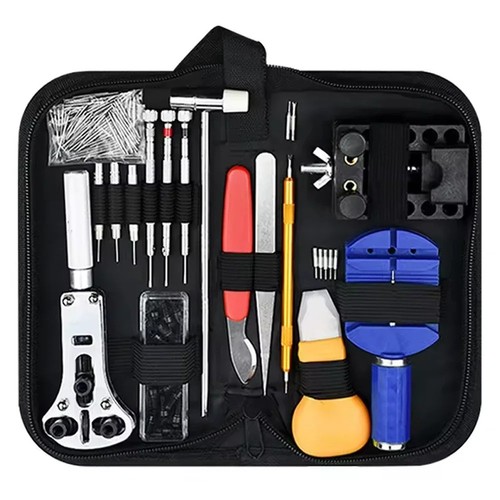 Case back opener setScrew-back openers and snap-back tools. Buy a set rather than a single piece — case backs vary. Don't use a coin or knife; scratched casebacks hurt resale value permanently.
 NATO strapsThe practical daily-wear choice for vintage pieces. Cheap enough to replace when worn. Protects the case at the lugs from sweat and scratches. Buy in multiple widths.
 Watch storage caseStore unworn watches in a case with cushions, away from humidity. A closed case slows lubricant oxidation and protects crystal and case from abrasion.
 Spring bar toolThe Bergeon 6767 is the professional choice. Any good spring bar tool with a fork end and push pin end handles 90% of strap changes safely. The $15 alternatives vary in tip quality.