
Why this matters: the reproduction cartridge landscape
Reproduction cartridges (reproductions, or "repros") are modern PCBs loaded with ROM dumps of original games, housed in original-style or replica plastic shells. They exist on a spectrum: legitimate home-brew repros sold transparently as repros for games that were never officially released in a region, down to outright forgeries using original shells and doctored labels intended to deceive buyers into paying original prices.
The problem isn't repros themselves — it's opaque selling. A buyer paying $40 for what they're told is an original Earthbound deserves to know they're getting a $15 repro. Learning to read the physical evidence protects you.
NES cartridges: the original Nintendo Seal of Quality and board markings
The Seal of Quality label
Original Nintendo-licensed NES cartridges carry the "Official Nintendo Seal of Quality" on the label. On early production runs (pre-1989 approximately), this was a round gold seal. Later production shifted to an oval format. Reproductions typically reproduce this seal as part of the label printing, but the quality of the printing differs from original.
On genuine NES labels: the Nintendo logo text has crisp edges under magnification with no halftone dot pattern visible at normal inspection. The Seal of Quality has clean defined borders. Colors are even without bleed. Many repros use modern inkjet or laser printing processes that produce visible halftone patterns under a loupe (10x is sufficient) and slightly different color saturation than offset-printed originals.
Board markings on NES cartridges
NES PCBs manufactured by Nintendo carry board codes stamped or printed on the PCB surface. The code follows a format like "NES-TKROM-04" — the middle section describes the board configuration (TKROM, NROM, MMC3, etc.) and the trailing number indicates the revision. If you open a cart with a security bit screwdriver (3.8mm for NES) and the board inside shows a configuration code not documented for that game, it's a repro.
Documented board-to-game databases exist in the retro collecting community. The NES Cart Database maintained by multiple community contributors cross-references every licensed NES cart with its correct PCB type. If a cart of "Mega Man 3" opens to a board labeled "NROM" (which is used for very small early games), that's wrong — MM3 used boards like the TKROM. Cross-check board type against the game before buying.
SNES cartridges: PCB inspection and reproduction detection
SNES cartridges are a higher-stakes authentication target because several SNES titles command significant prices: Earthbound, Chrono Trigger, Harvest Moon, Final Fantasy III (US designation). These are reproduced at high volume.
PCB inspection on SNES carts
Genuine SNES PCBs have Nintendo-specific markings: the board code (e.g., "SHVC-1J3M-20" for Super Metroid) is stamped on the PCB. The suffix number indicates revision. Chips on genuine boards carry date codes — a format like "9347" meaning 1993, week 47. For a cart released in 1994, all chips should have date codes from 1993 or early 1994. A chip dated 2015 is an immediate tell.
Reproduction SNES boards frequently use flash chips (EEPROM or mask ROM programmed by the repro builder) that are physically different from the original mask ROM chips Nintendo used. Original mask ROMs are ceramic or black epoxy-topped chips with identifiable manufacturer markings. Modern flash chips have a different physical profile and often different pin counts visible on inspection.
Shell and label tells
Original SNES cart shells have a slightly textured surface and a distinctive plastic feel. Repro shells — particularly Chinese-manufactured ones — often have a shinier, slightly smoother surface texture. The screw bosses inside the cart are also slightly different dimensions on repro shells, and the shell snap-fit ribs along the cartridge edge are often less precisely formed.
For label condition: SNES label ink on originals is offset lithography, not inkjet. Halftone dot pattern under a loupe is the same test as NES labels. Additionally, original SNES labels have a specific laminate sheen — slightly matte, not fully glossy. Many repro labels are either too glossy or have an obviously different finish.
N64 cartridges: chip dates, screw types, and label texture
N64 uses 3.8mm security bit screws, same as NES. Opening an N64 cart for PCB inspection follows the same approach. Nintendo N64 PCBs carry board codes in formats like "NUS-NSMJ-0" for Super Mario 64 (US). The chip date code method applies here too — all original chips should have date codes consistent with the game's production era.
N64 labels have a distinct texture — a slightly rough matte surface that you can feel by running a finger across the label. Most repro labels are smoother. The Nintendo logo on N64 labels has a specific font rendering that repros often approximate but don't precisely match — the letter spacing and "i" dot positioning in "Nintendo" are consistent across all original labels but variable in repros.
High-value N64 titles with repro risk include: Stadium Events (extremely rare, most listings are repros), Bomberman 64: The Second Attack, ClayFighter Sculptor's Cut, and Worms Armageddon. For these titles, treat any purchase without confirmed opening and PCB inspection as speculative.
Game Boy cartridges: battery health and save-state authentication
Save battery inspection
Game Boy, Game Boy Color, and Game Boy Advance cartridges that save games internally (rather than to a password system) use a CR2025 or CR2032 lithium coin cell battery soldered to the PCB. These batteries have a nominal lifespan of approximately 15–20 years at low drain. Cartridges from the mid-to-late 1990s are now at or past this threshold — a dead battery means saved games cannot be written.
Testing a save battery requires only a multimeter set to DC voltage. The nominal voltage of a fresh CR2025 is 3V; replace when below approximately 2.7V. Battery replacement requires desoldering the old cell and soldering in a new one — a job achievable with basic soldering skills and a solder sucker, or professionally done by any electronics repair shop for low cost.
Pokemon Gold and Silver are the highest-profile save battery cases: both use real-time clock chips in addition to the main save battery, and the RTC must also be functioning for in-game time to work correctly. A Gold or Silver with a dead battery will fail to save AND show incorrect in-game time. Battery replacement restores saving; a secondary RTC-specific procedure is needed to reset the clock if the RTC battery is also depleted.
Game Boy Pokemon authentication
Pokemon Red, Blue, Yellow, Gold, Silver, and Crystal are among the most reproduced Game Boy titles globally. Genuine Game Boy carts have a specific Nintendo-stamped PCB inside. The board code for Pokemon Red (US) is "DMG-APUE-0" or similar revision suffixes. Repro boards lack this Nintendo stamping entirely and frequently show a generic PCB silkscreen with no manufacturer identification.
Label tells for Pokemon carts: original Game Boy labels have a specific sheen and a raised "Game Boy" logo text that you can feel with a fingernail. Repro labels are flat-printed, without the raised text feel. The colors on original labels are slightly different in gamut — the blue of Pokemon Blue on an original is a specific Pantone-like blue that cheap inkjet repros print slightly differently. Under 10x magnification, original labels show clean offset printing; repros show halftone dots.
Console restoration: NES 72-pin connector and SNES sound chip
NES 72-pin connector
The single most common hardware failure on NES consoles is the 72-pin connector — the cartridge slot that the cart pins make contact with. Over time, the connector pins lose spring tension, causing poor electrical contact and the famous blinking screen behavior. Cleaning with isopropyl alcohol (90%+ concentration) resolves contamination-based failures. Bent or fatigued pins require either a connector replacement (available from multiple retro hardware suppliers) or reshaping the existing connector pins, which requires patience and a thin flat object to re-bend each pin individually.
SNES sound chip restoration
The SNES uses Sony's SPC700 audio processor (DSP chip). Some consoles develop audio issues — no sound, distorted sound, or intermittent audio — from the SPC700 or its supporting capacitors aging. Capacitor replacement (recapping) on the SNES motherboard is the standard restoration: the original electrolytic capacitors on SNES boards are 30+ years old and prone to ESR increase or failure. A full SNES recap involves replacing approximately 14–16 capacitors with modern equivalents; part cost is low, labor time is moderate for someone with soldering experience.
Search eBay for these games
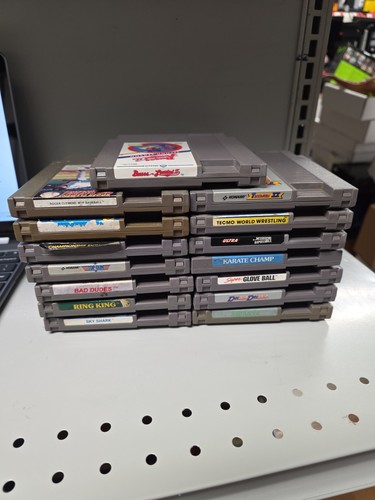 NES games lot
Lot buying for per-cart value. Check all labels for print quality before bidding.
NES games lot
Lot buying for per-cart value. Check all labels for print quality before bidding.
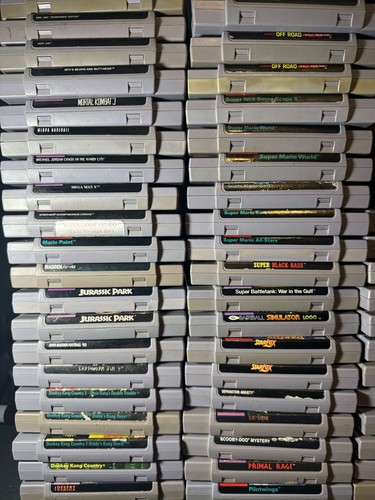 SNES games
Earthbound / Chrono Trigger: insist on PCB photos before paying premium.
SNES games
Earthbound / Chrono Trigger: insist on PCB photos before paying premium.
 N64 cartridges
Check chip date codes against production year. Label texture test applies.
N64 cartridges
Check chip date codes against production year. Label texture test applies.
 Game Boy Pokemon
Highest repro rate in the library. Always ask for PCB photo for Gold/Silver.
Game Boy Pokemon
Highest repro rate in the library. Always ask for PCB photo for Gold/Silver.
 Sega Genesis games
Lower repro risk overall. Standard Torx screws make inspection easy.
Sega Genesis games
Lower repro risk overall. Standard Torx screws make inspection easy.