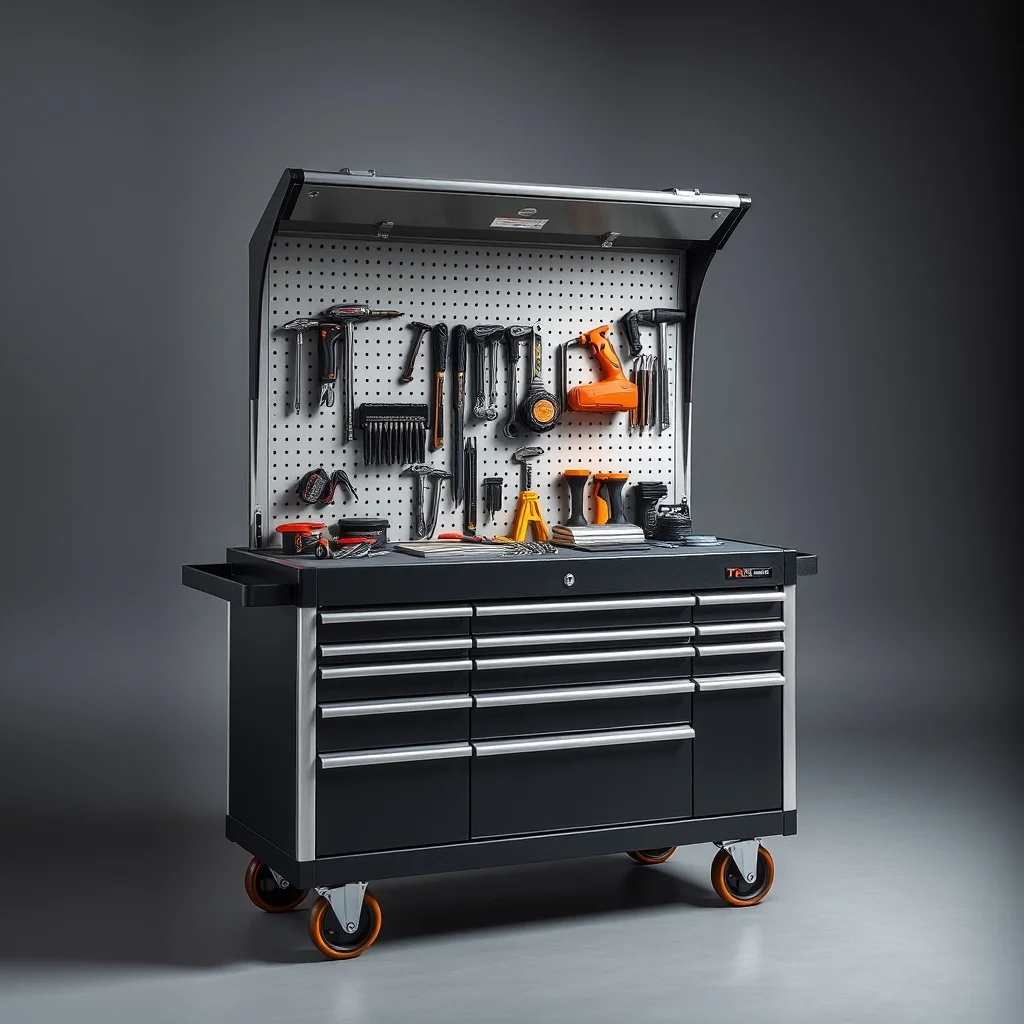
Steel gauge: the number that predicts longevity
Steel gauge in tool chests is counterintuitive: lower gauge numbers mean thicker steel. A 16-gauge steel chest is substantially heavier and more rigid than a 20-gauge steel chest. The difference is not cosmetic — thinner steel flexes under load, which causes drawers to bind, slide rails to misalign, and the overall structure to deform over years of heavy use.
| Gauge | Thickness | Typical use |
|---|---|---|
| 16 gauge | ~1.5 mm (0.060") | Professional grade. Very rigid under load. Heavy. Used in Snap-on, MAC, Matco, and high-end Husky/Craftsman pro lines. |
| 18 gauge | ~1.2 mm (0.048") | Heavy-duty homeowner to light commercial. Adequate for most shop use with moderate tool weight. Standard for mid-tier Craftsman, Husky, and Kobalt. |
| 20 gauge | ~0.9 mm (0.036") | Entry-level. Acceptable for light use. Prone to flexing if heavily loaded; bottom drawers will sag if filled with heavy hand tools. |
| 22+ gauge | <0.8 mm | Budget/value tier. Generally not recommended for professional tool storage. Deforms under sustained heavy load. |
For a garage or home shop where you carry a typical set of hand tools, 18-gauge steel is the practical minimum for a chest that will last without structural problems. If you work professionally and the chest will hold a full set of wrenches, sockets, power tools, and specialty tools across 20+ drawers, 16-gauge is the professional standard.
Drawer slides: the single biggest quality differentiator
Drawer slide quality affects your experience with a tool chest every single time you open a drawer. Three variables matter:
Extension type: partial vs full vs over-travel
A partial-extension slide opens the drawer roughly 3/4 of its depth — you cannot access items at the back without reaching in. A full-extension slide opens the drawer completely, so every item is accessible. An over-travel (100%+) slide opens past the cabinet depth, useful for very deep drawers. For tool storage, full-extension slides are strongly preferred — digging to the back of a tool drawer to find a specific wrench becomes genuinely frustrating with partial-extension slides.
Slide load rating
Ball-bearing slides are rated by maximum load per drawer pair. Common ratings: 50 lbs, 100 lbs, 150 lbs. A drawer full of metric and standard sockets plus pliers easily reaches 25–40 lbs; a drawer full of larger hand tools (hammers, wrenches, ratchet sets) can reach 50–70 lbs. Slides loaded beyond their rating wear out rapidly and eventually seize. For professional-level storage, slides rated at 100 lbs per drawer are a meaningful quality indicator.
Slide material: ball-bearing vs roller
Ball-bearing slides use steel ball bearings in a race — they are smooth, precise, and handle heavy loads well. Roller slides (cheaper) use a single plastic or steel roller, which is less precise and wears faster under heavy loads. Any tool chest marketed for professional use should use ball-bearing slides. Roller slides are acceptable only for light-duty or occasional use.
Rolling cabinet vs top chest: configuration choices
The two main tool chest formats serve different purposes and are designed to work together:
Rolling cabinet (bottom box)
Floor-standing on casters. Typically 24–56 inches wide, 36–42 inches tall. Contains the majority of storage in larger, deeper drawers. Has the lockable casters that let you roll it to the job and then secure it in place. The work surface is the top — most rolling cabinets have a flat top intended to accept a matching top chest and to serve as a work surface with the top chest removed.
Top chest (top box)
Sits on top of the rolling cabinet. Smaller drawers suited for smaller tools — screwdrivers, pliers, small wrenches, measuring tools. Typically has a handle for portability — you can carry the top chest to the job while leaving the heavy rolling cabinet in the shop. May include an integrated power strip, USB ports, or lighting on newer models.
Combo units
Rolling cabinet and top chest sold together, typically matched in width and finish. Best value per cubic inch of storage if you need both. The two units mount together with bolts or anti-tip brackets. Verify the combined height (rolling cabinet + top chest + casters) fits your garage ceiling and workspace — combined heights of 72–82 inches are common, which can be tight in garages with low utility tracks or shelving.
Shopping for tool chests? Browse current eBay listings → (we earn a small commission; your price is unchanged).
Drawer configuration: count, depth, and height
Drawer count in a spec sheet is less useful than drawer configuration. A 12-drawer chest with two shallow top drawers, six medium drawers, and four deep lower drawers distributes storage very differently from a 12-drawer chest with twelve identical medium-height drawers. For tool organization, a mix of drawer heights is preferred:
- Shallow drawers (2–3 inch interior height): Flat tools — rulers, levels, chisels, small drivers, utility knives
- Medium drawers (4–6 inch interior height): Wrenches, pliers, sockets on trays, cordless tool batteries
- Deep drawers (8–12 inch interior height): Power tools, larger items, tool cases, extension cords
Total cubic inch capacity is occasionally listed in spec sheets and is the most honest single comparison number for storage volume. Calculate it yourself if necessary: interior width × interior depth × interior height of each drawer, summed across all drawers.
Casters: mobility and stability
Caster quality on rolling tool chests is often undersized relative to the weight the chest will carry. A full-size rolling cabinet loaded with tools can easily reach 400–600 lbs. Casters rated for that weight need to be 3–5 inch diameter with steel or heavy-duty polyurethane wheels. Smaller casters (2 inch) struggle on uneven concrete floors and wear out faster under heavy loads.
All four casters should be lockable — two swivel casters in the front for steering, two rigid or lockable casters in the rear, with locking mechanisms that can be engaged with a foot. Verify the casters lock before buying; a tool chest that rolls when you lean on it is a safety hazard.
Drawer liners: why they matter for your tools
Bare steel drawer bottoms allow tools to slide around, damage each other's finishes, and create noise. Drawer liners serve three practical functions: they cushion tools to prevent finish damage (especially important for precision measuring tools and chrome-plated sockets), they prevent sliding during drawer opening/closing, and on oil-resistant liners, they resist spill penetration into the drawer bottom.
EVA foam (closed-cell) is the most common choice — it resists oil absorption, cuts easily to fit, and compresses slightly to grip tools. Tool mat liners (textured rubber or PVC) are easier to clean and also effective. Avoid open-cell foam — it absorbs oil and fluids and harbors rust-causing moisture.
Lock quality and security
Most tool chests include a keyed lock that secures all drawers via a single keyed cylinder — either a single lock that engages a rod running through the cabinet, or individual drawer locks. Single-rod locking systems (one key locks everything) are convenient but mechanically simpler. Multi-lock systems (separate lock per drawer or section) are more secure but require the same key engagement for each section.
Consumer-grade tool chest locks are not high-security — they deter casual access, not determined theft. If security is a genuine concern in your shop, a separate cable lock through the drawer handles or a purpose-built tool chest with heavier-duty locks is the appropriate solution. For home garage use, the standard lock is adequate for the realistic threat model.
Common buying mistakes
- Buying by drawer count: 14 drawers of thin steel with partial-extension slides is objectively worse than 10 drawers of 18-gauge steel with full-extension ball-bearing slides. Count isn't quality.
- Underestimating total weight: A 26-drawer rolling cabinet can weigh 300 lbs empty. Add tools and you may not be able to roll it without help. Verify caster rating vs your expected total load.
- Mismatching cabinet width with top chest: Rolling cabinet and top chest must match width to align properly and mount safely. Don't assume any top chest fits any rolling cabinet, even from the same brand.
- Skipping drawer liners: A bare-metal drawer with expensive socket sets sliding around is a false economy. Liners are cheap; damaged chrome tools are not.
- Buying a used chest without inspecting the slides in person: Worn or bent slides on a used chest are expensive or impractical to replace. Open every drawer before committing to a used purchase.
The honest summary
For a home garage or small shop, an 18-gauge rolling cabinet with full-extension ball-bearing slides rated at 100 lbs per drawer — from a brand that sells replacement slides — is the right target. Spend more on construction quality and less on extra drawers. A well-built 8-drawer chest that you can expand later beats a 16-drawer budget chest that sags under your socket sets within two years.
 Rolling tool chest
 Tool chest combo
 Tool drawer liner