🛹 Skateboarding — Gear Guide
Skateboard bearing speed ratings: what ABEC 3, 5, 7, and 9 actually measure — and what doesn't matter for skating
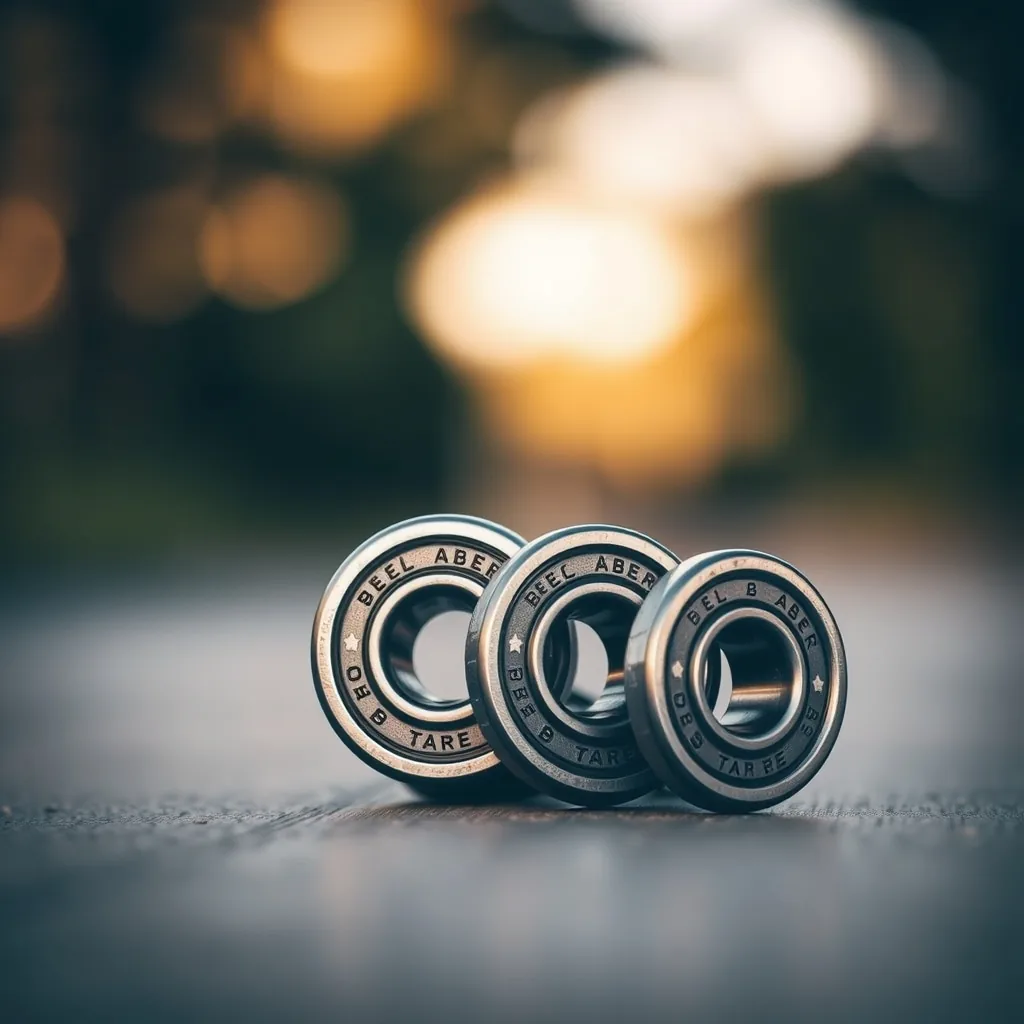
Every bearing package claims a speed rating. Most skaters assume higher is faster. The actual story is more interesting, and the practical takeaway is simpler than the marketing suggests.
Where ABEC comes from
ABEC stands for Annular Bearing Engineers' Committee. It's a subcommittee of the American Bearing Manufacturers Association (ABMA), and the rating system it produces dates to the 1960s. The ratings — ABEC 1, 3, 5, 7, and 9 — define progressively tighter manufacturing tolerances for precision ball bearings used in industrial equipment: electric motors, machine tool spindles, medical devices, and high-speed turbines.
The core measurements an ABEC rating specifies are:
- Bore diameter tolerance — how closely the inner ring bore matches its nominal dimension
- Outer ring OD tolerance — the same for the outer diameter
- Width tolerance — how consistently the bearing is machined to its specified width
- Running accuracy — specifically, radial runout and axial runout, which measure how much the ring wobbles as it rotates
At ABEC 1 (the loosest), tolerances are measured in ten-thousandths of an inch. By ABEC 9, you're working with tolerances measured in the hundred-thousandths. This precision matters enormously in a CNC spindle rotating at 40,000 RPM under sustained load. It determines whether the bearing runs true, generates heat uniformly, and lasts without fatigue failure.
Why these measurements don't translate to skating
The ABEC spec was built around industrial applications that share almost nothing with how a skateboard bearing actually operates. Consider the differences:
- RPM range: A machine tool spindle runs at 10,000–60,000 RPM for hours under consistent load. A skate wheel doing a fast downhill run might hit 15,000–18,000 RPM at peak, but most street and park skating sits well below 10,000 RPM. The tolerance differences between ABEC 5 and ABEC 9 are measurable only at high continuous RPM — at skate-wheel speeds, both perform identically.
- Load type: Industrial bearings sustain steady radial or axial loads. Skate bearings absorb impact loads — every landing, every curb, every pop — in unpredictable directions. The ABEC spec measures nothing about shock resistance or load capacity under impact.
- What ABEC does not measure: steel grade, steel hardness, ball quality, cage material, lubrication type, seal quality, or noise/vibration under impact. These are the variables that determine how a skate bearing performs in real use.
A bearing labeled ABEC 9 may use the same chrome steel balls and nylon cage as an ABEC 5 bearing from the same manufacturer, with no meaningful difference in skate performance. Some manufacturers apply ABEC ratings to bearings that were never tested against the spec at all — the label is marketing, not certification.
What actually determines skate bearing performance
Steel grade
Standard skate bearings use chrome steel (52100 alloy steel, also called SUJ2 in Japanese Industrial Standards). This is a fine-grained steel with high hardness and good wear resistance. Budget bearings from unknown brands often use carbon steel — softer, less wear-resistant, more prone to rust. You can't see the difference on the shelf, but you'll feel it after a few weeks of regular skating.
Ceramic bearings — specifically hybrid ceramics, which use steel rings with silicon nitride balls — are genuinely different. Ceramic balls are harder, don't rust, generate less heat, and are lighter. They also cost significantly more ($30–$90 for a full set of 8). For most skaters, ceramic isn't worth the premium; for downhill skaters where sustained high RPM is common, the heat and rust resistance are practical advantages.
Lubrication
New bearings come pre-lubricated from the factory. The lubrication type determines feel more than the ABEC rating does:
- Grease: thick, durable, suitable for wet or dirty conditions. Bearings feel slightly slower to spin up but hold speed well and resist contamination. Comes standard in most bearings.
- Light oil: thin, fast, appropriate for clean indoor skateparks. Bearings spin up quickly and feel noticeably faster, but require more frequent re-lubrication and contaminate faster outdoors.
Bones Speed Cream is the most-used skate bearing lubricant because it's a light oil formulated specifically for bearings — not too thin (doesn't fling off), not too thick (doesn't drag). Sewing machine oil is a reasonable substitute. Never use WD-40 as a lubricant: it's a solvent and water displacer that flushes lubrication out rather than adding it.
Seals and shields
Bearings come with either rubber seals (designated with a "RS" or "2RS" suffix) or metal shields ("Z" or "ZZ"). Rubber seals close tighter, keeping dirt and water out more effectively — better for street skating and outdoor use. Metal shields are easier to remove for cleaning but provide less protection. If you're frequently skating dusty or damp spots, rubber-sealed bearings will outlast open or shield-only bearings.
Cage material
The cage (also called the retainer) holds the balls in position. Most skate bearings use nylon or glass-fiber-reinforced nylon cages. Some use steel. Nylon is lightweight and runs quietly; steel is more durable at extreme temperatures. For skating, nylon is fine in almost every scenario. The cage will outlast the balls and races in normal skating.
How to clean bearings properly
Cleaning bearings is worth doing every few months if you skate outdoors regularly, or whenever you notice increased rolling resistance or grinding sounds.
- Remove the bearings from the wheels (use the truck axle as a lever — push the wheel to the side so the axle catches the inner race, then pry).
- If your bearings have rubber seals, remove them carefully with a pin or dental pick, working around the groove. Metal shields can usually stay on for a rough clean.
- Submerge the bearings in acetone or 91%+ isopropyl alcohol. Swirl or shake for several minutes. The solvent flushes old lube, dirt, and grit from the races and ball complement.
- Rinse with clean solvent, then let the bearings dry completely — ideally 30–60 minutes. Spinning them on a pencil helps.
- Apply 1–2 drops of light bearing oil (Bones Speed Cream or equivalent) to each bearing. Spin to distribute. Do not over-lube — excess oil attracts more dirt.
- Replace seals, reseat in wheels, and ride.
Properly cleaned and re-lubed bearings often perform as well as or better than new budget bearings. The labor cost of the procedure is maybe 20 minutes for a full set of 8.
When to replace bearings
Replace bearings when:
- You hear grinding or crunching during normal rolling — the balls or races are damaged and cleaning won't help.
- After cleaning and re-lubing, the bearing spins fewer than 8–10 seconds when flicked freely on a pen or axle.
- The bearing wobbles visibly on the axle — the outer ring or inner race is deformed.
- You've cleaned them twice and performance hasn't improved.
One bearing failure in eight typically means replacing that wheel's pair rather than all eight at once, unless they're the same age and have equal use.
The honest recommendation
The ABEC number on a bearing package tells you almost nothing useful about how the bearing will perform in skating. It describes industrial precision tolerances for machinery that operates under completely different conditions than a skateboard wheel.
What matters:
- Chrome steel construction from an established manufacturer (Bones, Shake Junt, Bronson, Sector 9, Mini Logo)
- Appropriate lubrication for your skating environment (light oil for parks, grease for outdoors)
- Rubber seals if you skate outdoors or in dusty areas
- Cleaning every few months
Bones Reds (~$16 for 8) are the most-recommended starting point for a reason — not because of the ABEC spec, but because they use quality steel, appropriate lubrication, and have a 30+ year track record in skating. Spending more on higher-ABEC-labeled bearings from unknown brands will not make you faster. Spending $10 more on Bones Swiss, which uses Swiss-manufactured steel and better tolerances for skating, might make a noticeable difference if you're a high-mileage skater. But ABEC 9 from a no-name brand is a worse investment than ABEC 3 from Bones.
The number on the package is industrial specification. The quality of the steel, lube, and seals is what you're actually buying.
Gear actually worth buying
Smart eBay searches we'd start with ourselves. We earn a small commission on qualifying sales through these links; the price you pay is the same whether you use them or go direct to eBay. Full disclosure.
 Bones Reds (8-pack)
The default chrome-steel benchmark. Not ABEC-rated — rated to Bones' own skate spec. Reliable, cheap, widely available.
Bones Reds (8-pack)
The default chrome-steel benchmark. Not ABEC-rated — rated to Bones' own skate spec. Reliable, cheap, widely available.
 Bones Swiss bearings
Swiss-manufactured steel, tighter tolerances for skating. The step-up from Reds if you want noticeably better longevity on high-mileage skating.
Bones Swiss bearings
Swiss-manufactured steel, tighter tolerances for skating. The step-up from Reds if you want noticeably better longevity on high-mileage skating.
 Bronson Speed Co. bearings
Popular alternative to Bones. Rubber seals, chrome steel, widely used by street skaters in the mid-price range.
Bronson Speed Co. bearings
Popular alternative to Bones. Rubber seals, chrome steel, widely used by street skaters in the mid-price range.
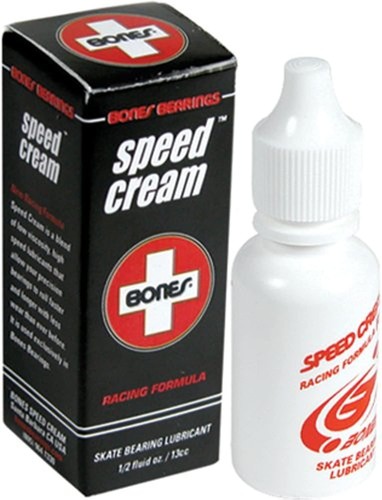 Bones Speed Cream
The standard skate bearing lubricant. Light oil formula, 1–2 drops per bearing after cleaning. Extends life significantly.
Bones Speed Cream
The standard skate bearing lubricant. Light oil formula, 1–2 drops per bearing after cleaning. Extends life significantly.
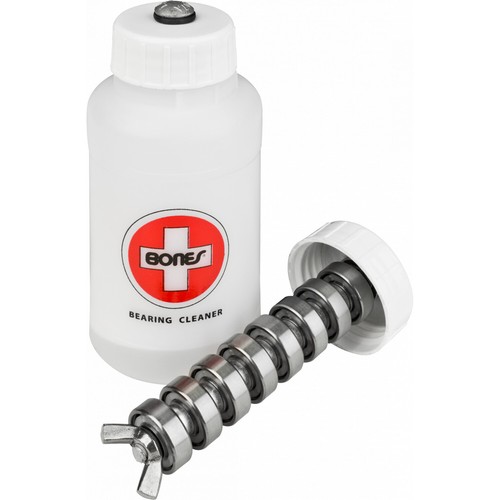 Bearing cleaning unit
A small jar-style cleaning unit makes flushing all 8 bearings in one go easy. Use with acetone or high-% isopropyl.
Bearing cleaning unit
A small jar-style cleaning unit makes flushing all 8 bearings in one go easy. Use with acetone or high-% isopropyl.