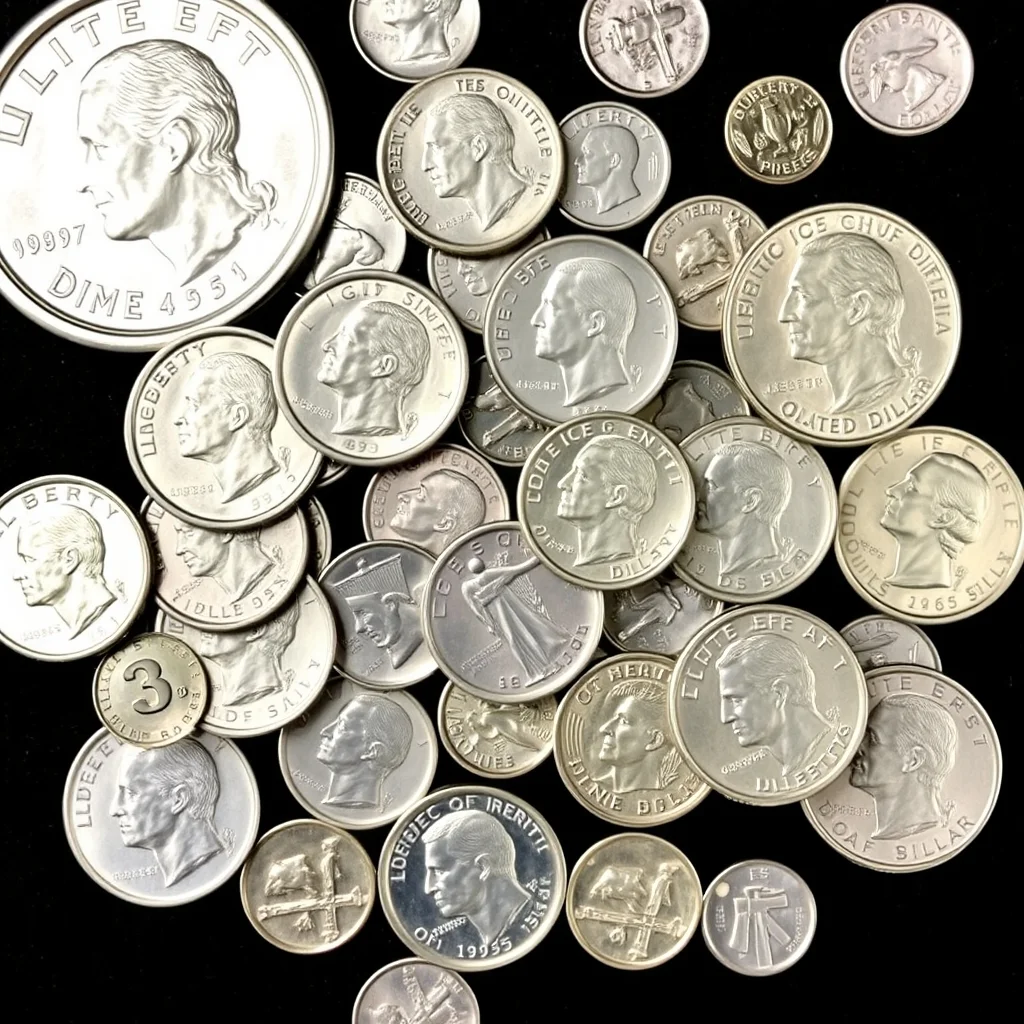
What is junk silver?
"Junk silver" is the collector and dealer term for pre-1965 United States coinage — dimes, quarters, and half dollars — that contains 90% silver. The "junk" label isn't a quality judgment; it means the coins have no significant numismatic (collector) premium and trade purely or primarily on their silver content. From a bullion perspective, junk silver is one of the most efficient ways to acquire silver near melt value.
Congress switched US coinage to clad (copper-nickel over copper core) in 1965 following the Coinage Act of 1965, which was a direct response to silver prices rising to the point where the metal value of coins exceeded their face value. Everything minted in 1964 and earlier for dimes, quarters, and halves contains 90% silver. Kennedy half dollars from 1965–1970 are 40% silver (not 90%); the shift to zero-silver happened in 1971 for halves, and 1965 for dimes and quarters.
Where the 0.715 ASW figure comes from
ASW stands for Actual Silver Weight — the troy ounces of pure silver in a given coin or lot. For 90% silver coinage, the 0.715 figure is the ASW per $1 of face value. Here's the derivation:
Step 1: Gross weight per denomination
US coinage has standardized gross weights established by the Coinage Acts:
| Denomination | Gross weight (grams) | Gross weight (troy oz) | Silver content (90%) | ASW (troy oz) |
|---|---|---|---|---|
| Dime (pre-1965) | 2.500 g | 0.08038 troy oz | × 0.90 | 0.07234 troy oz |
| Quarter (pre-1965) | 6.250 g | 0.20094 troy oz | × 0.90 | 0.18084 troy oz |
| Half dollar (pre-1965) | 12.500 g | 0.40188 troy oz | × 0.90 | 0.36169 troy oz |
| Morgan/Peace dollar | 26.730 g | 0.85937 troy oz | × 0.90 | 0.77344 troy oz |
Step 2: The $1 face value calculation
For a $1 face value bag, you would have 10 dimes, or 4 quarters, or 2 half dollars. Let's verify each:
The theoretical figure is 0.7234. The industry convention rounds to 0.715 — a 1.2% reduction to account for wear. Circulated coins have lost some surface silver over decades of handling; the 0.715 figure assumes a typical mix of circulated (VG to XF) coins and applies a small wear discount. For lightly circulated or uncirculated coins, ASW is closer to the full 0.7234.
Applying the math: bag calculations
Standard junk silver bags are sold in $1,000 face value lots (a "bag") or $500 and $100 face lots. Here's the math for each:
| Face value lot | ASW (@ 0.715) | ASW (@ 0.723, uncirculated) |
|---|---|---|
| $100 face | 71.5 troy oz | 72.3 troy oz |
| $500 face | 357.5 troy oz | 361.5 troy oz |
| $1,000 face | 715 troy oz | 723 troy oz |
Melt value calculation is then: ASW × current spot price per troy oz. If spot silver is $30/troy oz and you have a $1,000 face junk silver bag:
How junk silver trades relative to melt
Junk silver doesn't always trade at exactly melt value. Understanding when premium is rational and when it isn't is the practical skill.
Premiums above melt
Dealers typically charge a premium above melt on junk silver — this is how they make money. Historical retail premiums have ranged from roughly 2–15% above melt depending on market conditions, dealer location, and lot size. During silver spikes or supply crunches (2011, early 2020), retail premiums on junk silver bags temporarily reached 20–30% above melt as physical supply dried up while paper silver (futures) was readily available.
Buying at a modest premium is often rational because the alternative — buying 1 oz Eagles — typically carries a higher per-ounce premium. A 5% premium on junk silver is often cheaper than the 8–12% typical retail premium on American Silver Eagles when both are bought at the same time from the same dealer.
When premium above melt is not rational
If you are buying junk silver as a pure silver-by-weight play and the premium exceeds what you could get buying generic silver rounds (which typically carry 2–4% premiums at retail), junk silver no longer makes economic sense for that purpose. Junk silver commands its premium primarily because of recognizability — the coins are genuine US government-issued coinage, easily recognizable and testable. That recognizability has real value for barter and peer-to-peer transactions where a generic round needs more explanation.
Recognizing constitutional silver: what to check
The counterfeit risk with 90% junk silver is real but lower than with gold, simply because the silver value is lower per coin. That said, there are silver-plated copper coins in circulation designed to pass as genuine 90% silver. Practical checks:
The jingle test
Pre-1965 90% silver coins have a distinctive high-pitched ring when dropped or bounced on a hard surface. Clad coins (post-1964) have a dull, flat sound. Drop a dime, quarter, or half on a hard surface and compare the ring. After hearing genuine 90% silver a few times, the difference is obvious.
Date check
Dimes: Roosevelt dimes are 90% silver for dates 1946–1964. Mercury dimes (1916–1945) are also 90% silver. Quarters: Washington quarters 1932–1964. Half dollars: Liberty Walking (1916–1947), Franklin (1948–1963), Kennedy 1964 only for 90% silver (1965–1970 are 40%). Morgan dollars: 1878–1904, 1921. Peace dollars: 1921–1935.
Visual edge
Post-1964 clad coins show a visible copper stripe on the edge when viewed closely. Pre-1965 90% silver coins have a uniform silver-colored edge. This is one of the fastest field checks.
Weight
Refer to the gross weights in the table above. A genuine 1964 or earlier dime weighs 2.50 grams. A clad dime weighs 2.27 grams. If you have a scale accurate to 0.01g, checking a sample from a lot is worthwhile when dealing with an unknown seller.
The 40% Kennedy halves (1965–1970)
Kennedy half dollars from 1965 to 1970 are 40% silver, not 90%. The ASW per coin is 0.1479 troy oz (versus 0.3617 troy oz for the 90% variety). These are sometimes mixed into junk silver lots or sold separately. The math:
ASW per $1 face of 40% halves: 2 coins × 0.14792 = 0.2958 troy oz — less than half the 0.715 figure for 90% silver. Don't mix these into your 90% calculations. They trade at a discount per troy oz of silver compared to 90% silver because the smaller silver content per coin makes them less efficient to store and trade.
Morgan dollars: numismatic vs bullion math
Morgan dollars (90% silver, 0.7734 troy oz ASW each) occupy a gray zone between junk silver and numismatic coins. Common-date Morgans — 1881-S, 1884-O, 1886-P, 1897-P — trade at or near melt value in lower grades (G-4 through VG-8). Key-date Morgans trade on numismatic premium regardless of silver content.
If you are buying Morgans as a silver play, verify you are paying near melt for common dates. Sellers sometimes mix in common Morgans with slight premiums framed as "collectibles" even when condition doesn't justify it. Calculate ASW × spot; if the ask price is significantly above that on a common-date VG coin, you are paying a numismatic premium for a coin that is not a numismatic coin.
Practical buying checklist
- Look up current spot silver price before negotiating (kitco.com, spot price APIs, or any bullion dealer's live quote)
- Calculate melt value: face value × 0.715 × spot per troy oz
- Add 5–10% for a fair retail premium; add 15–20% if market is tight
- Verify dates on a sample before accepting a lot from a new seller
- Check the edge on quarters and halves for the copper stripe that identifies clad coins
- For large lots, spot-check weights on a sample (5–10 coins per $100 face)
- Store in sealed tubes or bags — 90% silver does tarnish in air, though it doesn't affect melt value
Search eBay for junk silver and bullion
 90% junk silver coins
Bags, rolls, and mixed lots of pre-1965 US 90% silver coinage.
90% junk silver coins
Bags, rolls, and mixed lots of pre-1965 US 90% silver coinage.
 Morgan silver dollars
0.7734 troy oz ASW. Check dates — common vs key-date difference is significant.
Morgan silver dollars
0.7734 troy oz ASW. Check dates — common vs key-date difference is significant.
 American Silver Eagle 1 oz
0.9993 fine, US Mint sovereign. Higher premium than junk silver but most recognized coin domestically.
American Silver Eagle 1 oz
0.9993 fine, US Mint sovereign. Higher premium than junk silver but most recognized coin domestically.
 Constitutional silver half dollar
Pre-1965 halves. 0.3617 troy oz ASW each; rolls of 20 give ~7.23 troy oz.
Constitutional silver half dollar
Pre-1965 halves. 0.3617 troy oz ASW each; rolls of 20 give ~7.23 troy oz.