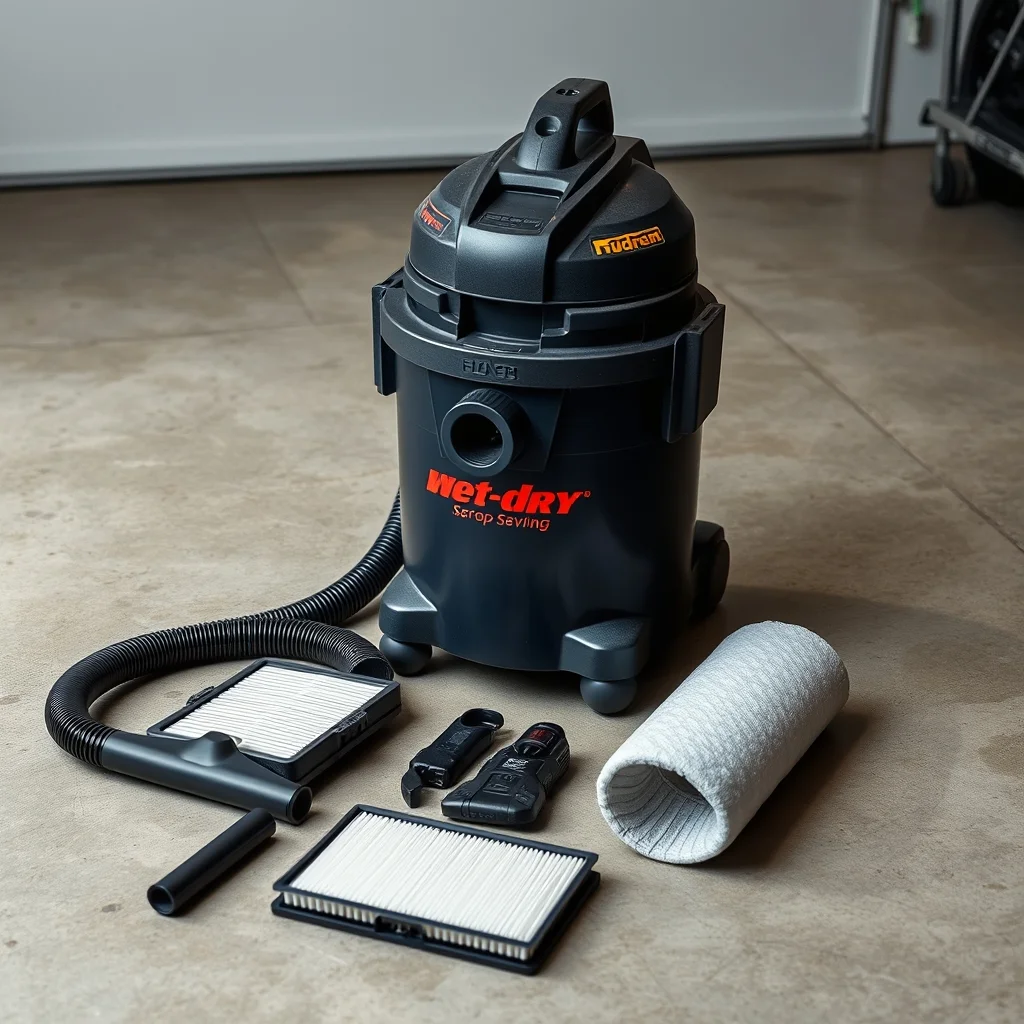
The two specs that actually matter: CFM and water lift
A shop vacuum's cleaning ability depends on two distinct measurements that describe different physical phenomena:
CFM (cubic feet per minute) measures airflow — how much air the motor moves per minute. Higher CFM means the vac can pick up more material, move it faster through the hose, and handle larger debris without clogging. CFM is what determines pickup speed on a flat surface for sawdust, drywall dust, wood chips, and similar dry debris. Typical range is 50–200 CFM for consumer shop vacs.
Water lift (also called sealed suction or static pressure), measured in inches of water column, describes the maximum suction pressure when the hose is completely blocked. This determines whether the vac can pick up heavy, dense debris — wet sand, gravel, heavy wet material — and how well it handles resistance in longer hose runs. Typical range is 40–80 inches of water lift.
The two specs are related but not interchangeable. A motor optimized for high CFM (open-flow) may not produce as much water lift. A motor optimized for sealed suction may move less air in open operation. Most consumer shop vacs balance both reasonably; professional dust extractors may emphasize water lift for use with long hose runs or dense materials.
Gallon capacity: how often do you want to empty it?
Capacity is simpler than most buyers expect: it determines how much debris you can collect before the tank fills and performance degrades (or the float shuts off suction on wet pickup). It does not directly affect cleaning power.
| Capacity | Best for | Typical weight (full, wet) |
|---|---|---|
| 2–4 gallon | Job-site portability, quick cleanups, tight spaces, car detailing | 18–35 lbs full of water |
| 5–8 gallon | Small workshops, light renovation work, homeowners who clean up regularly | 42–70 lbs full of water |
| 10–14 gallon | Medium workshops, concrete and masonry work, moderate-volume debris | 83–120 lbs full of water |
| 16–22 gallon | Large workshops, production environments, heavy wet pickup (flooding cleanup) | 133–185 lbs full of water |
Note the weights above for full wet pickup — a 16-gallon vac full of water weighs over 130 lbs. Most have casters, but moving a full large-capacity vac up stairs or across uneven surfaces requires planning. If portability matters, choose accordingly.
Wet/dry capability: what it means and what it doesn't
A true wet/dry shop vac can pick up both dry debris and liquids. The distinction matters because the motor on a wet/dry vac is sealed and positioned so liquid cannot contact it — the motor sits above the drum and pulls air up through the collection tank. A household vacuum's motor is not designed for this and can be destroyed by liquid pickup.
Wet pickup requires removing or changing the filter. Standard dry-pickup cartridge filters will be ruined by water — a wet foam sleeve filter is used instead, or the cartridge is removed entirely for large-volume liquid pickup. Always check your vac's manual: running with no filter on dry debris will blow fine dust through the motor and potentially out the exhaust.
Most consumer shop vacs rated for wet/dry use include both a cartridge filter (for dry use) and a foam sleeve (for wet use) in the box. If you bought a used vac, verify both are present.
Filter types and micron ratings
The filter is the component that most buyers ignore until the motor starts struggling or fine dust starts blowing back into the room. The wrong filter for the job either clogs quickly (reducing suction) or allows fine particles to pass through (returning them to the air).
Standard dry cartridge filters
Most shop vacs ship with a pleated paper or synthetic cartridge rated at roughly 5–35 microns. Adequate for wood chips, sawdust, drywall dust, and general construction debris. The micron rating means particles above that size are captured; smaller particles may pass through.
Fine dust filters
Rated at 1–5 microns. Required when working with fine materials like drywall compound dust, fine sanding dust, or any application where you want to minimize airborne particulates returned to the room. These filters clog faster and require more frequent cleaning or replacement.
HEPA-rated filters
Rated at 0.3 microns at 99.97% efficiency. Required for hazardous dust applications: lead paint abatement, asbestos-containing materials, silica dust from concrete or masonry cutting. If you are doing any work on pre-1980 painted surfaces or cutting concrete, a HEPA-rated shop vac is appropriate. Standard filters do not capture particles at the size that makes silica and lead dangerous.
Foam sleeve filters
Used for wet pickup. Protects the filter area from water ingestion. Does not filter fine dry particles — only use for liquid cleanup, then switch back to the cartridge filter for dry debris.
Hose diameter and length: the spec hidden in accessories
Two hose diameters dominate the consumer market: 1-7/8 inch (most smaller vacs) and 2-1/2 inch (most larger vacs). These are not interchangeable — a 2-1/2" hose on a 1-7/8" inlet port won't seal properly, and vice versa. Floor tools, crevice nozzles, and brush attachments are similarly sized — check that accessories match your vac's hose diameter before purchasing.
Longer hose runs reduce CFM. Every foot of hose adds resistance to airflow. A 10-foot extension hose on a moderately powered vac can meaningfully reduce pickup performance. For fixed shop installations, consider routing a centralized hose to multiple drop points rather than dragging the unit around.
Shopping for shop vacuums? Browse current eBay listings → (we earn a small commission; your price is unchanged).
Dust collection for power tools: the blower port
Most larger shop vacs include a blower port — an outlet that reverses the airflow, turning the vac into a blower. More useful for shop integration is the ability to connect the vac to a table saw, router table, sander, or other power tool using a tool-triggered auto-start feature. Some vacs include an outlet port that powers a connected tool; when the tool starts, the vac starts automatically. This feature eliminates the need to separately turn on the vac before every sanding or routing operation.
For dedicated dust collection at a table saw or bandsaw, a dedicated dust collector (which uses a bag and high-volume airflow) will outperform a shop vac. Shop vacs are better suited for cleanup and tool integration on smaller tools; dust collectors are better for sustained high-volume chip removal from stationary tools.
Noise levels: an honest caveat
Shop vacuums are loud — typically 75–85 dB at arm's length, which is in the range where hearing protection is advisable for extended use. Noise levels vary between models but are rarely prominently disclosed. If noise is a concern (shared walls, noise ordinances, sensitive workspace), look specifically for models marketed as "quiet" or with sound ratings in the spec sheet. Expect to pay a premium for meaningful noise reduction.
Common buying mistakes
- Buying by peak HP: As noted, this number doesn't predict cleaning performance. Compare CFM and water lift instead.
- Getting the wrong filter for the job: Using a dry cartridge filter for wet pickup ruins the filter. Using a standard cartridge for fine drywall dust blows it back into the room.
- Overbuying on capacity: A 16-gallon vac for a small woodshop means you're moving a massive machine around constantly. Match capacity to how often you can realistically empty it.
- Ignoring hose diameter: Buying a larger vac only to find the accessories you already own don't fit the 2-1/2" inlet is a common frustration. Verify compatibility before purchasing accessories separately.
- Not buying a HEPA filter when needed: For any renovation work in older structures, the upgrade to HEPA-rated filtration is a safety decision, not a preference.
The honest summary
For most workshops and home use, a 5–10 gallon wet/dry vac with at least 100 CFM and two filter types (dry cartridge + foam sleeve) covers nearly every task. Buy from a brand with widely available replacement filters — filter availability matters more than brand loyalty for long-term use. If you work with fine dust regularly, upgrade the filter first; it's cheaper than a new vac and often solves the problem.
 Shop vacuum wet dry
 Shop vac filter
 Shop vac accessories