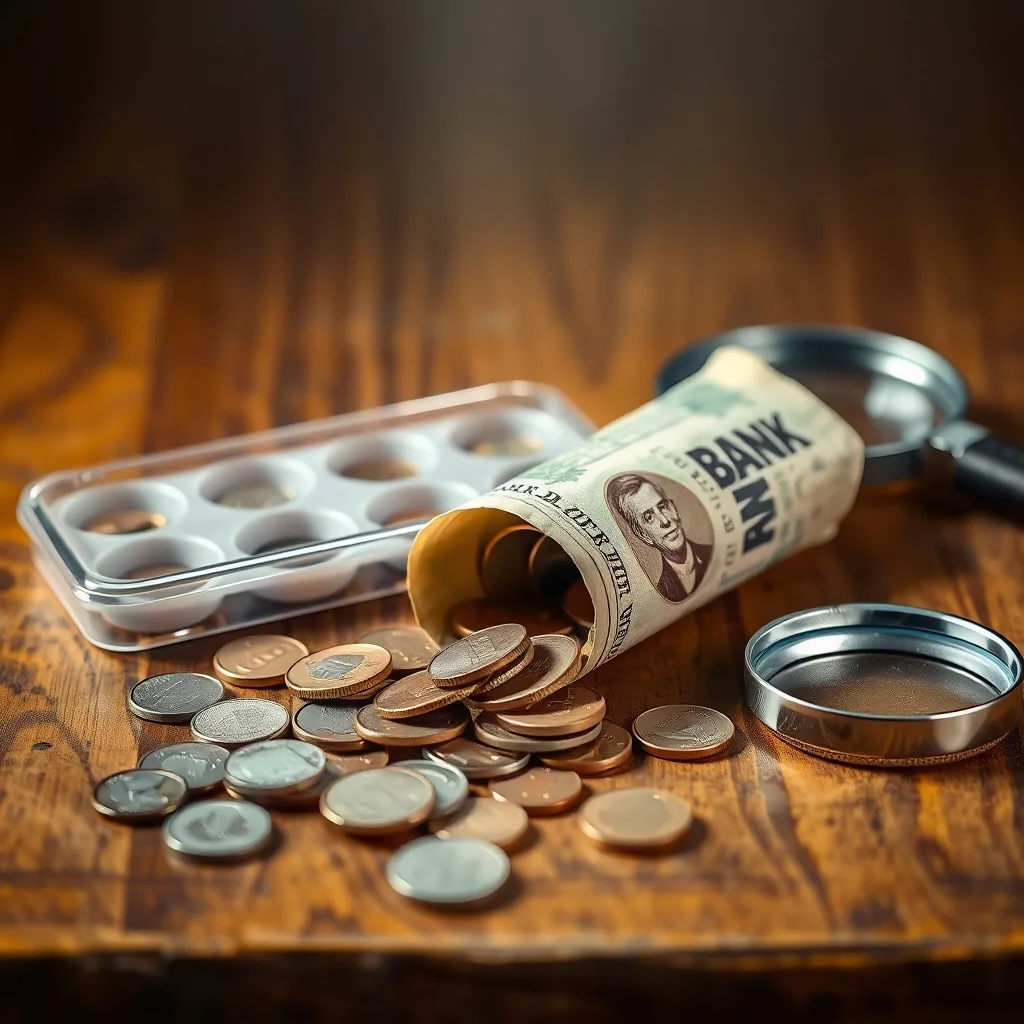
Sourcing penny rolls: bank-wrapped vs customer-wrapped
The most important distinction in roll hunting is between bank-machine-wrapped rolls and customer-wrapped rolls. It matters because it tells you the probability that the roll has been searched before.
Bank-machine-wrapped rolls
Bank machines count coins directly from the till and wrap them mechanically. The coins were never individually examined. These rolls are the most valuable for hunting because they are genuinely unsearched. You can identify them by the uniform paper wrapping, consistent color, and the printed denomination and issuing bank markings (often). The paper wrapping on bank-machine rolls tends to be a consistent taut wrap; hand-wrapping is often visible as slightly uneven tension.
Getting bank-wrapped rolls requires a relationship with a bank teller. Ask your local bank branch specifically for "teller rolls" or "bank-wrapped penny rolls" rather than "pennies." Some branches will order box lots ($25 face, 50 rolls) on request. The availability varies significantly by branch — some tellers will do this for regular customers; others won't. Credit unions are often easier to work with than large retail banks.
Customer-wrapped rolls
When customers bring in coin jars to deposit or exchange, banks often accept them in rolled form. These rolls may or may not have been searched before wrapping. There is no reliable way to tell from the outside. The best you can do is check the wrapping consistency and, once you open a few from a lot, look at the date distribution — an unusually clean set of dates (all 1990s, for example, with nothing older) suggests a previous searcher pulled the interesting dates.
Customer-wrapped rolls from online sellers (eBay, coin shows) should be assumed searched unless the seller specifically describes how they acquired the coins. The phrase "unsearched" on eBay is not a guarantee — it is a claim, and an unverifiable one. Factor the risk accordingly.
Regional patterns
Penny composition varies by region based on when coins entered circulation locally. Rolls from rural areas in the Midwest and South tend to have older average dates than rolls from high-turnover urban circulation. Older neighborhoods with older establishments (hardware stores, diners) are more likely to have decades-old coins still in their tills. This is anecdotal but widely reported among roll hunters — the theory is that high-velocity urban circulation has coins turning over faster and older dates being spent out faster.
What to search for: the main targets
Wheat cents (1909–1958)
The most commonly found "treasure" in a roll of mixed pennies. The coins have not been in general circulation for over 60 years, but they do still circulate occasionally and turn up in rolls, particularly from older coin stashes deposited to banks. Common-date wheat cents in circulated condition are worth a modest premium over face value — typically a few cents to about a dollar depending on date and condition. Key dates (1909-S VDB, 1914-D, 1931-S) command significant collector premiums and are very unlikely to be found in a roll without extraordinary luck, but not impossible.
The quick wheat check: look at the reverse. The wheat cent design has two wheat stalks flanking the central legends; the Lincoln Memorial reverse (1959–2008) and subsequent designs are immediately distinct. Once you know what both look like, a roll can be visually scanned very quickly by standing coins up on their edges and tilting them to see the reverse.
1943 steel cents
In 1943, the US Mint switched from copper to zinc-coated steel for pennies, freeing copper for wartime use. Steel cents are visually distinctive (silver-gray rather than copper-red or copper-brown). They are worth a modest premium in any condition; high-grade examples command more. They are occasionally found in rolls. A magnet test identifies them instantly — steel cents stick; copper and zinc cents don't.
1944 steel cent (rare)
A small number of leftover 1943 steel planchets were accidentally used in 1944, creating genuine 1944 steel cents. These are genuinely rare. If you find a silver-colored 1944 penny that sticks to a magnet, get it authenticated by PCGS or NGC before drawing conclusions. Most apparent 1944 steel cents are either cleaned copper coins (stripping removes the brown and gives a silver appearance), chrome-plated fakes, or 1944-S cents (which are copper). Weight helps: a genuine steel cent weighs 2.70 grams; a copper cent weighs 3.11 grams.
Doubled die errors
After the 1955 doubled die, other doubled die issues affect later dates. The 1969-S doubled die obverse is considered the second most prominent DDO in the Lincoln series — the doubling is dramatic on LIBERTY and the date. It is rare in roll circulation but has been found. The 1972 doubled die obverse is more accessible; the doubling is visible on the date, LIBERTY, and IN GOD WE TRUST. 1984 and 1995 DDOs also have collector markets. A 5x loupe is the minimum tool for hunting doubled dies.
Wide AM varieties (1992–1999)
Between 1992 and 1999, the Lincoln Memorial reverse underwent subtle design changes related to the spacing between the "A" and "M" in AMERICA. Regular business strike coins from 1993–1998 have Close AM (the letters nearly touching). But some coins from those years exist with Wide AM — a spacing variant more typical of proof coins that made it onto regular-strike business dies. These Wide AM varieties are collectible and command premiums because they are scarcer than the standard date.
The key Wide AM dates to look for are 1992 Close AM (rare — this year normally has Wide AM, so Close AM is the anomaly), 1998 Wide AM, 1999 Wide AM, and 2000 Wide AM. To check, hold the coin under magnification and look at the base of the "A" and "M" in AMERICA. Wide AM: clearly visible gap between the letters. Close AM: letters appear to nearly touch or actually touch at the base.
BIE varieties
BIE varieties are Lincoln cents with a small die chip that creates the appearance of an extra letter "I" between the "B" and "E" in LIBERTY. These occur across many dates when the die chips in that specific location. They are minor varieties collected by specialists; most trade for a modest premium (a few dollars to low tens of dollars) depending on how prominent the chip is and what date/mint the coin is from.
Off-center strikes and other minting errors
Off-center strikes occur when a planchet is not properly centered in the collar during striking. The result is a coin with part of the design missing and a corresponding area of plain unstruck metal. Value depends on the percentage off-center: 5% off-center is minor; 50% off-center (where half the design is visible and the date is still present) can be worth tens of dollars. Broadstrikes (struck without the collar, producing an oversized spread design), doubled strikes, and rotated die errors are also found occasionally in roll hunting — less frequently than doubled dies but not rare over thousands of rolls.
The pre-1982 copper sorting play
US pennies minted before 1982 (with a few 1982 exceptions) are 95% copper and 5% zinc/tin alloy. Post-1982 pennies are a zinc core with copper plating (97.5% zinc, 2.5% copper). The weight difference is measurable:
| Type | Composition | Weight |
|---|---|---|
| Pre-1982 (copper) | 95% Cu, 5% Zn/Sn | 3.11 grams |
| Post-1982 (zinc) | 97.5% Zn, 2.5% Cu | 2.50 grams |
| 1982 transition year | Both types minted | 3.11g or 2.50g |
The copper melt value of a pre-1982 cent is, at typical copper prices, above face value. However, melting US coins is illegal under 31 U.S.C. § 5111(d). The sorting play is not about melting — it is about accumulating copper cents in the anticipation that either (a) the law changes, (b) the coins have collector value as copper cents once the denomination is discontinued, or (c) inflation erodes the dollar enough that 1-cent copper content trades at a premium for numismatic/historical reasons.
Identifying pre-1982 cents from post-1982 cents can be done by:
- Date: 1981 and earlier = copper. 1983 and later = zinc. 1982 = either (weigh or check the density).
- Weight: 3.11g vs 2.50g is easily distinguishable on a gram scale.
- Sound: Drop a copper cent on a hard surface and then a zinc cent. Zinc has a noticeably duller, lower-pitched ring. Copper has a clearer, higher pitch. Once you hear both side by side, the difference is obvious.
- Edge: Look at the edge of a 1982 cent. Zinc cents show a uniform copper color on the edge; if you see a distinctive layered look (copper plating over a different-colored core), it's zinc. Pre-1982 copper cents have a uniform copper edge.
Tools for roll hunting
- A jeweler's loupe (5x minimum, 10x better) for mint marks, doubled dies, and variety checking
- A gram-accurate digital scale (0.01g resolution) for the 1982 copper/zinc distinction and for error coin weights
- A strong neodymium magnet for the 1943 steel cent check
- Reference images for Wide AM varieties and major doubled dies — print or save these before you sort
- Coin tubes for storing keepers (copper tubes for wheat cents, plastic flips for errors)
Managing expectations
Roll hunting is a low-expected-value activity if your goal is profit. The realistic outcome of most rolls is face value (you deposit back what you pulled out after keeping a handful of wheat cents). The finding of a genuine error or key date is the exception, not the rule. Most roll hunters do it for the process — the scan of each coin, the occasional discovery of a 1940s wheat cent, the slim chance of a Wide AM — rather than as a systematic profit strategy.
What roll hunting is genuinely good for: building a circulated date set of Lincoln Memorial cents inexpensively, finding wheat cents at face value rather than paying coin shop premiums, and occasionally, in a lifetime of hunting, finding something genuinely remarkable. The base cost is face value. That's a reasonable bet.
Roll hunting searches on eBay
 Penny rolls unsearched
Mixed-date rolls. "Unsearched" is a claim — price accordingly.
Penny rolls unsearched
Mixed-date rolls. "Unsearched" is a claim — price accordingly.
 Wheat cent rolls
Rolls of 1909–1958 wheat cents for collectors and hunters.
Wheat cent rolls
Rolls of 1909–1958 wheat cents for collectors and hunters.
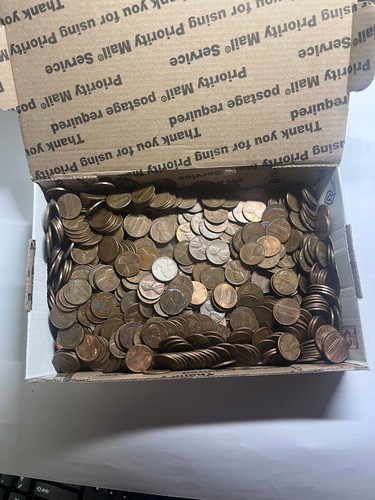 Copper pennies bulk lot
Pre-1982 copper cents already sorted. Saves sorting time.
Copper pennies bulk lot
Pre-1982 copper cents already sorted. Saves sorting time.
 Error pennies lot
Off-center, doubled dies, broadstrikes. Useful for studying types before you know what you're looking for in a roll.
Error pennies lot
Off-center, doubled dies, broadstrikes. Useful for studying types before you know what you're looking for in a roll.