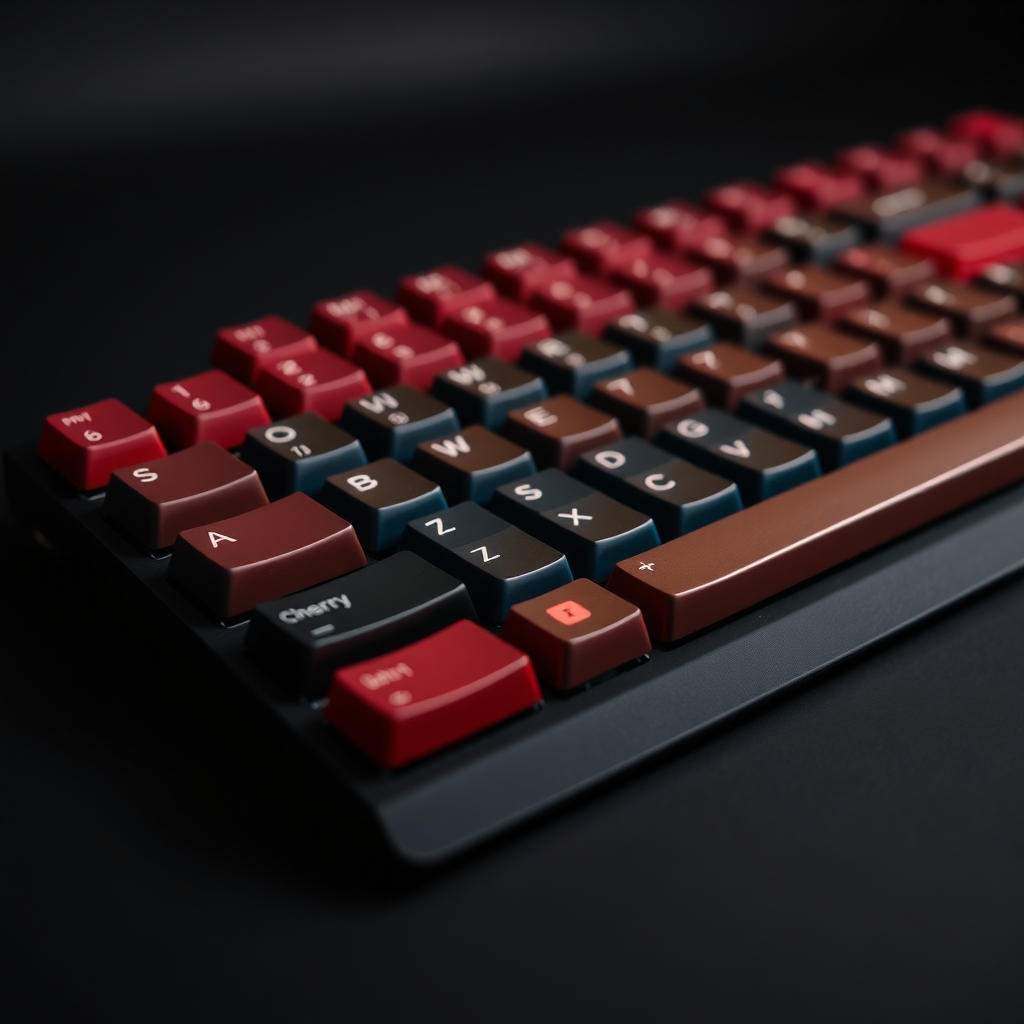
The three families: linear, tactile, clicky
Every mechanical keyboard switch falls into one of three categories based on how the actuation event is communicated to your fingers. Linear switches travel smoothly from top to bottom with no feedback bump — the resistance is the same throughout the entire stroke. Tactile switches produce a physical bump at or near the actuation point, letting you feel when the keystroke has registered without pressing the key to the bottom. Clicky switches produce both the tactile bump and an audible click, usually via a click jacket or click bar mechanism that creates a sharp snap.
The right category depends on use: typists who want typing confirmation without noise usually gravitate toward tactile; gamers who want fast, consistent actuation with no travel interruption tend to prefer linear; people who want sound feedback (and are in a location where that is acceptable) go for clicky. The marketing language around "perfect for gaming" or "ideal for typing" is largely noise — what matters is the spec sheet.
Cherry MX: the reference benchmark
Cherry GmbH has been making MX-series switches since 1984. They remain the industry baseline against which every other switch is measured, even though many competitors now match or exceed them in smoothness and value. The MX stem is a cross-shaped plus sign that became the standard mounting format used across the industry.
| Switch | Type | Actuation | Pre-travel | Total travel |
|---|---|---|---|---|
| MX Red | Linear | 45 g | 2.0 mm | 4.0 mm |
| MX Brown | Tactile | 45 g | 2.0 mm | 4.0 mm |
| MX Blue | Clicky | 50 g | 2.2 mm | 4.0 mm |
| MX Silent Red | Linear (dampened) | 45 g | 1.9 mm | 3.7 mm |
| MX Speed Silver | Linear | 45 g | 1.2 mm | 3.4 mm |
The MX Red is the most-sold switch Cherry makes. 45 g actuation, perfectly linear, 4 mm total travel. It works well for both typing and gaming. The stem has a small degree of stem wobble that enthusiasts complain about, but most users never notice it in practice.
The MX Brown is often criticized as the "worst of both worlds" — the tactile bump is subtle enough that many typists don't feel it reliably, but it's present enough to disrupt smooth gaming keystrokes. That reputation is somewhat earned. If you want tactile feedback, there are switches (Holy Pandas, Topre) that deliver a far more pronounced bump. The Brown exists as a compromise that satisfies many office users.
The MX Blue produces its click via a click jacket — a separate plastic piece around the stem that snaps against the housing when the key actuates. The click itself occurs at 2.2 mm pre-travel; bottom-out is at 4 mm. The Blue is loud (approximately 60–65 dB in open air) and its click mechanism adds slight spring in the actuation feel.
The MX Silent Red uses rubber dampening pads on the stem legs to absorb the bottom-out and up-stroke impact. The result is a softer thud rather than a hard clack. Actuation force is unchanged at 45 g; total travel shortens slightly to 3.7 mm because the dampening pads compress before the stem reaches the housing floor. Offices and shared spaces make this the practical choice.
The MX Speed Silver is Cherry's response to gaming keyboards marketed on "fastest actuation." Pre-travel drops to 1.2 mm versus 2.0 mm on the Red, meaning registration happens much earlier in the keystroke. Total travel is 3.4 mm. Whether this translates to measurable gaming advantage is debatable — most professional gaming research points to reaction time, monitor latency, and input lag dwarfing the 0.8 mm pre-travel difference.
Gateron: smoother stems, lower price
Gateron's MX-format switches use the same cross-mount system and are broadly compatible with Cherry-compatible keyboards. The key difference is manufacturing smoothness: Gateron's nylon housings and POM stems produce a noticeably less scratchy linear feel than stock Cherry MX, without any lubing. The community consensus that Gateron linears are smoother out-of-box than Cherry linears is well-established and verified across thousands of comparison reviews.
Gateron Yellow
The Yellow is Gateron's lightest linear: 35 g actuation force, 2.0 mm pre-travel, 4.0 mm total travel. The reduced weight makes it fast to bottom out with minimal effort — popular with gamers who want a feather-light press. The trade-off is accidental actuation when resting fingers on keys. For touch typists who hover, this is not an issue; for those who rest their fingers, 35 g can register unintentionally.
Gateron Black Ink
The Black Ink series uses an ink-black smoky housing combined with a different nylon formulation that Gateron claims reduces friction further than their standard switches. Actuation force is 60 g — the heaviest Gateron linear — which makes them satisfying for heavy typists who want firm pushback without switching to tactile. Pre-travel 2.0 mm, total travel 4.0 mm. The Black Ink V2 corrected a spring ping issue present in V1.
Gateron Oil King
The Oil King comes factory pre-lubed with Gateron's proprietary lubricant applied to the stem legs. Actuation force is approximately 37 g — slightly heavier than Yellow, significantly lighter than Black Ink. The factory lube is applied conservatively and consistently, producing a buttery linear feel that most users would previously have achieved only by hand-lubing a set themselves. Pre-travel 2.0 mm, total travel 4.0 mm. For buyers who want the lubed feel without the 4–6 hours of work, the Oil King is the practical choice.
Kailh Box switches: water resistance and click bars
Kailh Box switches use an IP56 water-resistance rating achieved through a box-shaped housing that surrounds and seals the stem contact area. Standard MX switches are open on the sides; Kailh Box switches enclose the electrical contact inside a sealed box, preventing dust and liquid ingress. The stems use a square cross-shape inside the box rather than the MX plus-sign.
The click mechanism on Box White, Box Jade, and Box Navy uses a click bar rather than a click jacket. A click bar is a metal leaf spring that snaps on both the down-stroke and the up-stroke, producing two distinct clicks per keypress. This double-click characteristic (one going down, one coming up) is distinctive and divides opinion. The click bar also produces a sharper, crisper sound than a click jacket — closer to an Alps-style click than a Cherry Blue.
Box Brown and Box Red follow the same sealed housing principle with tactile and linear characteristics respectively. For keyboards used near liquids, in dusty workshops, or by people who eat near their keyboard, the Box series is a pragmatic choice.
Holy Pandas and other boutique tactiles
The Holy Panda is a Frankenstein switch: it combines the stem from a Halo True or Halo Clear switch (produced by Input Club) with the housing from an Invyr Panda switch (originally a limited-run board accessory). The result is one of the most pronounced tactile bumps available in a standard MX-format switch — a sharp, early, high-bump tactile that enthusiasts describe as "thocky and poppy." Actuation force runs approximately 67 g at the tactile bump peak.
Drop (formerly Massdrop) now licenses the Holy Panda design and produces them as the Drop Holy Pandas — functionally identical to the original combination and substantially easier to source than hunting for vintage Invyr Panda housings. They are priced at a premium reflecting the boutique origin, typically $1.00–$1.25 per switch versus $0.25–$0.40 for Cherry or Gateron.
Topre: electrocapacitive, not mechanical
Topre switches are technically not mechanical switches — they use an electrocapacitive sensing mechanism with a conical coil spring beneath a rubber dome rather than metal contacts. The keystroke feel is a combination of the rubber dome's initial soft resistance, followed by the spring's bottom-out. The result is described as a smooth, rounded bump that dissipates into a soft landing — quite unlike the sharp MX-format tactile bump.
Topre switches are available in 35 g, 45 g, and 55 g variants (measured at the dome compression point). Realforce keyboards from Topre Corporation and Happy Hacking Keyboard (HHKB) are the primary retail vehicles for Topre. They command significant price premiums — Realforce boards often run $200–$350 — reflecting lower production volumes and the premium build quality of the boards themselves.
Topre is not compatible with standard MX-format keycaps without an adapter. The stem profile is different, and keycap compatibility is a real constraint for anyone who wants to run custom keycap sets.
Alps SKCM: vintage tactile reference
Alps Electric Company produced SKCM-series switches from the mid-1980s into the 1990s, and they remain sought-after by vintage keyboard collectors. The SKCM Orange and SKCM Cream variants produce a sharp, papery tactile click that many describe as the most satisfying tactile feel of any switch ever produced. The SKCM White and SKCM Salmon are lighter-tactile variants.
Alps switches are not practical for new builds: they require Alps-compatible keycaps (the stem mount is entirely different from MX format), the boards that use them are decades old and increasingly worn, and replacement switch stock is limited to new-old-stock finds and desoldered pulls from donor boards. The primary audience is collectors who restore classic boards — Apple IIe keyboards, AEK64, and early Macintosh keyboards — not people building new custom keyboards.
Hot-swap versus soldered PCB
A hot-swap PCB uses spring-loaded sockets (Kailh hot-swap sockets are the most common type) that grip switch pins mechanically, allowing switches to be pulled and replaced without a soldering iron. The practical consequence is significant: you can change your switch choice entirely after building the board, try multiple types over the life of the keyboard, and replace a failed switch in under a minute.
Soldered PCBs offer one advantage: the switch-to-PCB connection is more mechanically robust and can produce a slightly tighter feel, since there is no socket flex between the switch and board. Custom keyboard builders who have decided exactly what switch they want sometimes prefer soldered for this reason. In practice the difference is negligible for most users.
The hot-swap socket has a rated cycle life — Kailh sockets are typically rated to 100 insertions. This means if you are swapping switches monthly you could, in theory, wear out a socket. In practice, most users do not swap switches frequently enough for this to become an issue. If you are new to the hobby and genuinely unsure which switch you will prefer, hot-swap is the obvious choice.
Stabilizer types: plate-mount versus PCB-mount
Stabilizers (stabs) hold the wide keys — spacebar, left shift, backspace, enter — steady by connecting both ends to a central wire. Without stabilizers, wide keys rock or feel uneven under finger pressure. Stabilizer quality has an outsized effect on typing feel because most keystrokes on a full-size board hit stab keys frequently.
Plate-mount stabilizers clip onto the plate (the metal or polycarbonate layer that switches mount into before the PCB). They are generally less expensive and easier to install. The downside is that plate tolerances vary, and loose-fitting plate stabs can rattle noticeably. Most prebuilt keyboards use plate-mount stabilizers.
PCB-mount stabilizers screw or snap directly to the PCB. The screw-in variety (used by Durock, TX, and C3 Equalz stabs) provide a stable, rattle-free mount when properly installed and lubed. Custom keyboard builders overwhelmingly use PCB-mount screw-in stabilizers because the rattle reduction is substantial.
Both types use either a Cherry-style wire (bent at the ends, hooks into the stabilizer housing) or a Costar-style wire (a different retention mechanism used by some vintage boards). Cherry-style is the current standard; Costar stabs are found on older keyboards and are harder to lube correctly.
Stabilizer preparation — lubing the housing interior, the stem legs, and the wire — is as important as switch choice in determining how a keyboard sounds and feels. An unlubed stabilizer on a high-end board will sound worse than a well-lubed stabilizer on a budget board.
Search eBay for keyboards and switches
 Keychron Q1
Aluminum hot-swap 75% board. Good platform for trying different switch types.
 Drop CTRL high-profile
TKL hot-swap board with per-key RGB. Aluminum case, good build quality.
 Cherry MX switches lot
Red, Brown, Blue, Speed Silver. Search "lot" for bulk quantities at lower per-switch cost.
 GMK custom keycap set
Double-shot ABS, Cherry profile. Secondary market for group buy sets.
 Vintage IBM Model M
Buckling spring switches. The reference for tactile-clicky feel, circa 1984–1996.