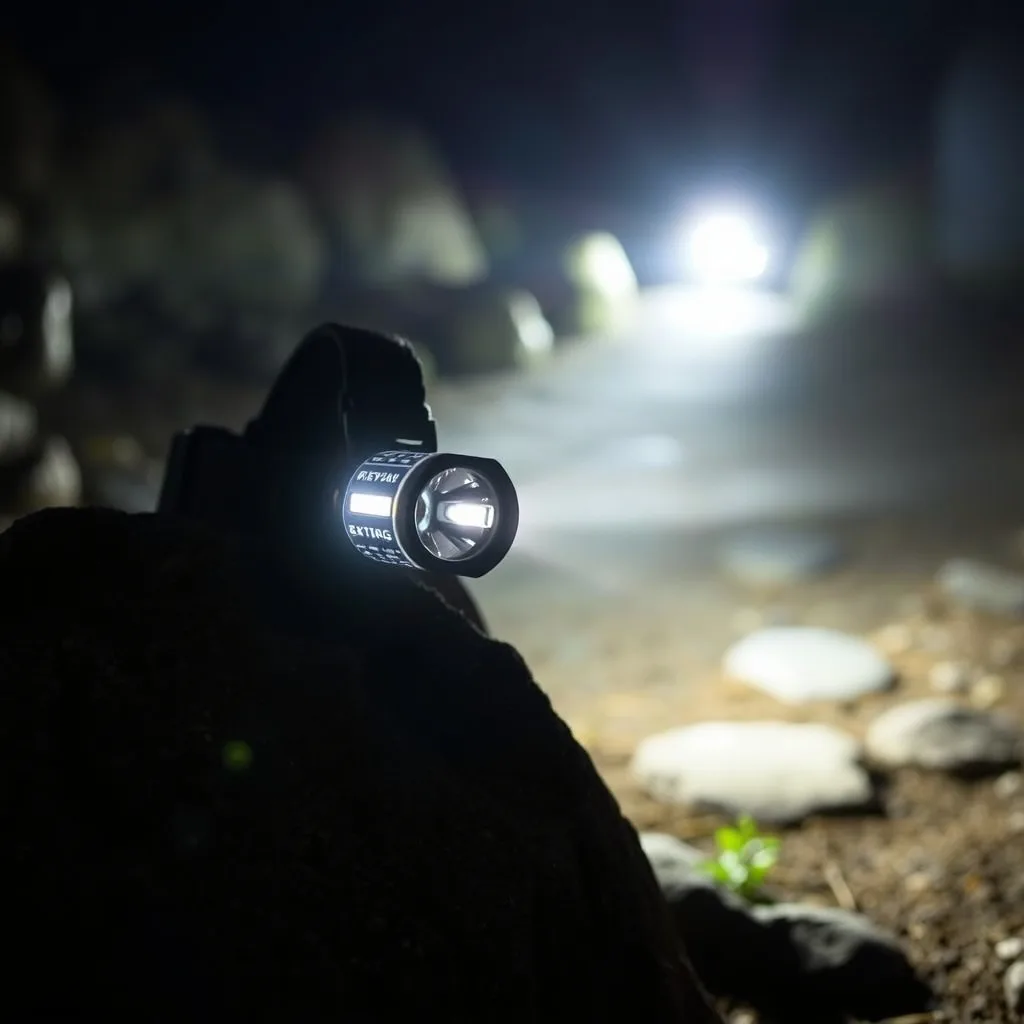
Lumens: peak vs regulated output
Lumens measure total light output — a useful starting point but a poor final answer. The problem is that most headlamps advertise peak lumens, which is the maximum output for the first few seconds or minutes before the lamp steps down to a lower, sustained level. This step-down happens for two reasons: thermal management (LEDs generate heat and must be limited to prevent damage) and battery management (sustained high output would drain most batteries in 30–90 minutes).
Regulated output headlamps maintain consistent brightness throughout the battery life until a final drop near empty. Non-regulated headlamps gradually dim as the battery drains, starting at peak output and declining from there. Regulated output is meaningfully better for night hiking, reading, and any use where consistent light matters.
Practical lumen benchmarks
- 50–100 lumens: Camp tasks close up, reading in a tent, walking on well-lit paths. Most people operate here 80% of the time.
- 150–300 lumens: General trail walking, campsite navigation, most backpacking use. The sweet spot for runtime vs brightness for most campers.
- 400–700 lumens: Trail running, technical terrain, longer beam distance needed for navigation at speed. Runtime starts dropping into the 2–5 hour range at this level.
- 800–1500+ lumens: Search and rescue, caving, technical mountaineering. Rarely needed for recreational camping; high heat and short runtime on max mode.
Beam distance and beam angle: throw vs flood
Spot (throw) beam
A tight, focused spot beam throws light far ahead — 80–200+ meters for high-powered headlamps. Useful for trail running at pace, navigating technical terrain where you need to see obstacles at distance, and search use. The narrow beam creates harsh shadows close-in and makes campsite tasks like cooking and reading uncomfortable. Spot beams are optimized for speed and distance, not proximity.
Flood (wide) beam
A wide flood beam spreads light across a broad area close to the user. Excellent for campsite use, cooking, reading, and close-up technical work. Poor for seeing trail obstacles at distance — the light is dispersed rather than concentrated. Wide flood headlamps are more comfortable to wear in proximity to others because they don't hit other people's eyes as directly.
Hybrid / adjustable beams
Many quality headlamps offer both a reflector (for throw) and a flood LED, switchable via mode button. Others use a sliding lens or physical reflector adjustment to shift from spot to flood. This flexibility makes them genuinely more useful across different situations than pure spot or flood designs.
Shopping for headlamps? Browse current eBay listings → (we earn a small commission; your price is unchanged).
Battery: rechargeable vs AAA
Rechargeable (internal lithium battery)
USB-C rechargeable headlamps with internal lithium batteries are the most convenient option for most users. Charge before a trip with any USB charger or power bank; no need to carry spare batteries. Runtime is typically similar to AAA alkaline for equivalent output.
The limitations: you can't swap in fresh batteries in the field if you run out with no charging option. In very cold temperatures (below 10°F/-12°C), lithium-ion batteries lose capacity significantly faster than alkaline batteries — sometimes 30–50% capacity reduction at extreme cold. For multi-day trips in sustained cold without power bank access, a headlamp that accepts AAA lithium batteries offers better field reliability.
AAA (alkaline or lithium)
AAA headlamps allow you to carry spare batteries and swap them in the field — a meaningful advantage on extended backcountry trips without charging access. AAA alkaline batteries also maintain better capacity than lithium-ion in sustained cold (below 20°F/-7°C). AAA lithium batteries (not alkaline — the Energizer and Energizer Ultimate Lithium in AAA size) are the best cold-weather battery choice and are significantly lighter than alkaline.
The trade-off is ongoing cost and environmental impact of disposable batteries for frequent users.
Hybrid designs
Some headlamps (notably several Black Diamond and Petzl models) accept both a proprietary rechargeable battery pack and standard AAA batteries. This is arguably the most flexible design for backcountry use — recharge when you have power, swap AAA when you don't.
Red light: when it matters and UI considerations
Red light has two primary use cases:
- Night vision preservation — the human eye's rhodopsin (night-vision pigment) is not sensitive to red wavelengths. Using red light preserves dark adaptation, allowing you to see effectively in low ambient light after the headlamp is off. Essential for stargazing and useful any time you want to maintain situational awareness in darkness.
- Not blinding others — red light is significantly less disruptive to people nearby at camp. If you're moving through a shared campsite at night, red mode prevents blinding tentmates and neighbors.
The UI issue with red light: on many headlamps, cycling from off to red requires pressing through white modes first, or using a specific button sequence. If you'll use red light frequently, test the mode switching before buying. The best designs put red on an easily accessible separate switch or make it the first press from off.
IPX waterproofing ratings
IPX ratings describe water resistance; the "X" indicates that dust-resistance is not rated. For headlamps specifically:
| IPX rating | Protection level | Appropriate for |
|---|---|---|
| IPX4 | Splash resistant from any direction | Light rain; not appropriate for heavy rain or submersion |
| IPX5 | Water jet resistant (limited pressure) | Heavy rain; not for submersion |
| IPX6 | Powerful water jet resistant | Heavy sustained rain and splashing |
| IPX7 | Submersion to 1 meter for 30 minutes | Rain, stream crossing; temporary submersion |
| IPX8 | Submersion beyond 1 meter | Diving, extended submersion; uncommon in headlamps |
For most camping and backpacking use, IPX4 is adequate for rain protection. If you're paddling, running rivers, or camping in sustained heavy precipitation, IPX6 or IPX7 provides meaningful additional protection.
Weight and headband design
Headlamp weight ranges from under 1 oz (ultralight single-LED designs) to 5+ oz (high-output models with large battery packs). For backpacking, weight matters; for car camping, it doesn't. More important for comfort is headband design:
- Single elastic band — the lightest and simplest; tends to slip on smooth hair
- Top strap + main band — better stability for running and technical use; more comfortable for extended wear
- Silicone grip strips — prevents slipping on the main band without adding weight
Tilt range on the headlamp housing matters for reading in a tent or working with your hands on a surface in front of you. Look for at least 50–60 degrees of tilt adjustment to point the beam downward when needed.
Common mistakes
- Buying based on peak lumens without checking runtime at medium output — the number you'll actually use
- Choosing a spot-only beam for campsite use — flood beam is far more comfortable for close-up tasks
- Ignoring battery swappability for extended backcountry trips without charging access
- Buying an IPX4 headlamp for paddling or sustained rain — step up to IPX6 or IPX7 for wet environments
- Not testing red light mode accessibility before a trip where you'll need it frequently
- Underestimating battery drain at cold temperatures with lithium-ion designs
Find headlamps on eBay
We earn a small commission on qualifying sales; your price is unchanged. Full disclosure.
 Rechargeable headlamp
USB-C charging; no spare batteries needed; check cold-weather rating.
View on eBay →
Rechargeable headlamp
USB-C charging; no spare batteries needed; check cold-weather rating.
View on eBay →
 LED headlamp
Multiple modes; look for regulated output and accessible mode cycling.
View on eBay →
LED headlamp
Multiple modes; look for regulated output and accessible mode cycling.
View on eBay →
 Bright headlamp
500+ lumens with spot throw; check beam distance in meters, not just lumens.
View on eBay →
Bright headlamp
500+ lumens with spot throw; check beam distance in meters, not just lumens.
View on eBay →
 Headlamp camping
200–500 lumens; wide flood preferred for campsite tasks and reading.
View on eBay →
Headlamp camping
200–500 lumens; wide flood preferred for campsite tasks and reading.
View on eBay →
 Headlamp with red light
Night vision + courtesy mode; check that red is easily accessible in UI.
View on eBay →
Headlamp with red light
Night vision + courtesy mode; check that red is easily accessible in UI.
View on eBay →