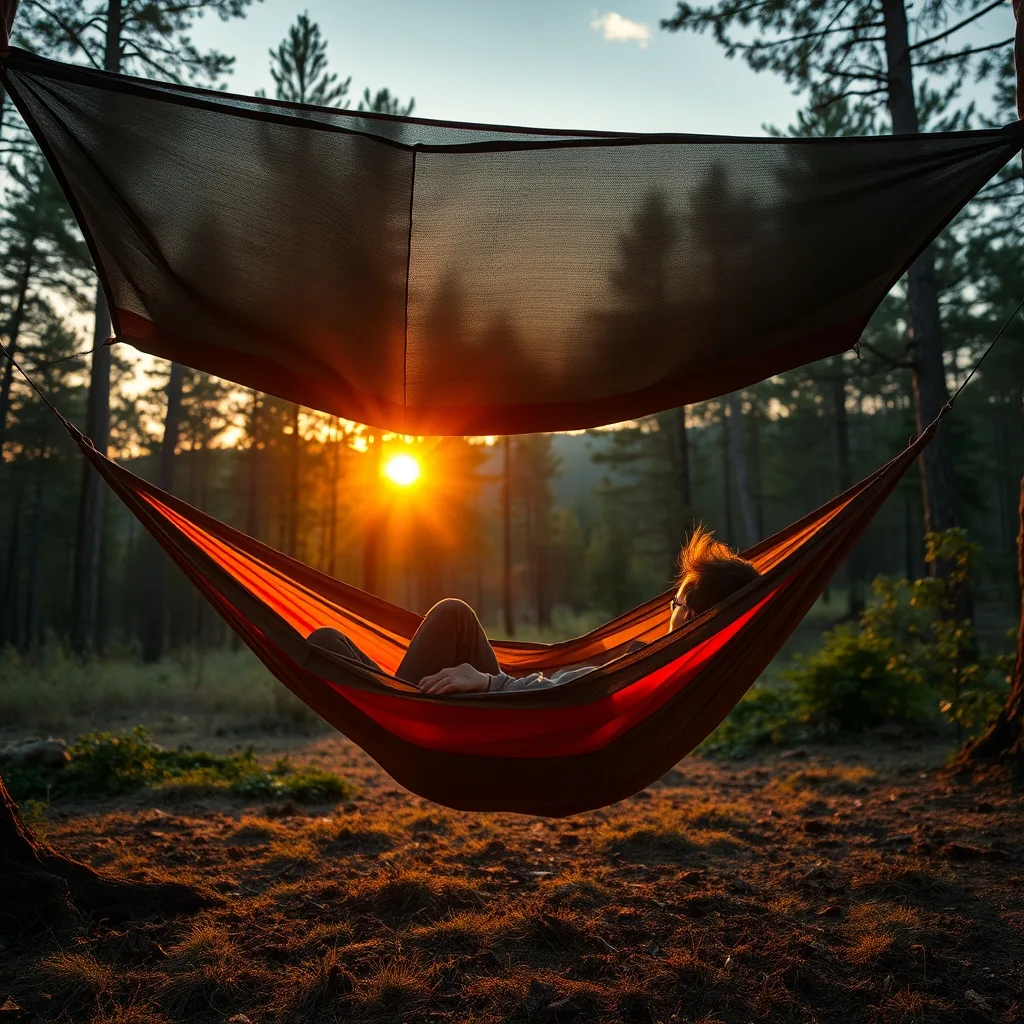
The cold-butt problem and why it's not optional
When you lie in a gathered-end hammock, your body weight compresses whatever insulation is beneath you. A sleeping bag rated to 30°F has that rating because the down or synthetic fill lofts to a certain height and traps a layer of air. In a hammock, the fill beneath you is compressed flat under your body weight and provides almost zero insulation. The effective sleeping temperature of most sleeping bags in a hammock without an underquilt is 15–20°F higher than the bag's rating — a 30°F bag might keep you comfortable only to 45–50°F in a hammock.
This is not a minor adjustment. It's the fundamental thermal difference between ground sleeping and hammock sleeping, and it's why experienced hammock campers consider an underquilt non-negotiable for any night below about 55°F.
An underquilt hangs beneath the hammock body, insulating from below without being compressed by your weight. It's essentially a sleeping bag designed to hang below rather than envelop you from inside. Properly adjusted — snug enough to eliminate cold air gaps, loose enough not to compress the loft — an underquilt restores the effective temperature rating of your sleep system.
Gathered-end vs bridge design
Almost all hammocks sold to the camping market are gathered-end: both ends of a rectangular piece of fabric are gathered into a bundle and attached to suspension. When you lie in a gathered-end hammock along the centerline, you're in a slight banana curve — your body curves with the hammock's sag. This is uncomfortable for side sleepers and for anyone with back issues, because the forced curve puts pressure on the lumbar.
The solution most hammock campers discover is the diagonal lay: you shift your body so your head is toward one end at an angle of roughly 20–30 degrees from the centerline. At this angle, the hammock bed is flatter because you're not trying to lie along the deepest part of the curve. A wide hammock (ENO DoubleNest at 63 inches wide, Warbonnet Blackbird at 64+ inches) gives you more room for a diagonal lay than a narrow recreational hammock.
Bridge hammocks (Kammock, Clark Jungle Hammock, some Warbonnet designs) use a spreader bar or ridgeline system at each end to hold the fabric taut in a flat position, eliminating the banana curve and enabling a flat centerline lie. Bridge designs are heavier (the spreader bar or ridgeline adds weight) but solve the diagonal-lay requirement. Some campers strongly prefer them; others find the diagonal gather-end lay comfortable enough that they never bother.
The 30-degree hang rule
The standard recommendation for gathered-end hammock suspension is to hang the straps at approximately 30 degrees below horizontal — a 30-degree angle from the tree to the hammock attachment point. At 30 degrees, the hammock body has enough sag to allow a flat diagonal lay while the strap tension remains manageable.
At flatter angles (straps closer to horizontal), tension on the straps and anchors increases dramatically — a physics consequence of the force vector. At 0 degrees (perfectly horizontal), theoretical strap tension would be infinite. At 30 degrees, tension in each strap is roughly twice the weight in the hammock. At 45 degrees, it's about 1.4 times. This matters for tree straps and anchor points, and it's why hammock manufacturers specify minimum strap width for tree contact (typically 0.75 to 1 inch to avoid bark damage).
The practical hang: with trees about 15 feet apart and straps at 30 degrees, your hammock body will hang with about 18–24 inches of sag in the center. That's the target. A structural ridgeline — a fixed-length cord connecting the two ends of the hammock body — is a useful addition to set consistent sag regardless of tree spacing.
ENO DoubleNest: the entry point
Eagles Nest Outfitters (ENO) makes the most widely distributed camping hammocks in North America. The DoubleNest is their large-format model: 63 × 94 inches, approximately 25 oz, rated to 400 lbs. The polyester ripstop nylon is durable without being ultralight.
The DoubleNest is a capable gathered-end hammock for recreational and car-camping use, and it works for backpacking at its weight. It doesn't include suspension straps — ENO sells their Atlas or Helios straps separately. The Helios at ~3.5 oz are the ultralight option; the Atlas at ~12 oz are burlier and more durable for frequent use.
ENO's bug net, the Guardian, attaches to the ridgeline and wraps the hammock body. It works, but it's a separate purchase. For a complete bug-protected system from ENO, you're buying the hammock + bug net + straps separately, which adds up.
Warbonnet Blackbird: integrated features at a price step
Warbonnet Outdoors, a small cottage manufacturer based in Colorado, makes the Blackbird — a gathered-end hammock with an integrated bug net built into the body and a structural ridgeline included. The XLC version is longer and wider than the standard, designed for taller or larger campers. The Blackbird also includes a gear channel sewn into the hammock body — a horizontal pocket at mid-hammock that you can use for a sleeping pad if you choose that route instead of an underquilt.
The integrated bug net changes the setup experience significantly: no separate net purchase, no fidgeting with a separate net attachment. The zipper entry opens easily in the dark. The structural ridgeline included with the Blackbird means consistent sag from first night, without having to measure or eyeball the hang.
Warbonnet is a cottage manufacturer with relatively long lead times — expect 2–4 weeks for new orders. The secondary market is active. The Blackbird is noticeably more expensive than an ENO DoubleNest; the integrated bug net and ridgeline arguably account for most of the difference.
Dutchware Chameleon: modular system
Dutchware Gear makes the Chameleon — a gathered-end hammock body built with a zipper track that accepts interchangeable components: bug nets, tarps, and door panels that attach directly. The design philosophy is "one hammock body, multiple configurations" — you configure it for summer (body + bug net, no tarp), spring/fall (body + bug net + tarp), or rain (closed tarp doors).
The Chameleon's modular approach makes sense for campers who want to avoid carrying components they don't need. A July High Sierra trip with no bugs in sight: leave the bug net home. A humid Southeast summer: full bug net and tarp. The zipper track is the key component, and it holds up well in typical use.
Dutchware also makes suspension hardware — the popular Whoopie slings and Beetle Buckle systems — that many hammock campers use regardless of what hammock brand they own. The adjustability of Whoopie slings (an adjustable loop made from Dyneema) makes fine-tuning sag easier than fixed-length straps.
Suspension systems: straps, Whoopie slings, and weight
Tree straps are the part most beginners underestimate. The strap attaches to the tree and must be wide enough to avoid bark damage (Leave No Trace standards generally require a minimum 0.75-inch width, though many land management areas require 1-inch or wider — verify the rules for your specific area). Webbing straps are the standard; Dyneema straps are lighter but more expensive.
From the tree strap you need to connect to the hammock, typically with a carabiner or a cinch system. The length of the system between strap and hammock determines your final hang height and angle. Whoopie slings (adjustable Dyneema loops) allow infinite adjustment without unknotting; they're popular for good reason.
Total suspension weight for a gram-counted setup: tree straps at 0.5–1 oz each (lightweight webbing) + Whoopie slings at ~0.7 oz each adds roughly 2–4 oz total suspension. ENO Atlas straps are ~12 oz for the pair — heavy but durable.
Underquilt vs sleeping pad
Some hammock campers use a closed-cell foam sleeping pad or an inflatable pad inside the hammock rather than an underquilt. This works — the pad doesn't compress the way down does, so a foam pad provides reasonable insulation from below. The trade-off: a pad inside a gathered-end hammock shifts around during the night and is difficult to keep positioned. It also limits diagonal-lay comfort since the pad creates a rigid surface beneath you.
An underquilt solves both problems: it hangs beneath the hammock body, doesn't shift, and doesn't interfere with body position. Down underquilts from Hammock Gear (Burrow), Enlightened Equipment, and similar cottage makers are typically rated by comfort temperature similar to sleeping bags. For three-season use (down to ~35–40°F), a 40°F underquilt is adequate. For colder conditions, size down to 20°F or layer a closed-cell pad inside in addition to the underquilt.
The honest three-season hammock kit
For a first hammock camping setup that will handle three-season use down to 35–40°F: ENO DoubleNest or Warbonnet Blackbird (with integrated bug net) + ENO Helios or Dutchware straps + a down underquilt rated to 40°F or lower + a tarp (ENO ProFly or a DCF tarp at 10–12 oz). Total system weight is typically 2–3 lbs for the hammock, suspension, bug net, and tarp — without the underquilt, which adds 12–18 oz.
The total hammock system is comparable in weight to a quality ultralight tent. Its advantage is comfort (many hammock campers sleep better suspended), ability to set up on uneven or rocky terrain, and no ground preparation. Its disadvantage is tree dependence, the insulation complexity, and initial setup learning curve.
Search eBay for hammock camping gear
 ENO DoubleNest
Entry to intermediate gathered-end. Check that bug net and straps are included if listed as bundle.
Warbonnet Blackbird XLC
Integrated bug net + ridgeline. Verify size (XLC vs standard) and condition of zipper entry.
ENO DoubleNest
Entry to intermediate gathered-end. Check that bug net and straps are included if listed as bundle.
Warbonnet Blackbird XLC
Integrated bug net + ridgeline. Verify size (XLC vs standard) and condition of zipper entry.
 Hammock Gear Burrow underquilt
Down underquilt rated to 20°F or 40°F. Check fill power and temperature rating in listing.
Dutchware Chameleon
Modular system. Verify which accessories (bug net, tarp) are included with the hammock body.
Hammock Gear Burrow underquilt
Down underquilt rated to 20°F or 40°F. Check fill power and temperature rating in listing.
Dutchware Chameleon
Modular system. Verify which accessories (bug net, tarp) are included with the hammock body.