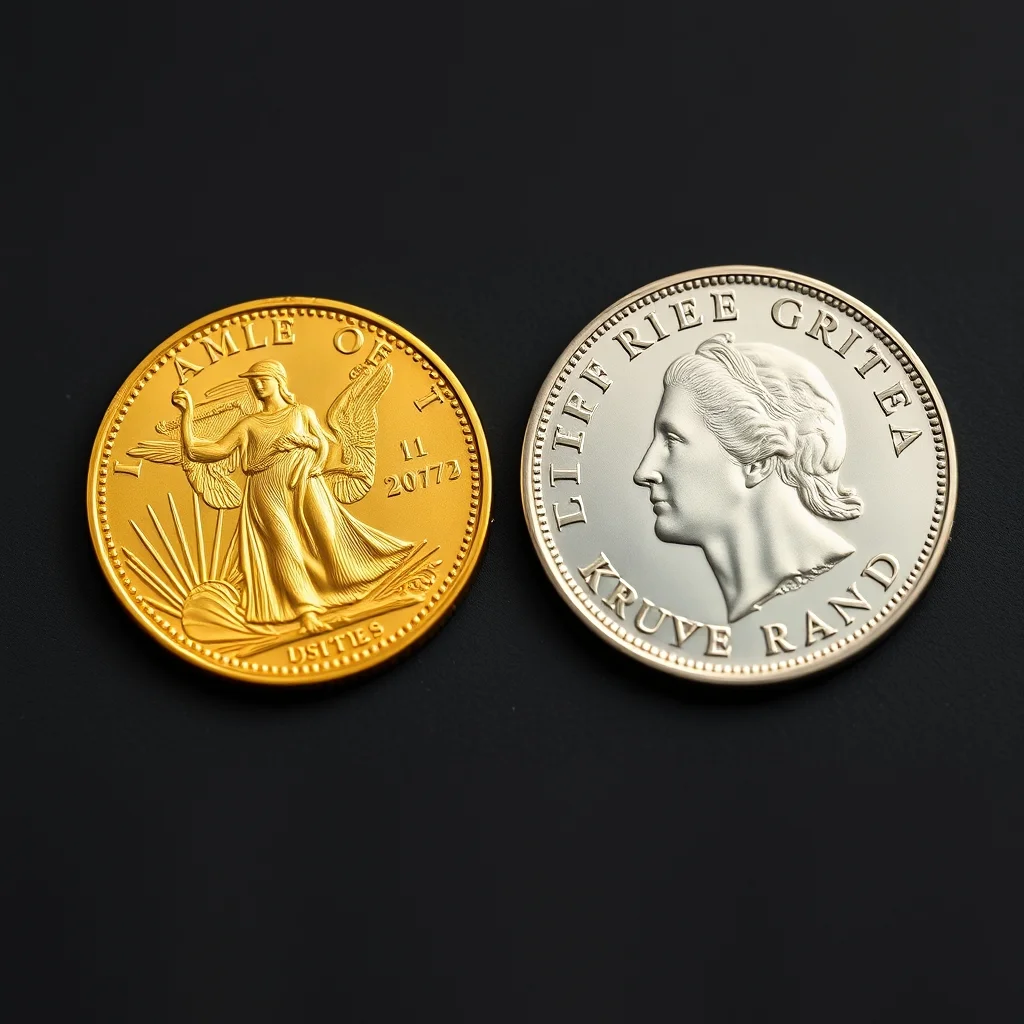
The core difference: 22k versus 24k
The American Gold Eagle and the South African Krugerrand are both 22-karat gold coins, but that's a fact often garbled in comparison pieces. Let's be precise: both are 22k (0.9167 fine). The 1 oz Eagle weighs 1.0909 troy oz total — it contains exactly 1 troy oz of fine gold, plus 0.0909 troy oz of alloy (copper and silver). The Krugerrand also weighs 1.0909 troy oz total, containing exactly 1 troy oz of fine gold alloyed with copper.
Where they differ is that the Eagle's alloy contains both copper and silver, giving the coin a slightly different appearance and harder strike, whereas the Krugerrand's alloy is copper-only, which produces the coin's characteristic reddish-gold tone compared to the Eagle's warmer yellow.
| Specification | American Gold Eagle (1 oz) | Krugerrand (1 oz) |
|---|---|---|
| Issuer | United States Mint | South African Mint + Rand Refinery |
| First minted | 1986 | 1967 |
| Fineness | 0.9167 (22k) | 0.9167 (22k) |
| Total weight | 1.0909 troy oz | 1.0909 troy oz |
| Fine gold content | 1.0000 troy oz | 1.0000 troy oz |
| Alloy metals | Copper + silver | Copper only |
| Legal tender face value | $50 USD | Not denominated (legal tender by weight) |
| Typical premium over spot | 4–8% | 2–5% |
Why the Krugerrand typically carries a lower premium
The Krugerrand is the world's first modern gold bullion coin. When South Africa introduced it in 1967, the explicit purpose was to make gold ownership accessible to private investors globally — hence the lack of a face value denomination, which would have complicated pricing. For decades it dominated global bullion coin sales.
Because the Krugerrand is produced in such volume and has been traded across global markets for nearly 60 years, the market for it is extremely liquid. Dealers know it, buyers know it, and the bid-ask spread is tight. That depth of market tends to suppress premiums: when inventory is plentiful and a coin is universally recognized, dealers don't need to charge much above spot to move product.
The Eagle, introduced in 1986, carries a modest premium above the Krugerrand partly because it is a US Mint sovereign issue with a face-value denomination (which provides a theoretical legal floor, though an irrelevant one given gold prices), and partly because North American retail demand for an American-branded coin creates additional demand pressure.
Does purity actually matter for bullion buyers?
Both coins contain the same amount of fine gold. If you are buying gold by the ounce as a store of value, the 22k alloy vs a 24k alloy (like the Canadian Gold Maple Leaf or the US Gold Buffalo) makes no functional difference to gold content. The 0.9167 fine coin weighs more because the alloy makes up the balance — but the gold is all there.
Where fineness can matter: some IRAs (Individual Retirement Accounts) that hold physical gold have fineness requirements. IRS rules historically required 0.9950 fineness or better for gold held in an IRA, which disqualified the 22k Eagle and Krugerrand. That changed — the Tax Relief Act of 1997 specifically exempted the Eagle from the fineness requirement, so the Eagle is IRA-eligible. The Krugerrand, not being a US Mint product, is generally not IRA-eligible. Verify the current rules with your custodian before acting on this.
For collectors and numismatists, fineness matters differently. High-fineness coins like the Canadian Maple Leaf are notorious for "milk spots" — oxidation hazing that appears on the surface and can reduce eye appeal in proof or uncirculated specimens. The alloyed 22k Eagle is generally more resistant to this.
Recognizing genuine coins: what to check
Counterfeits exist for both coins, particularly as gold prices rise. The practical authentication checks that experienced dealers and collectors use:
Weight and dimensions
The 1 oz Eagle and 1 oz Krugerrand both weigh 33.93 grams (1.0909 troy oz). Diameter: Eagle is 32.7 mm, Krugerrand is 32.6 mm. Thickness: Eagle is 2.87 mm, Krugerrand is 2.84 mm. A precision digital scale accurate to 0.01g is a basic verification tool. Most counterfeits are either tungsten-cored (density close to gold) or cheaper base-metal coins with gold plating. Weight checks catch the plated fakes; density/dimensions testing is needed for tungsten.
The ping test
Gold produces a distinctive high-pitched ring when struck. The Bullion Test or Sigma Metalytics devices (non-destructive XRF or eddy-current testers) are used by dealers for fast verification. For individual buyers, a free mobile app like the "Bullion Test" app measures resonance frequency of a coin dropped on a hard surface — genuine gold coins have a characteristic frequency profile.
Visual details
On the Eagle: look at the reeding (the ridged edge). Genuine Eagles have 161 reeds on the 1 oz version. The obverse Saint-Gaudens design shows Lady Liberty with fine hair detail; counterfeits often flatten or soften this detail. On the Krugerrand: the springbok antelope on the reverse shows fine hair texture in genuine coins. The word "KRUGERRAND" on the reverse should have sharp, clean lettering.
Magnet test
Gold is not magnetic. Neodymium magnets will not attract genuine gold coins. A coin that sticks to a magnet is either not gold or is plated over a ferromagnetic core. Note that a coin that doesn't stick to a magnet is not proven genuine — just not base ferrous metal.
Premium over spot: the math that actually matters
Say spot gold is trading at $2,000/troy oz. A dealer is offering a 1 oz Krugerrand at $2,080 and a 1 oz American Gold Eagle at $2,130.
- Krugerrand premium: ($2,080 − $2,000) / $2,000 = 4.0% over spot
- Eagle premium: ($2,130 − $2,000) / $2,000 = 6.5% over spot
If you are buying gold purely as a store of value and plan to sell back to a dealer eventually, you want to buy at the lowest premium you can, because you will also sell at a premium (the dealer's buy price will be above spot as well). The spread between what you pay and what a dealer will later pay you back is your effective cost of ownership beyond the gold itself.
Historically, Krugerrands have offered slightly tighter buy-sell spreads than Eagles among US dealers, though this varies significantly by dealer and market conditions. For the Eagle, the sovereign US Mint brand means strong retail demand, which maintains premium at resale — but it also means you pay more to acquire.
Which coin is easier to sell?
In North America, the American Gold Eagle is the most recognized gold coin by retail buyers, pawn shops, and coin dealers. Most Americans who recognize any gold coin recognize the Eagle. That recognition has real value if you ever need to sell quickly to an unknown buyer rather than a professional dealer.
The Krugerrand is globally recognized — it will sell without hesitation at any professional bullion dealer anywhere in the world. It is slightly less likely to be recognized by a casual buyer in the United States, but that matters mainly if you are selling outside the dealer network.
For IRA eligibility, reselling to dealers, or trading through online platforms like APMEX, JM Bullion, or similar, both coins are equally liquid. The difference shows up at the retail or peer-to-peer end of the market.
Fractional sizes and their premium implications
Both the Eagle and Krugerrand come in fractional sizes: 1/2 oz, 1/4 oz, and 1/10 oz. The premium-over-spot percentage increases substantially for smaller denominations. A 1/10 oz Eagle might carry a premium of 15–25% over spot (proportionally) versus 4–8% for the full ounce, because the fabrication cost and dealer margin are roughly fixed per coin regardless of gold content.
If you are buying gold as a store of value, 1 oz coins are almost always the most efficient choice per gram of gold acquired. Fractional coins make sense for gifting, for precise allocation, or when you want coins that are easier to sell in small lots without breaking a full ounce.
Proof and collectible versions
Both coins are produced in proof (highly polished, mirror-finish) versions intended for collectors. Proof Eagles are produced by the US Mint with a cameo frosted design against a mirrored field; they carry significant premiums above bullion versions and are graded by PCGS and NGC. Proof Krugerrands (introduced in 1967 and continued annually) similarly trade at collector premiums.
For bullion buyers, proof coins are not the right purchase unless you specifically want the numismatic angle. You pay for the aesthetics and the graded registry slab, not for additional gold content. Buy uncirculated (bullion) versions if your goal is gold at minimum premium.
The honest bottom line
If you are a US-based buyer stacking physical gold as a hedge or store of value, the American Gold Eagle is the more convenient choice: universally recognized domestically, IRA-eligible, backed by the US Mint, and liquid at any dealer. You pay slightly more for those attributes.
If you are optimizing purely on lowest-premium-per-ounce and plan to sell through professional dealers, the Krugerrand has historically offered tighter spreads. The coin is equally genuine, equally sovereign in its origin, and equally liquid in professional markets worldwide.
For either coin: verify weights and dimensions on receipt, store in sealed capsules or mint-provided tubes, and keep a record of your purchase price including premium paid — you'll want that for cost-basis calculations later.
 American Gold Eagle 1 oz
 Krugerrand 1 oz
 Canadian Gold Maple Leaf