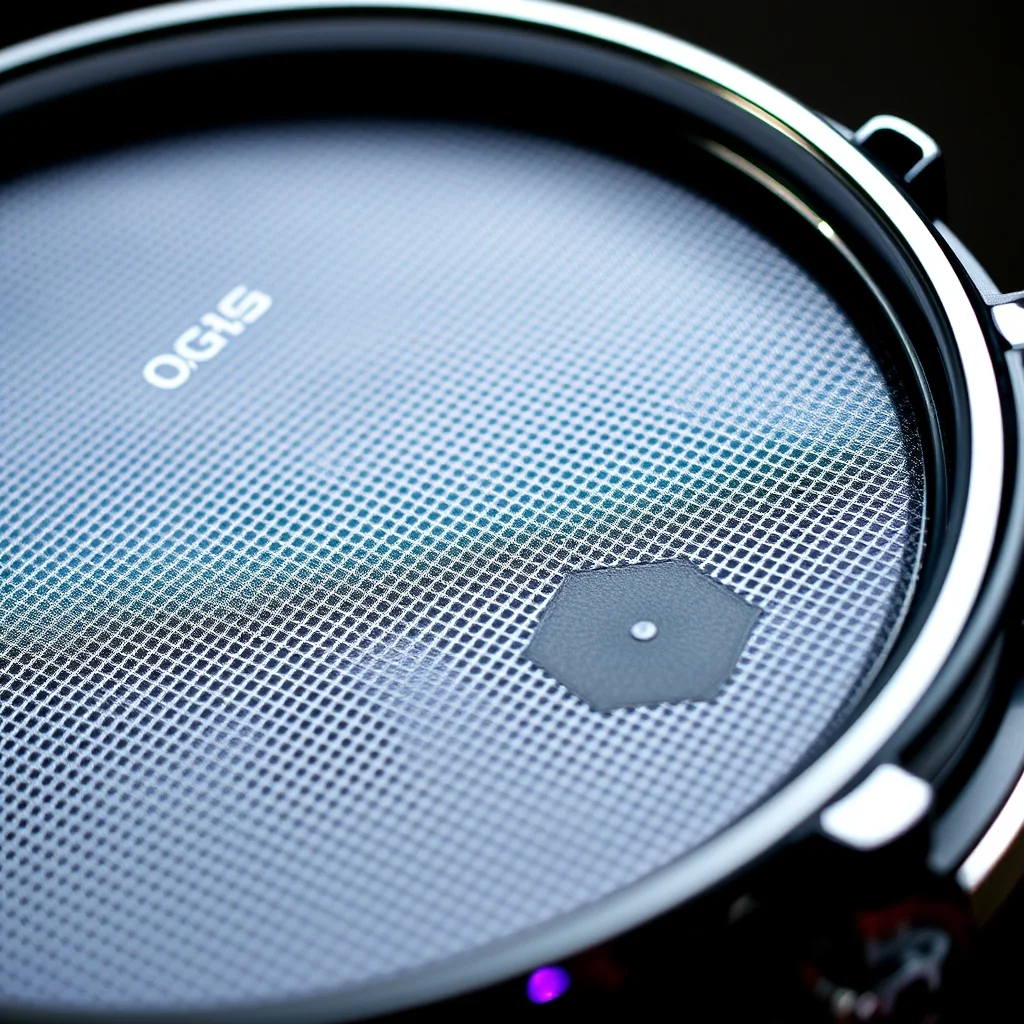
Mesh heads vs rubber pads: the central decision
The pad surface type is the single most impactful decision in an electronic drum kit purchase. Rubber pads use a solid rubber playing surface that bounces the stick back sharply — similar to playing on a table. Mesh heads use a woven mesh material stretched over a frame. The mesh absorbs the stick strike and gives it back at a controlled rebound, closer in feel to a real drum head. The mesh also compresses slightly under the stick, which distributes the impact impulse over a longer time, dramatically reducing vibration transfer to the rack and floor.
Noise and vibration
Rubber pads are significantly louder than mesh pads — not in terms of audio output (both generate sound through the module and speakers/headphones), but in terms of mechanical strike noise. The stick hitting a rubber pad creates a sharp transient sound that travels through the rack and the floor. In a flat or adjacent to neighbors, this can be as disruptive as an acoustic kit. Mesh heads are not silent — the stroke still generates noise — but the mechanical impact sound is substantially lower. For home practice environments, mesh heads are the specification worth prioritizing above almost anything else.
Cymbal pads
Cymbal pads are typically rubber regardless of whether the kit has mesh drum heads. Some premium kits use fabric or layered material for improved cymbal feel and choke response. The quality of the edge zone detection on cymbal pads (detecting whether the player hits the edge vs the bow of the cymbal, which triggers different sounds) varies significantly between entry and mid-tier kits.
The drum module: trigger response and sound library
The module is the signal processor and sound generator of an electronic kit. It receives electrical pulses from the pad triggers, translates them to MIDI velocity data, and generates sounds from its internal library or routes MIDI to an external instrument. Module quality has two distinct dimensions: trigger processing and sound quality.
Trigger response and sensitivity
Trigger response describes how accurately the module translates pad strikes to velocity levels and how quickly it responds. A poor trigger circuit produces "double triggering" — a single strike generates two notes — or fails to detect soft ghost strokes at low velocity. A better trigger circuit has higher velocity resolution (more granular levels from soft to hard strike), better crosstalk rejection (preventing a hard snare hit from triggering a nearby tom), and lower latency between strike and sound generation.
Manufacturers describe their trigger performance in proprietary terms. Roland's trigger technology is consistently referenced as the industry benchmark. Alesis, Roland, and Yamaha all make competitive mid-tier modules; entry-level modules from budget brands often struggle with consistent ghost note response and double-trigger rejection at high playing speeds.
Onboard sound library
The module's sound library determines the quality of drum sounds available without external software. Better modules include multi-layered samples (different velocity layers, mic positions, and release samples for a more natural response across dynamics), dry and ambient room sound options, and a wider variety of drum kit presets. At the high end, modules like Roland's TD-27 and TD-50 use physical modeling (acoustic behavior simulated in real time) rather than static samples, which avoids the "machine gun effect" on fast repeated strokes.
For recording, the module can route audio directly to a DAW or connect via USB MIDI to trigger software drum instruments (Superior Drummer, BFD, Steven Slate Drums) that offer more sophisticated sound libraries than any standalone module.
Shopping for electronic drum kits? Browse current eBay listings → (we earn a small commission; your price is unchanged).
Hi-hat controller type
The hi-hat is typically the most technically demanding element in an electronic drum kit to implement accurately. An acoustic hi-hat has continuous open/closed control — the player can position the pedal anywhere between fully open and fully closed, and the hi-hat sounds at every intermediate position differently. Electronic kits approximate this with varying degrees of accuracy.
Simple hi-hat controller (open/closed only)
Entry-level kits use a simple switch-based hi-hat controller that detects only two states: pedal up (open) or pedal down (closed). This gives no half-open or continuous positional control. For beginners playing simple patterns, this is adequate. For any playing that involves half-open hi-hat technique (a common jazz, funk, and pop technique), it is a significant limitation.
Analog continuous controller
Better hi-hat controllers use a variable resistor or magnetic sensor that reads the pedal position continuously. This gives the module continuous position data, allowing graduated open/half-open/closed sounds depending on pedal position. The feel of these controllers varies — some use a proprietary hi-hat pedal that ships with the kit; others allow a standard hi-hat stand to be connected, which gives closer-to-acoustic feel. Roland's VH series hi-hat controllers (used on their mid-to-high-tier kits) are widely referenced as the most natural-feeling electronic hi-hat available.
Pad count and configuration
A standard acoustic drum kit has a minimum of 9 playing surfaces: kick, snare, hi-hat (with top and bottom cymbals as one unit), rack tom, floor tom, crash cymbal, and ride cymbal. Electronic kits are described by their pad count. A "7-piece" electronic kit might have kick, snare, 3 toms, hi-hat, and one crash/ride — which is sufficient for most music but leaves no room for a second crash or china. A "9-piece" or larger kit adds additional cymbal pads.
Entry kits often have 3 tom pads; mid-tier kits may have 4. The practical difference: most rock and pop drumming uses kick, snare, hi-hat, two toms, and two cymbals. Three toms is not essential for most music but matters for players replicating specific multi-tom patterns or fills.
Expandability: inputs and compatibility
Expandability refers to whether the module has spare trigger input jacks for additional pads, and whether the rack system can physically accommodate more pads. A module with 8 inputs that ships with an 8-pad kit has no expansion room — adding a crash cymbal requires replacing the module. A module with 12 inputs on an 8-pad kit has four spare inputs for future pads.
Check the module's trigger input count against the number of pads in the kit: the difference is the expansion room. Also verify that the rack has mounting points or additional clamp capacity for more pads. Some kits have fixed rack designs that cannot accept additional components without replacing the entire rack.
Buying used electronic drum kits
Electronic drum kits age reasonably well. The main wear points: mesh heads eventually develop small tears or lose tension (replaceable and inexpensive); cymbal pad surfaces can show wear at the edges where the rim shot zone is hit repeatedly; hi-hat controllers with moving parts may develop contact issues. The module electronics are generally durable. When buying used, test every pad for consistent trigger response across the full pad surface area (hit the center, edge zones, and rim separately on each pad) and verify that no inputs are reading phantom triggers with no pad connected.
Shop electronic drum kits on eBay
We earn a small commission on qualifying sales; your price is unchanged. Full disclosure.
 Electronic drum kit mesh
Quietest option for home practice. View on eBay →
Electronic drum kit mesh
Quietest option for home practice. View on eBay →
 Roland electronic drums
TD series. Industry benchmark for trigger response. View on eBay →
Roland electronic drums
TD series. Industry benchmark for trigger response. View on eBay →
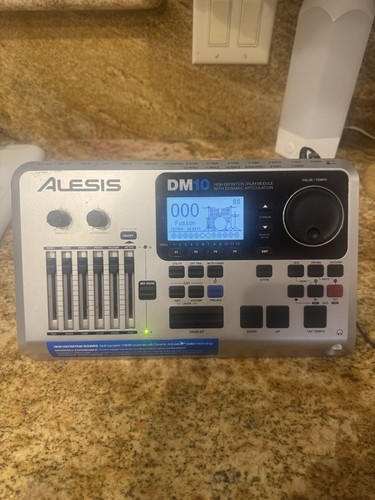 Drum module
Upgrade module to improve response on existing kit. View on eBay →
Electronic drum kit
Complete sets. Check pad material spec before buying. View on eBay →
Drum module
Upgrade module to improve response on existing kit. View on eBay →
Electronic drum kit
Complete sets. Check pad material spec before buying. View on eBay →
 Drum throne
Adjustable stool for correct playing height. View on eBay →
Drum throne
Adjustable stool for correct playing height. View on eBay →