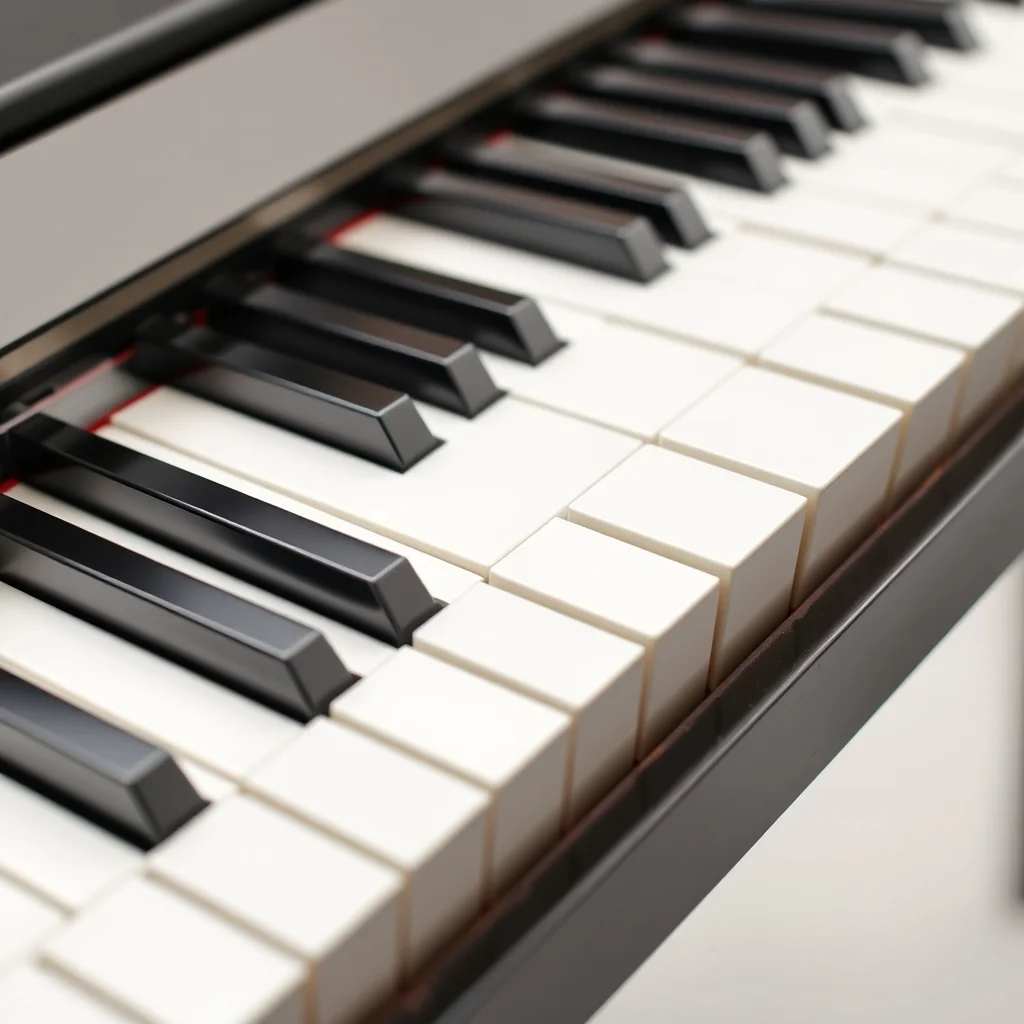
Why key action is the purchase you cannot undo
A digital piano's sound engine can be updated in firmware. Its connectivity can be expanded with adapters. But the key action — the physical mechanism under each key — is fixed at the factory. Buying a piano with a weak or unresponsive action and hoping to get used to it tends not to work. The resistance and return speed of keys shape how your fingers develop, particularly for techniques like rapid repetition and voicing control in chords.
The categories to understand are: fully weighted vs semi-weighted vs unweighted, graded vs non-graded action, and hammer mechanism vs spring-return mechanism. These are not marketing synonyms for each other — they describe genuinely different physical designs.
Fully weighted vs semi-weighted vs unweighted
Fully weighted keys use mechanical counterweights or hammer assemblies to create resistance. They feel closer to an acoustic piano and are the standard for serious study. Semi-weighted keys add spring tension to a lighter chassis — adequate for synthesizer-style performance, too light for developing acoustic-piano technique. Unweighted (synth-action) keys return on springs alone and are suited to organ and synth parts, not piano practice.
Graded hammer action
An acoustic piano has heavier keys in the bass register and progressively lighter keys as you move toward the treble — this is a physical consequence of the longer, heavier hammers at the low end. A graded hammer action replicates this weight gradient across the 88-key range. Non-graded weighted actions have uniform resistance across all 88 keys. For someone learning piano from scratch, graded action matters — the student builds the correct muscle memory for register-appropriate touch. For someone primarily performing and recording rather than building technique, non-graded weighted may be acceptable.
Sensor count per key: dual vs triple
Each key has sensors that detect when it starts moving and when it bottoms out. A dual-sensor design detects key-down and key-up. A triple-sensor design adds a third detection point partway through the key stroke, which enables faster repeated-note legato — the sensors can detect that a key has started returning before it fully re-seats, allowing the next note-on before the key fully resets. For classical technique (trills, repeated-note passages), triple sensors are meaningfully better. Manufacturers label these differently: Yamaha calls theirs GH3X or GHC, Roland uses PHA-50, Kawai uses RHIII or GFC. Check the specific action name, not just "weighted."
Sound engine: polyphony, sample quality, and resonance modeling
The sound engine has two axes worth understanding: polyphony (how many simultaneous notes it can produce) and sample fidelity (the quality of the underlying recordings).
Polyphony floors
Polyphony is the count of simultaneous notes a piano can sustain before older notes are cut off. Entry-level instruments often have 64-voice polyphony. Mid-range instruments typically offer 128 or 192 voices. High-end instruments may offer 256 or more. The practical floor for serious playing is typically 128 voices. Here is why: a single held chord with the sustain pedal depressed can use multiple voices per note (stereo samples, sympathetic resonance layers). A 64-voice limit can cause audible note dropouts in full-pedal passages with complex harmonies. If the piano you are considering lists 64-note polyphony, treat that as a budget constraint, not a feature.
Sample quality and source instruments
Most major brands sample concert grand pianos as the source for their piano voices. Yamaha's higher-tier instruments use CFX (their 9-foot concert grand) and Bösendorfer Imperial samples. Roland uses their own Imperial Grand samples. Kawai uses recordings of their EX concert grand. The practical difference between brand X's samples and brand Y's samples is often overstated in marketing — at mid-price, most instruments sound convincing through headphones. The gaps become more apparent through good studio monitors at louder volumes.
Resonance and physical modeling
Better instruments simulate acoustic behaviors that go beyond raw samples: string resonance (when you hold the sustain pedal, undamped strings sympathetically vibrate with notes you play), damper resonance (the sound of the felt dampers lifting), and half-pedal detection (graduated sustain rather than binary on/off). These add realism during playing, particularly for players who have studied acoustic piano and notice their absence.
Shopping for digital pianos? Browse current eBay listings → (we earn a small commission; your price is unchanged).
Speakers: built-in output and headphone practice
Digital pianos at the bedroom and studio level vary considerably in speaker systems. Entry-level slab pianos typically have two small full-range speakers positioned upward or forward. Better instruments add separate tweeters and woofers, sometimes angled to project toward the player the way an acoustic piano's soundboard projects upward. The wattage numbers in spec sheets are frequently misleading — a 14-watt system with well-designed speaker placement can sound more convincing than a 30-watt system with poor dispersion.
For most practice and home use, headphones matter as much as the built-in speakers. A digital piano without a headphone jack is unusual today, but the quality of the headphone amplifier varies. Some instruments also include binaural sampling modes — a stereo image optimized specifically for headphone listening that creates a more convincing acoustic space around the player. Yamaha's Binaural Sampling and Roland's Headphones 3D Ambience are examples of this.
Cabinet vs slab
A cabinet-style digital piano (one that looks like an upright with legs and a music rest built in) integrates the speaker system into a larger wooden enclosure, which typically improves bass response and overall acoustic projection compared to a slab. A slab-style piano is portable and pairs with a separate stand and optional external monitor. If the piano will primarily live in one room and be played through its own speakers, the cabinet form factor usually provides a better acoustic experience. If the piano will move, record into a DAW, or primarily be played through headphones or studio monitors, the slab has no acoustic disadvantage.
Connectivity: MIDI, USB, and what each port actually does
Digital pianos have three categories of connectivity: audio output, MIDI, and data/power USB. Understanding which you need avoids buying the wrong thing.
Audio outputs
Headphone jacks (usually 6.35mm / ¼" and sometimes 3.5mm) output analog audio. Line outputs (6.35mm L/R or sometimes RCA) let you connect to an audio interface, mixer, or powered monitors without going through the headphone amp. If you plan to record into a DAW, you want either line outputs into an audio interface, or USB audio (see below). Headphone-out-to-interface-in works but often adds noise and level mismatch.
MIDI vs USB-MIDI vs USB audio
Traditional 5-pin DIN MIDI ports are now rare on instruments below professional tier, but they remain the standard for connecting to hardware synths and certain studio equipment. Most digital pianos now include a USB Type-B port labeled "USB to Host" — this transmits MIDI data over USB to a computer without requiring a separate MIDI interface. Some instruments also transmit audio over this same USB connection (USB audio), meaning you can record piano directly into a DAW without an audio interface at all. Whether a USB-to-Host port transmits MIDI only or MIDI plus audio varies by model and is worth confirming before purchase.
Bluetooth MIDI
Several manufacturers now include Bluetooth MIDI, which lets you connect wirelessly to a tablet or phone for use with learning apps (Flowkey, Simply Piano, Playground Sessions) without a cable. This is a convenience feature, not a professional-recording feature — Bluetooth MIDI has slightly variable latency that makes it unsuitable for recording into a DAW. For app-based learning, it is genuinely useful.
Key count: why 88 keys matter
A standard piano has 88 keys. Most classical repertoire uses the full range. Digital pianos are sold in 88-key, 76-key, 61-key, and smaller configurations. For anyone learning classical repertoire or wanting to develop full technique, 88 keys is not optional — pieces regularly use the lowest and highest octaves. For a synthesizer player, stage performer, or someone playing pop/jazz/production work, 76 or 61 keys may be sufficient for the repertoire they actually play. There is no middle-ground answer: it depends on what you intend to play.
What to check before buying used
Used digital pianos on eBay and secondhand markets can represent good value, particularly instruments from major manufacturers whose build quality tends to be consistent. Things to check: play every key and listen for the mechanism sound (a quieter key or delayed response typically indicates a hammer assembly issue or stuck component); test the sustain pedal input (worn jacks can cause intermittent sustain); listen for speaker buzz at medium volume; confirm all line outputs and headphone jacks function. The internal sound engine and samples are not subject to wear in the way acoustic piano hammers and strings are — the key action and outputs are the main mechanical concerns.
Shop digital pianos on eBay
We earn a small commission on qualifying sales; your price is unchanged. Full disclosure.
 Digital piano 88 weighted
Full 88-key graded hammer action — the floor for serious practice. View on eBay →
Digital piano 88 weighted
Full 88-key graded hammer action — the floor for serious practice. View on eBay →
 Yamaha digital piano
GH3X and GHC actions, CFX/Bösendorfer samples at higher tiers. View on eBay →
Yamaha digital piano
GH3X and GHC actions, CFX/Bösendorfer samples at higher tiers. View on eBay →
 Digital piano hammer action
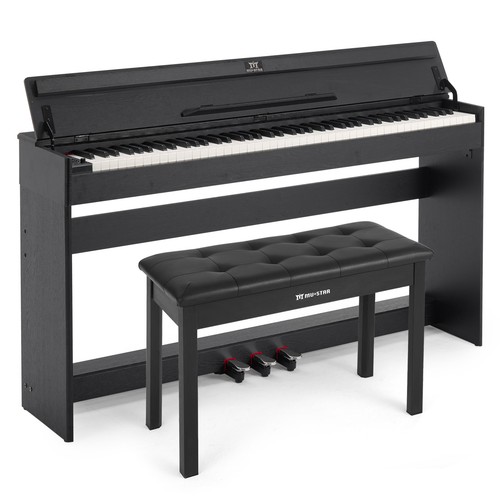
Physical hammer mechanism for correct repetition technique development. View on eBay →
Digital piano hammer action
Physical hammer mechanism for correct repetition technique development. View on eBay →
 Digital piano stand
Z-style recommended for heavy 88-key slabs. Check width range and weight rating. View on eBay →
Digital piano bench
Adjustable-height bench for correct elbow-to-key alignment. View on eBay →
Digital piano stand
Z-style recommended for heavy 88-key slabs. Check width range and weight rating. View on eBay →
Digital piano bench
Adjustable-height bench for correct elbow-to-key alignment. View on eBay →