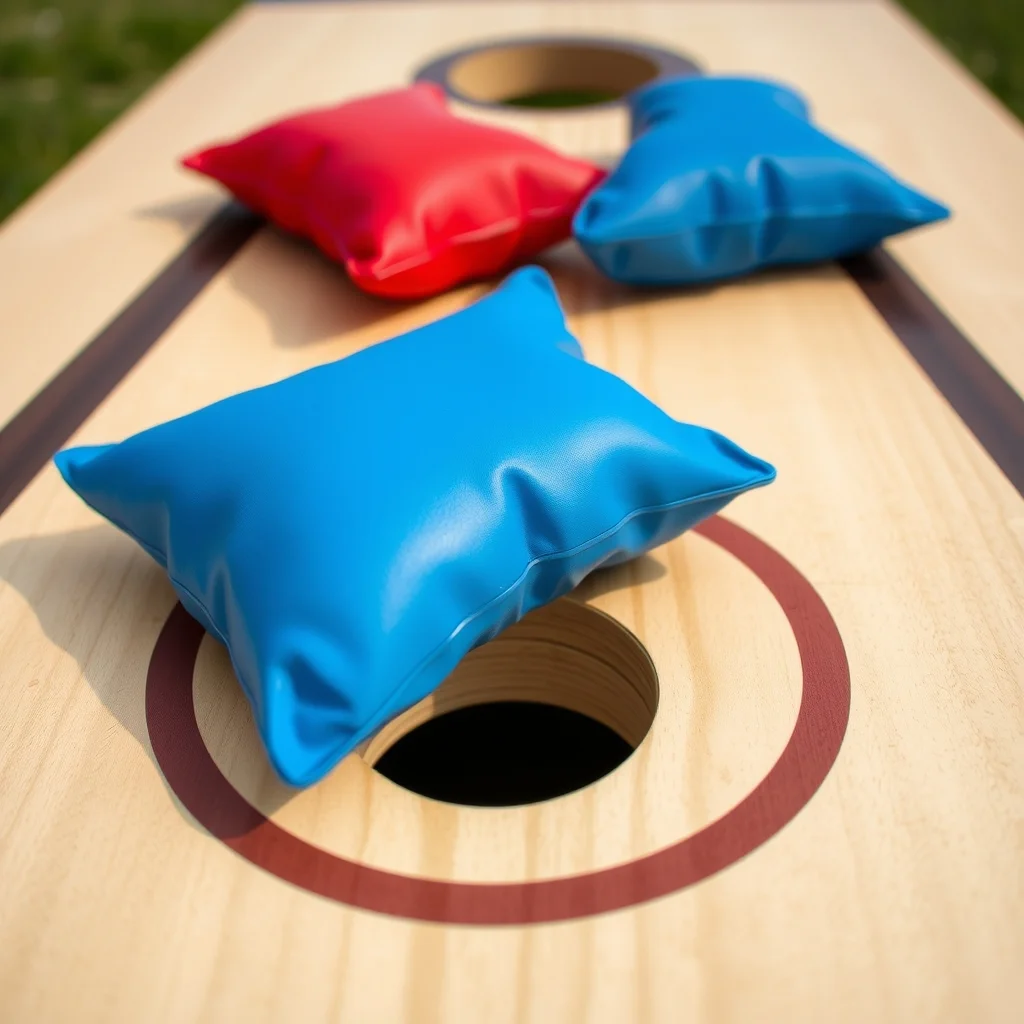
ACL regulation spec: what "regulation" actually means
The American Cornhole League (ACL) is the primary governing body for competitive cornhole in the United States, and their equipment specifications are widely used as the de facto standard even for recreational play. Understanding the regulation spec helps you identify which products are accurately marketed as "regulation" versus which are using the term loosely.
| Spec | ACL Regulation |
|---|---|
| Board dimensions | 24 inches × 48 inches |
| Board thickness | Minimum 3/4 inch (plywood) |
| Hole diameter | 6 inches |
| Hole position | Center of hole: 9 inches from top edge, 12 inches from side edges |
| Front leg height | 2.5–4 inches from ground to front board edge |
| Rear leg height | 12 inches from ground to rear board edge |
| Bag weight | 6 oz ±0.25 oz |
| Bag dimensions | 6×6 inches ±0.5 inches |
| Pitcher distance | 27 feet (front of board to front of board) |
Board surface materials: what determines playability
The board surface is the single biggest factor in how bags slide, bounce, and stop. There are meaningful differences between board materials that have direct consequences for how the game plays.
Baltic birch plywood (best)
Baltic birch is the material of choice for high-quality cornhole boards. It's a multi-ply plywood with minimal voids, very consistent thickness across the surface, and low tendency to warp under moisture exposure. Bags slide predictably on Baltic birch. A properly finished Baltic birch board (sanded to 220 grit, sealed, and poly-coated) provides a smooth, consistent playing surface that doesn't degrade quickly with outdoor use.
The more plies (typically 11–13 in 3/4" Baltic birch), the less likely the board is to develop minor surface curvature over time. Voids in cheaper plywoods can create dead spots on the surface where bags behave inconsistently.
Sanded pine or birch plywood
Standard home-center plywood (B/C or better grade sanded softwood plywood) is a serviceable and significantly cheaper alternative. The main risk is moisture-related warping, which happens faster on softwood plywoods than on Baltic birch. Boards stored outdoors, left in a garage with temperature fluctuations, or frequently played on wet grass are more likely to cup or twist over time.
A well-sealed pine board can last for years. The key is the finish — at least two coats of polyurethane or equivalent sealant applied before painting, and a topcoat after, to prevent moisture infiltration through the paint layer.
OSB and MDF (avoid)
Oriented strand board (OSB) and medium-density fiberboard (MDF) are both used in some budget cornhole sets and should be avoided for regular play. OSB has a rough, uneven texture that creates unpredictable bag behavior — the strands of wood at different orientations produce different friction zones across the surface. MDF is smooth but absorbs moisture rapidly and swells, which destroys flatness after outdoor exposure. Neither material holds up to the conditions cornhole is typically played in.
Bag fill: resin vs corn
Cornhole bags are traditionally filled with whole kernel corn — hence the name. Modern competitive play has largely shifted to resin (plastic pellet) fill, and for good reason. Understanding the difference helps you choose bags that perform consistently across playing conditions.
Corn fill (traditional)
Dried whole kernel corn is the traditional fill material and is still used in many recreational bag sets. Corn fill bags feel natural, have a satisfying throw weight, and tend to produce a good "thud" on landing rather than a bounce. The disadvantage is moisture: corn absorbs humidity and can swell, clump, or mold if bags are stored wet or played in consistently damp conditions. In dry climates and indoor use, corn fill bags are entirely viable.
Most bags sold as "corn fill" use dried field corn or feed corn, which is consistent in size. Bags that use inferior fill may have inconsistent weight distribution — some kernels may compact to one end of the bag, affecting throw behavior.
Resin fill (modern standard)
Plastic resin pellets are the fill material in virtually all ACL-approved competitive bags. Resin doesn't absorb moisture, doesn't compact over time, and maintains consistent weight distribution regardless of storage conditions. For outdoor play in varied weather, resin fill is the practical choice. Resin bags also tend to be more consistent in weight-to-weight tolerance, which matters for competitive play where 0.25 oz variation is within spec.
Shopping for cornhole gear? Browse current eBay listings → (we earn a small commission; your price is unchanged).
Slick vs stick sides: the dual-fabric bag system
Modern cornhole bags are typically double-sided, with different fabric on each face. One side is designed to slide on the board surface ("slick"), and the other is designed to grip and stop ("stick"). Choosing which side to throw with is a core part of competitive strategy.
The slick side
The slick side typically uses a woven or suede-like fabric with low friction against the board surface. Bags thrown slick-side-down will slide on landing, giving them more forward travel. A well-thrown slick bag aimed slightly short of the hole will slide in — or at least push another bag aside. Slick bags are the choice when you want to push through gaps or move opponent bags.
The stick side
The stick side uses a higher-friction fabric — often a brushed suede, felt-like, or textured material — that grips the board surface on landing. Stick bags stop where they land, making precise placement on the board easier for players with a controlled throw. They're also more forgiving on windy days because a lower-trajectory throw that hits the board firmly is more predictable than a high-arc throw with slide built in.
How bag fabric affects play
The fabric combination on professional bags typically uses specific materials whose exact specifications vary by manufacturer. Higher-end bag sets use fabrics that provide more consistent friction coefficients across the entire bag face, rather than fabric that wears inconsistently over time. A $20 set of bags may have adequate fabric for casual play but will develop inconsistent friction as the fabric wears at different rates.
Leg design and board stability
Board leg design directly affects whether the playing surface stays flat and stable during play. Two common designs:
Fixed legs (superior)
Fixed legs that are screwed or bolted in place and do not fold provide the most rigid connection to the board. There's no hinge to loosen or slide under load. The trade-off is transport — a board with fixed legs must be carried as-is or transported vertically. Fixed-leg boards are more common in permanent backyard setups and competitive tables.
Folding legs
Folding legs hinge flat against the underside of the board for transport, then unfold and lock in position for play. The hinge mechanism is the critical quality differentiator. Budget cornhole boards often have thin-gauge hinges that loosen with use, causing the board to rock during play. Look for hinges with a positive lock position (usually a notch or crossbar that prevents the legs from folding back inward during play) and hardware rated for the board's weight.
The best folding-leg boards feel rigid when deployed — no wobble when you press down on the board surface with moderate force. Test this before committing to a pair if possible.
Portable vs permanent setups
For backyard and portable use, folding boards with a carry strap or bag are the practical choice. Standard boards (24×48 inches, 3/4" plywood) weigh approximately 15–25 lbs each depending on the wood and leg assembly. Pairs ship in sets of two and can typically be carried in one trip with a handle or strap.
For permanent installations on a concrete patio or in a garage, fixed-leg boards or boards with removable legs stored in a shed are worth considering. Boards that live outdoors permanently need a more aggressive finish treatment — exterior-grade polyurethane or marine varnish — and periodic refinishing as the topcoat wears.
Spec summary
| Category | Backyard/casual | Competitive/ACL |
|---|---|---|
| Board surface | Sanded pine plywood, sealed | Baltic birch, sealed + topcoat |
| Bag fill | Corn (dry climate) or resin | Resin (all conditions) |
| Bag fabric | Standard canvas dual-sided | Performance fabric, dual slick/stick |
| Leg type | Folding (adequate hinge) | Fixed or quality folding |
| Budget | $60–$150 per set | $150–$300+ per set (boards); $40–$100+ (bags) |
 Regulation boards
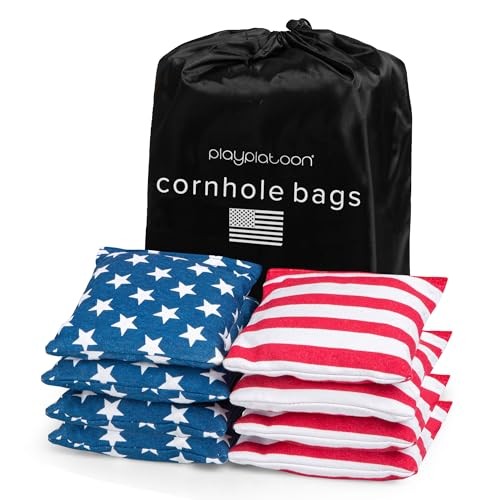 8-bag set
 All-weather bags