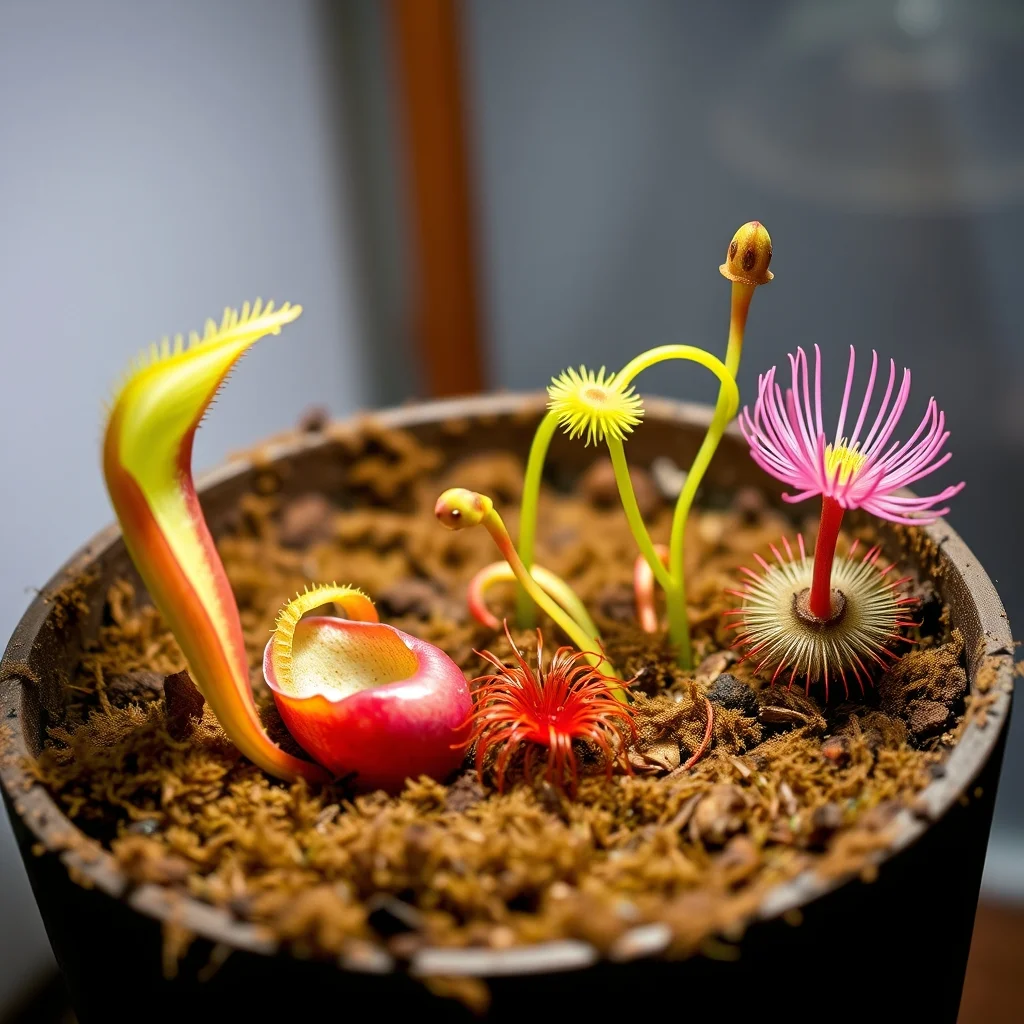
Why carnivorous plants have unusual requirements
All major carnivorous plant groups — flytraps, sundews, pitcher plants, butterworts, bladderworts — evolved in the same type of environment: waterlogged, highly acidic, nutrient-poor substrate with bright sunlight and high humidity. These are bog conditions, typically associated with sphagnum moss, peat, and mineral-poor sandy soils.
In nutrient-depleted environments, capturing insects becomes a competitive advantage for obtaining nitrogen and phosphorus. The adaptation is real and functional — but it means these plants have no tolerance for the mineral content found in tap water, the nitrogen content found in standard potting mix, or the nutrient applications we'd use on garden plants. Adding fertilizer to a carnivorous plant typically burns and kills it.
Water: pure water only
This is the single most important care requirement. Use only:
- Distilled water — the most reliable and widely available option. Sold in gallon jugs at grocery stores.
- Rainwater — collected in a clean container, excellent if your area gets regular rain and you can collect it before it runs through mineral-containing surfaces.
- Reverse osmosis (RO) water — produced by an RO filter. Good option if you grow many plants and want to avoid buying jugs.
Tap water in most municipalities contains dissolved minerals (calcium, magnesium, sodium, chlorine, and fluorides) at concentrations that accumulate in the soil and damage carnivorous plant roots over weeks to months. Even "soft" tap water treated with sodium-based water softeners is harmful — the sodium is just as problematic as the calcium it replaced. Do not use tap water.
The tray watering method
Place the pot in a tray or saucer with about one inch of pure water. The plant draws moisture upward through the drainage holes. This replicates the naturally waterlogged bog conditions these plants evolved in. Refill the tray when it approaches empty. Most temperate carnivorous plants (flytraps, North American Sarracenia, most Drosera) prefer continuously wet conditions during their growing season.
Soil: nutrient-free substrate
The standard recommendation is a 50/50 mix of peat moss and perlite or peat moss and silica sand. Both ratios provide drainage while retaining moisture and remain nutrient-free.
| Component | Purpose | What to avoid |
|---|---|---|
| Peat moss (Canadian sphagnum peat) | Moisture retention, acidity | Peat with added fertilizer or lime (read the bag) |
| Perlite | Drainage and aeration | Perlite with added wetting agents or fertilizer |
| Silica sand (horticultural or pool filter sand) | Drainage | Play sand, beach sand, or builder's sand (mineral content too high) |
| Long-fiber sphagnum moss | Alternative top dressing or full medium for some species | Dried sphagnum that's been stored compressed and lost structure |
Do not use standard potting mix, succulent mix, or garden soil. Do not add fertilizer, compost, or any organic amendment. The plants obtain their nitrogen from insects — their root systems are adapted to nutrient-poor conditions and cannot tolerate concentrated fertilizer applications.
Light requirements
Most carnivorous plants need high light intensity. Venus flytraps and North American Sarracenia require a minimum of four to six hours of direct sun daily, and they perform best in full sun conditions. If growing indoors, a south-facing windowsill is the minimum — supplemental grow lighting is usually needed to maintain health in typical indoor conditions.
Shopping for carnivorous plants and supplies? Browse current eBay listings → (we earn a small commission; your price is unchanged).
Light by species
- Venus flytrap (Dionaea muscipula): Four or more hours of direct sun. Traps become larger, more robust, and redder inside with adequate light. Indoor flytraps often struggle without supplemental lighting.
- Sundews (Drosera): Temperate sundews (D. rotundifolia, D. filiformis) need conditions similar to flytraps. Cape sundew (D. capensis) is more tolerant of lower light and is a good indoor starting point — bright indirect to moderate direct light.
- North American pitcher plants (Sarracenia): Full sun outdoors. These are plants for a sunny patio, bog garden, or outdoor pond. They perform poorly as indoor specimens.
- Tropical pitcher plants (Nepenthes): Bright indirect light. Well-suited to a south window with some shade from direct afternoon sun. Easier to grow indoors than Sarracenia.
- Butterworts (Pinguicula): Bright indirect light. Mexican Pinguicula are particularly well-suited to indoor windowsill growing under a moderate level of light.
Winter dormancy for temperate species
Venus flytraps, North American Sarracenia, and many temperate Drosera species require a winter dormancy period. This is a genuine physiological need, not optional maintenance. Plants that are denied dormancy typically weaken over one to three years and eventually die.
Dormancy is triggered by shortening day length and cooler temperatures. In practice: from roughly November through February, move temperate carnivorous plants to a cold location (typically 35–50°F / 2–10°C). Unheated garages, sheds, or outdoor cold frames work well in most climates. Refrigerators can be used for small plants kept in plastic bags with slightly moist sphagnum.
During dormancy, flytraps die back to small rosettes. The rhizome (the thick white bulb at the base) remains alive. Reduce watering during dormancy but do not let the soil dry out completely. Resume normal care in late February to March as temperatures rise and day length increases.
Common mistakes and how to avoid them
Using tap water. This is the most common cause of decline. Minerals accumulate in the soil and eventually reach toxic concentrations. If your plant was previously doing well and you switched to tap water, flushing the pot with large volumes of distilled water may help, but replacing the soil and repotting is more reliable.
Fertilizing. Standard fertilizers damage and often kill carnivorous plants. If you want to supplement their diet, allow small live insects to walk across the traps or leaf surface. Do not force-trigger flytrap traps repeatedly with fingers or objects — the trap uses energy to close and digest; triggering it repeatedly without prey weakens the plant over time.
Repotting with wrong media. If you repot a carnivorous plant into standard potting mix, even briefly, it will show stress. Have the correct peat/perlite mix prepared before repotting.
Low light. A flytrap in a dimly lit apartment will decline slowly. The traps become small and weak, new growth is pale, and the plant eventually stops producing traps. Supplemental lighting — a full-spectrum LED grow light running 12–14 hours daily — solves this reliably for flytraps and many sundews.
Denying dormancy. Keeping a flytrap warm and under lights through winter seems kind but is physiologically stressful. The plant is programmed to require rest. Provide the cold period.
Which species to start with
If you are new to carnivorous plants, these species offer the highest probability of success for a new grower:
- Cape sundew (Drosera capensis): Grows year-round, no dormancy required, tolerates somewhat lower light than flytraps, propagates easily from leaf cuttings. The most beginner-forgiving carnivorous plant overall.
- Venus flytrap (Dionaea muscipula): Highly rewarding but requires dormancy. Buy from specialist sellers, not big-box retailers. Standard cultivar is fine to start — save the specialty cultivars until you have a system that works.
- Sarracenia purpurea: The purple pitcher plant. Cold-hardy, grows outdoors in a bog garden or pot in most of the continental US. Self-sufficient once established in a sunny outdoor position.
 Venus flytrap (live)
 Sundew (Drosera)
 Pitcher plant (live)
 Carnivorous plant soil