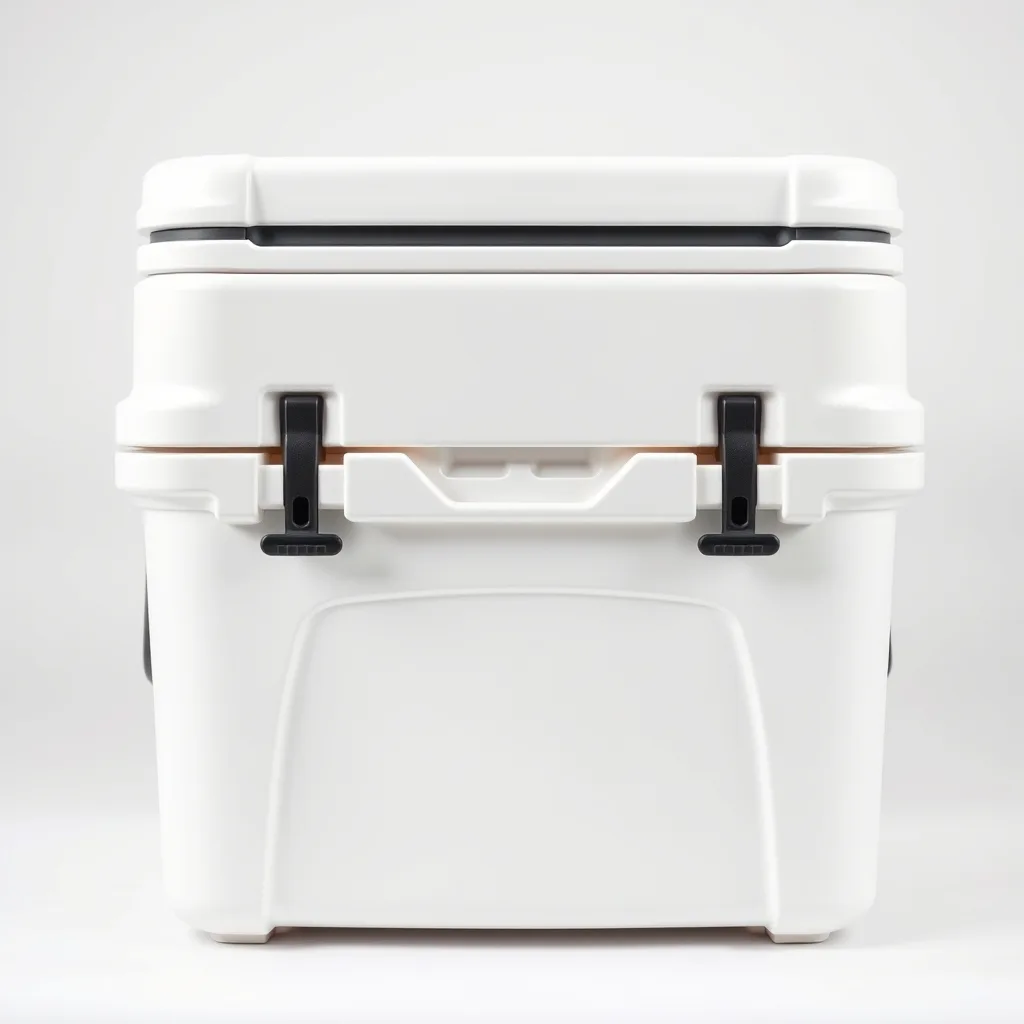
What actually determines ice retention
Insulation thickness and lid seal quality are the two primary drivers of ice retention. Everything else — pre-chilling, ice-to-contents ratio, shade, and how often you open the lid — affects real-world performance, but they're variables you control. The cooler's construction determines the ceiling.
Insulation thickness
Wall insulation in premium coolers is typically polyurethane foam injected under pressure into the cooler shell. Rotomolded coolers achieve 2–3 inches of wall insulation; standard injection-molded or blow-molded coolers typically have 1–1.5 inches. That difference translates directly into ice life — often 2–3x more retention in comparable conditions.
Lid gasket and seal
A freezer-grade lid gasket that seals completely around the perimeter is a standard feature on rotomolded coolers; it's often absent or vestigial on budget models. A poorly sealed lid allows warm air in and cold air out every time you open it, dramatically accelerating melt. Check for a visible continuous gasket and test that the lid closes without gaps before buying.
Drain plug design
An insulated drain plug — with plastic or foam fill rather than a hollow tube — prevents conduction heat loss through the drain. Most premium coolers include this; most budget coolers don't. A hollow metal drain plug will melt ice faster than you'd expect from a small component.
Rotomolded vs injection-molded vs blow-molded
Rotomolded (roto)
Rotationally molded coolers are produced by rotating a mold containing polyethylene powder while it's heated. The result is a seamless one-piece shell with no joints or seams for heat to transfer through. Insulation is injected as foam between the inner and outer shells. This process is expensive — rotomolded coolers typically cost $200–$500+ depending on size — but produces the best passive ice retention available.
Rotomolded coolers are also significantly heavier than equivalent-capacity standard coolers. A 45-quart roto cooler might weigh 22–28 lbs empty; a comparable standard cooler might weigh 8–12 lbs. For anything beyond car-camping, that weight matters.
Injection-molded
The majority of mid-range hard coolers are injection-molded. Separate inner and outer shells are molded and then joined, with foam poured or injected in between. The join seam is a minor thermal weak point, but quality injection-molded coolers from established brands perform well for 1–3 day trips. This is the appropriate construction for most casual camping use.
Blow-molded
Blow molding uses air pressure to form a plastic shell. It's fast and inexpensive, and produces coolers in the $30–$80 range. Insulation is thinner, retention is limited to roughly 1 day in warm conditions, and lid seals are minimal. Fine for day use; not appropriate for multi-day trips where food safety depends on maintaining cold temperatures.
Shopping for camping coolers? Browse current eBay listings → (we earn a small commission; your price is unchanged).
Capacity: quarts and what they mean
Cooler capacity is measured in quarts of total interior volume. This is the gross volume — it includes the space taken up by ice, which is a substantial fraction of total capacity. A rough rule: plan on using 1–2 lbs of ice per quart of usable food space, or about 30–40% of the total capacity going to ice.
| Capacity | Practical use | Days of food (typical) |
|---|---|---|
| 20–28 qt | Solo day trip or 2-person day use | 1–2 days |
| 35–50 qt | 2–4 person weekend trip | 2–4 days (with good ice management) |
| 55–75 qt | Family car camping, 4–6 person | 4–7 days |
| 100+ qt | Large groups, base camp, extended trips | 7+ days with rotomolded construction |
Note that published quart ratings are gross volume. If you have specific requirements — say, a full-size watermelon, a case of 12 oz cans, and enough food for 4 adults for 3 days — measuring or calculating actual volume requirements before buying prevents a common sizing mistake.
Hard vs soft coolers
Hard-sided coolers
Rigid shell; better insulation; survives rough handling; can be sat on; bear-resistance certification is achievable. Heavy when empty; requires dedicated storage space; doesn't collapse when not in use. Appropriate as the primary cooler for any camping trip longer than a day.
Soft-sided coolers
Flexible insulated fabric; lightweight when empty; packable; waterproof liner options available. Ice retention typically maxes at 24–36 hours for quality models under moderate conditions. Best for: day hikes, kayaking, backpacking cooler bags, secondary beverage coolers at car camping. Not appropriate as a primary cooler for multi-day food storage where temperature control is critical.
Bear-resistant certification
Bear-resistant coolers are tested and certified by the Interagency Grizzly Bear Committee (IGBC) or tested against specific protocols by manufacturers. A cooler that is genuinely bear-resistant has a latching mechanism a bear cannot defeat — typically dual latches with a specific design that prevents bears from accessing the contents even under direct physical attack.
Bear certification matters if you're camping in areas with active bear populations where food storage regulations apply. Many national parks and wilderness areas require certified food storage containers; a non-certified cooler in a vehicle doesn't meet this requirement in regulated areas. Check current park regulations before your trip.
Not all rotomolded coolers are bear-certified. Check for the IGBC certification stamp or manufacturer documentation specifically mentioning IGBC testing if this is a requirement for your use case.
Ice management practices that actually matter
- Pre-chill the cooler — 24 hours of pre-chilling with cheap ice or refrigerated contents before loading is the single highest-ROI action for ice retention
- Keep contents cold before loading — hot food in a cold cooler accelerates melt; refrigerate or freeze food before packing
- Fill completely — empty air space in a cooler heats faster than ice-filled space; a full cooler retains ice longer than a half-empty one
- Block ice vs cubed ice — block ice melts significantly more slowly than cubed ice; use block for the bottom layer and cubed ice for fill and easy access
- Keep it in the shade — coolers in direct sun lose ice dramatically faster; even a tarp overhead makes a measurable difference
- Don't drain meltwater early — cold meltwater actively cools contents; drain it only when necessary for weight or when the cooler is too full
Weight trade-offs
A loaded 65-quart rotomolded cooler can weigh 80–100+ lbs. This is a meaningful consideration for any camping scenario that isn't a drive-to-site setup with truck or SUV access. For canoe tripping, kayaking, or portaging, standard hard coolers or soft coolers are more practical despite the retention trade-off.
Find camping coolers on eBay
We earn a small commission on qualifying sales; your price is unchanged. Full disclosure.
 Rotomolded cooler
Best retention; 2"+ walls; freezer gasket; heaviest option.
View on eBay →
Rotomolded cooler
Best retention; 2"+ walls; freezer gasket; heaviest option.
View on eBay →
 Hard cooler
Mid-range retention; lighter and less expensive than roto.
View on eBay →
Hard cooler
Mid-range retention; lighter and less expensive than roto.
View on eBay →
 Wheeled cooler
Telescoping handle + inline wheels; practical on firm surfaces.
View on eBay →
Wheeled cooler
Telescoping handle + inline wheels; practical on firm surfaces.
View on eBay →
 Soft cooler
Lightweight; packable; 1–2 day retention; best for day trips.
View on eBay →
Soft cooler
Lightweight; packable; 1–2 day retention; best for day trips.
View on eBay →
 Camping cooler 50 qt
Benchmark size for 2–4 person weekend trips; fits most vehicle cargo areas.
View on eBay →
Camping cooler 50 qt
Benchmark size for 2–4 person weekend trips; fits most vehicle cargo areas.
View on eBay →