Burner count: matching stove size to cooking needs
Single-burner stoves
A single-burner stove is appropriate for solo and two-person backpacking and lightweight camping. You cook one thing at a time. For simple camp meals — boiling water for coffee, heating a one-pot dinner — a single burner is all you need and saves significant weight and pack space.
Single-burner designs also dominate the backpacking category for obvious reasons. A compact isobutane canister stove with a folding windscreen can weigh under 3 oz and cook breakfast in under 5 minutes.
Two-burner stoves
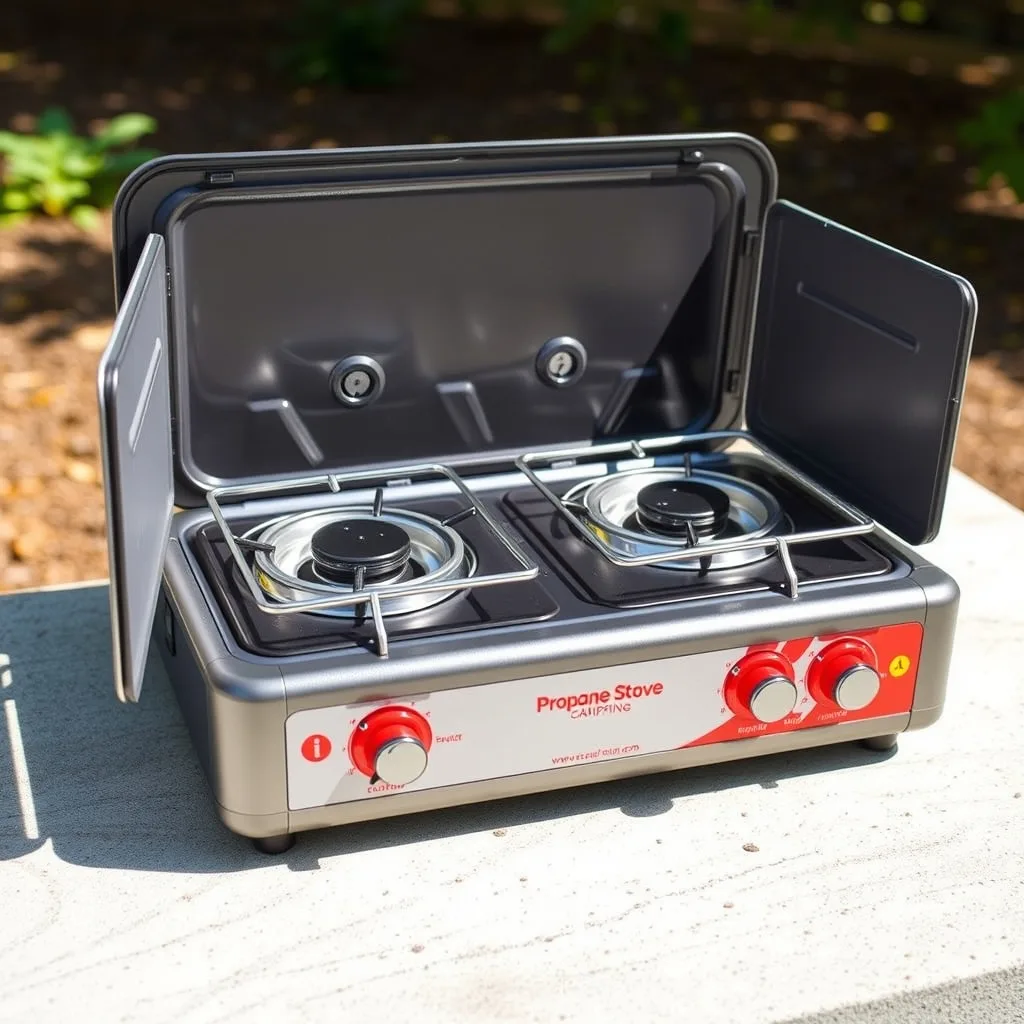
The two-burner camp stove is the standard for car camping and group cooking. Running a main dish on one burner and a side on the other simultaneously makes meal preparation practical at camp rather than just tolerable. Two-burner stoves typically connect to propane via a standard 1 lb green canister or via a hose to a bulk tank.
Most two-burner stoves fold into a case-style form factor for transport. Key things to check: independent control valves for each burner (so you can simmer on one while running high on the other), grate quality, and windscreen design.
Three-burner stoves
Three-burner stoves exist for larger groups or cooking setups that involve multiple simultaneous dishes. These are less common and typically heavier; they're most appropriate for established base camps rather than weekend car camping.
Fuel types
Propane (canister)
Standard green 1 lb propane canisters (Coleman-style) are the most common fuel for car-camping two-burner stoves. Propane provides consistent pressure down to around 20°F (-7°C), after which output drops. Canisters are widely available at gas stations, hardware stores, and outdoor retailers. You can also run larger two-burner stoves from 5 or 20 lb bulk propane tanks via an adapter hose, dramatically reducing cost per meal and avoiding the waste of partial canisters.
Isobutane-propane blends (canister backpacking)
Backpacking stoves typically use threaded Lindal-valve canisters filled with isobutane-propane or butane-propane blends. The isobutane component maintains reasonable pressure at lower temperatures compared to pure butane (which falters below about 32°F/0°C). Common blend ratios are 80% isobutane/20% propane or 70%/30%. These canisters are not interchangeable with standard green propane canisters — check the threading and valve type before buying.
In cold weather (below 20°F/-7°C), even iso-butane blends lose pressure and output. For cold-weather backpacking, warm the canister in a jacket before use or consider liquid fuel.
White gas / liquid fuel (multi-fuel)
Liquid-fuel stoves (MSR WhisperLite, Optimus Nova, and similar) run on white gas (Coleman fuel), unleaded gasoline, kerosene, or diesel depending on model. Liquid fuel provides excellent cold-weather performance because it vaporizes under pressure inside the stove rather than relying on canister pressure. Output is consistent even at temperatures well below 0°F.
The trade-offs: liquid fuel stoves require priming (a small controlled burn to pressurize the fuel line), are more mechanically complex, and require cleaning after extended use. They're the appropriate choice for expeditions in sustained cold, high-altitude mountaineering, and international travel where canister fuel isn't reliably available.
Shopping for camp stoves? Browse current eBay listings → (we earn a small commission; your price is unchanged).
BTU output: what it means and what it doesn't
BTU (British Thermal Units) per hour is the measure of a stove's maximum heat output. A higher BTU stove can boil water faster and handle larger pots. However, BTU output is only part of the cooking picture.
| BTU range | Category | Best for |
|---|---|---|
| Under 5,000 BTU | Ultralight backpacking | Boiling water; simple one-pot meals; not suitable for simmering or large pots |
| 7,500–10,000 BTU | Standard backpacking | Typical backpacking cooking; adequate for simmering with care; covers most camp meal needs |
| 10,000–14,000 BTU per burner | Car-camping standard | Practical for all camp cooking; boils water quickly; handles cast iron adequately |
| 15,000–20,000+ BTU per burner | High-output / group cooking | Large pots, faster boil times, wok cooking; diminishing practical returns for most camp meals |
The limitation of high BTU output without low-end control is the inability to simmer. A 20,000 BTU burner that can't turn down below 8,000 BTU will scorch sauces and eggs. For actual cooking (not just boiling), look for a wide BTU range — high ceiling for fast heat, low floor for simmering — rather than just maximum output.
Wind resistance
Wind is the single biggest factor reducing stove efficiency in the field. Even a light wind of 5–10 mph can triple boil times and dramatically increase fuel consumption. Wind protection design varies significantly across stoves:
- Integrated windscreens: Two-burner stoves typically have fold-up side panels that provide meaningful wind protection. Better designs have taller panels and a top lip that traps heat around pots.
- Recessed burner heads: Some backpacking stoves place the burner in a recessed pot stand that blocks wind. More effective than exposed burner heads with an aftermarket windscreen.
- Separate windscreens: An aftermarket reflector/windscreen is one of the most cost-effective upgrades for any stove. A simple piece of foil or thin aluminum in a U-shape can cut boil times meaningfully.
- Internal combustion designs: Some premium backpacking stoves (Jetboil, MSR Reactor) integrate the pot, burner, and heat exchanger into a system that's inherently resistant to wind. These are significantly more efficient in wind but limit you to the proprietary pot.
Car-camping vs backpacking stove comparison
| Feature | Car-camping stove | Backpacking stove |
|---|---|---|
| Burners | 2–3 | 1 |
| Fuel | Propane canister or bulk tank | Isobutane blend canister or liquid fuel |
| Weight | 3–8 lbs | 2–14 oz |
| Packed size | Case-style; fits in vehicle | Fits in palm or inside a pot |
| Cooking capacity | Full camp cooking; multiple dishes | One pot at a time; boiling and simple cooking |
| Grate size | Fits 12-inch pans | Fits 1–2L pots; limited stability for larger pots |
| Price range | $40–$200 | $20–$150 |
Common mistakes to avoid
- Buying a backpacking stove for car camping — you'll cook one thing at a time for a group that expects real meals
- Chasing maximum BTU without checking minimum output — simmering matters more than peak boil time for most camp cooking
- Ignoring wind performance — test your stove in wind before a trip, or bring a windscreen
- Using the wrong fuel type — isobutane canisters don't fit propane adapters; liquid-fuel stoves need the right fuel type for the jet installed
- Not pre-testing ignition — piezoelectric ignitors fail in cold weather; carry a lighter regardless
- Relying on canister stoves below 20°F without cold-weather strategy — pre-warm canisters or switch to liquid fuel for sustained cold
Find camp stoves on eBay
We earn a small commission on qualifying sales; your price is unchanged. Full disclosure.
 2 burner camp stove
Standard for car camping; independent burner control; check grate size.
View on eBay →
Propane camp stove
Green canister or bulk tank; consistent pressure to ~20°F; widely available.
View on eBay →
2 burner camp stove
Standard for car camping; independent burner control; check grate size.
View on eBay →
Propane camp stove
Green canister or bulk tank; consistent pressure to ~20°F; widely available.
View on eBay →
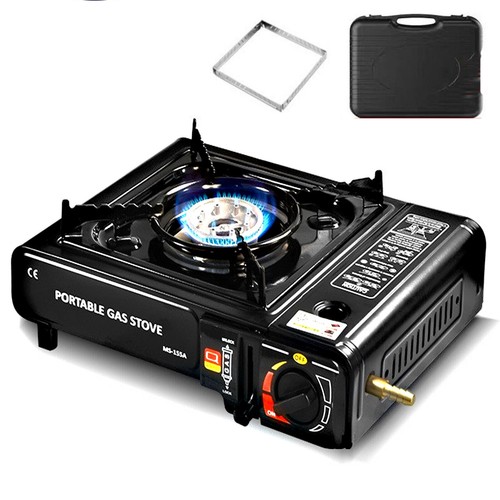 Portable camping stove
Single-burner; compact; for backpacking or solo use. Check cold-weather rating.
View on eBay →
Portable camping stove
Single-burner; compact; for backpacking or solo use. Check cold-weather rating.
View on eBay →
 Camping grill stove
Burner + grill combo for direct-heat cooking; versatile; neither function is top-tier.
View on eBay →
Camping grill stove
Burner + grill combo for direct-heat cooking; versatile; neither function is top-tier.
View on eBay →
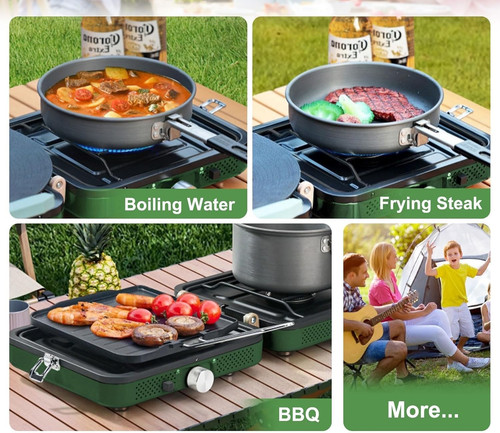 Camp stove with griddle
Two-burner with flat griddle surface; ideal for breakfast cooking. Check material — cast iron holds heat best.
View on eBay →
Camp stove with griddle
Two-burner with flat griddle surface; ideal for breakfast cooking. Check material — cast iron holds heat best.
View on eBay →