Scale length: 34" standard vs 35" for five-strings
Scale length is the distance from the nut to the bridge saddle. It directly affects string tension at a given pitch. A longer scale produces higher tension at the same tuning, which generally improves low-end definition and note clarity, particularly on lower-pitched strings.
The standard bass scale length is 34 inches, used on the vast majority of 4-string basses and many 5-strings. At 34 inches, a standard B string (the lowest on a 5-string) is often described as feeling floppy or losing definition, particularly in the lower positions. A 35-inch scale tightens this significantly. Most premium 5-string basses use 35-inch scale for this reason. There are high-quality 5-strings at 34 inches — the tightness of the B string also depends on string gauge and construction quality — but 35 inches is the reliable solution to low-B tension.
The practical tradeoff: a longer scale means a larger reach between frets, particularly in the lower positions. Players with smaller hands sometimes find a 35-inch scale uncomfortable for extended playing. Short-scale basses (30 inches) exist specifically for players who find standard scale uncomfortable; they have a notably different feel and some tonal character differences.
4-string vs 5-string: range vs playability
A standard 4-string bass is tuned E-A-D-G, covering the range needed for virtually all rock, pop, country, jazz, R&B, and most funk. The 5-string adds a low B below the E, extending the range down a perfect fourth. This is genuinely useful in certain genres: gospel and contemporary R&B use the low B melodically; metal players use it for drop-tuned riffs without retuning; some orchestral bass parts call for notes below low E.
The cost of the fifth string is neck width and weight. A 5-string neck is wider across the nut, requiring a wider hand span or an adjusted right-hand muting technique. String spacing at the bridge is typically narrower on a 5-string to keep the body width manageable. Some players find the narrower spacing comfortable for fingerstyle; others find slap technique harder to execute cleanly.
If you are learning bass and the music you play does not explicitly require a low B, a 4-string is the simpler starting point. Add a 5-string later when you have a specific musical reason for it rather than purchasing one speculatively.
Pickup types: Jazz, Precision, and humbuckers
The two historically dominant pickup configurations in electric bass are the Jazz bass (two single-coil pickups) and the Precision bass (one split-coil pickup). These are not just two ways to get the same sound — they produce meaningfully different tonal characters that work differently in a mix.
Jazz bass pickups
A Jazz bass has two single-coil pickups positioned at the neck and bridge. Used together with equal volumes, they hum-cancel each other (RWRP — reverse-wound reverse-polarity). The bridge pickup alone produces a tight, nasal, growly tone with pronounced upper-mids and highs. The neck pickup alone produces a warm, fat, less articulate tone. The blended sound — both at full — gives articulate mids with a scooped character. Jazz bass pickups sit further forward in a mix because of their mid-range clarity and note definition. Much of the recorded bass in jazz, soul, and contemporary R&B uses this configuration.
Precision bass pickups
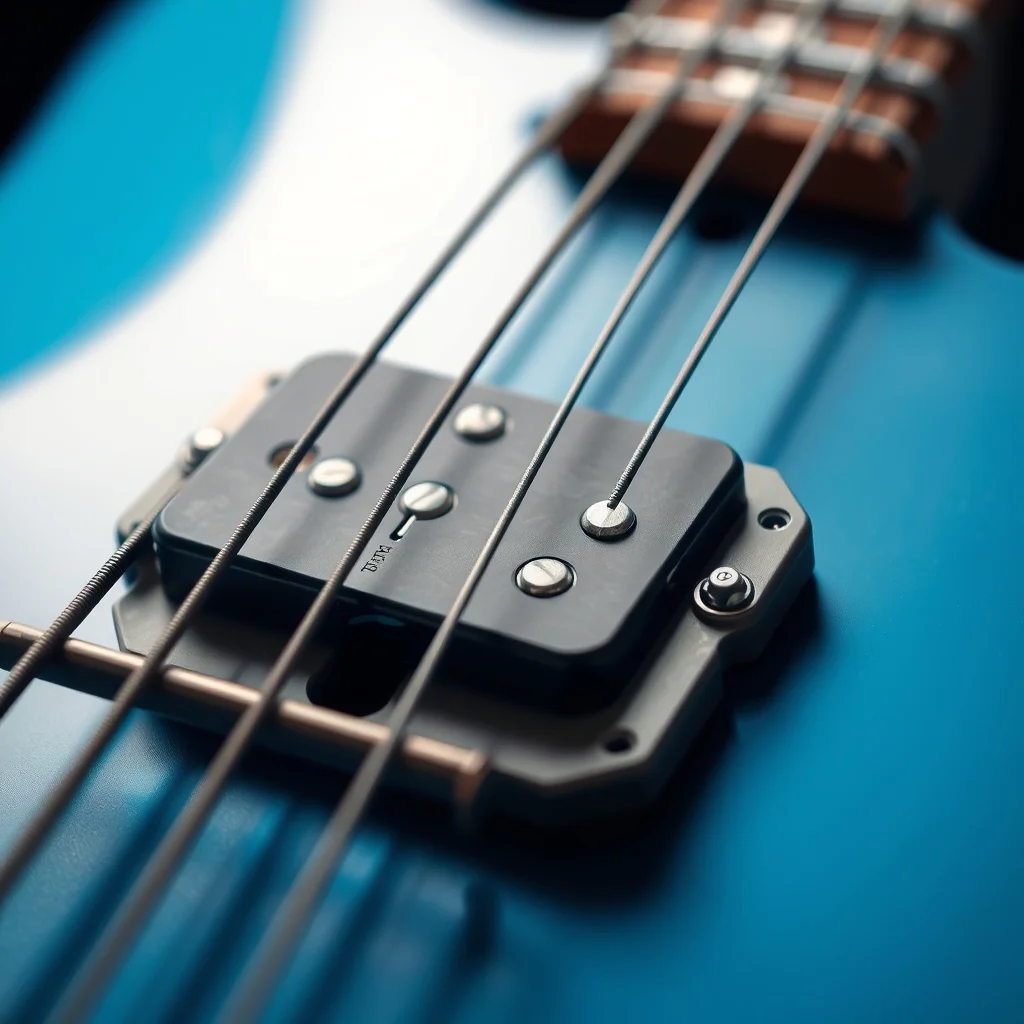
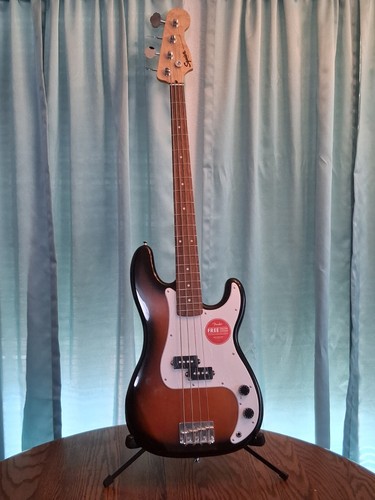
A Precision bass has a single split-coil pickup positioned in the middle of the body. Each coil covers two strings; the coils are reverse-wound, making the pickup hum-cancelling inherently. The tone is punchier, rounder, and sits lower in a mix than a Jazz bass — it has less high-end articulation and more fundamental. Motown recordings, classic rock bass lines, and country bass work heavily in this character. A Precision bass has a simpler control set: one volume, one tone. There is nothing wrong with this simplicity.
Humbuckers
Some bass designs use full-size humbuckers (common in extended-range and metal-oriented basses) or dual-coil soapbar pickups. These produce a higher-output, thicker sound with excellent hum rejection. Musicman's StingRay popularized a single bridge humbucker configuration that has its own distinct character — aggressive mids, strong sustain, works well for slap bass. Many modern instruments mix configurations: a Jazz pickup at the neck and a humbucker at the bridge, giving tonal versatility.
Shopping for bass guitars? Browse current eBay listings → (we earn a small commission; your price is unchanged).
Active vs passive electronics
This is one of the most commonly confused distinctions in bass gear. The pickups themselves can be passive (no battery required) or active (require battery, have higher output, lower noise). The preamp/EQ circuit can also be active (requires battery, boosts or cuts frequency ranges) or passive (a simple tone control that only cuts). These two layers are independent.
Passive bass
A passive bass has passive pickups and a passive tone control. No battery required. The circuit is simple and largely failure-proof on stage. Passive basses are typically described as having a more "organic" or "natural" character — this is partly real (the absence of an active circuit in the signal path) and partly the character of the pickups themselves. A passive Jazz or Precision bass is the most common recording bass configuration in history. The limitation is that the tone control is a passive low-pass filter — it only cuts; it cannot boost treble.
Active preamp
An active preamp (also called an "onboard preamp") adds a battery-powered EQ circuit to the signal chain. This lets you boost as well as cut bass, mids, and treble from the instrument itself, before it reaches an amp or interface. Useful for players who need different tones without reaching for the amp. Also typically increases output level, which can be useful for long cable runs in live settings. The common bass preamp formats are 2-band (bass and treble) and 3-band (bass, mid, and treble). The downside: battery dependency, slightly more complex wiring, and some players find the sound character less natural.
Neck profile and nut width
The neck profile (the cross-sectional shape when looking at the neck end-on) and nut width affect how comfortable a bass is to play over extended sessions. Common profile shapes are C (rounded, general-purpose), U (chunkier, traditional), and D (flatter back, fast playing). Most players develop a preference through trying instruments rather than from spec sheets.
Nut width on a 4-string typically ranges from about 1.5 inches (38mm) for Jazz-style basses to 1.625 inches (41.3mm) for Precision-style basses. The wider nut gives more spacing between strings for fingerstyle but can feel wide for players with smaller hands. Five-string basses are typically 1.75–1.875 inches (44–47mm) at the nut.
Strings: roundwound vs flatwound
The string type significantly affects tone and feel. Roundwound strings (the industry standard today) have a bright, articulate sound with pronounced finger noise on the strings. Flatwound strings have a smooth outer wrap, produce a darker, mellower tone with no finger noise, and have a different feel under the fingers — smoother, less grippy. Flatwound strings are strongly associated with vintage Motown and jazz tones. Many players start on roundwounds and explore flatwounds once they have a clearer sense of the tone they want.
Shop bass guitars on eBay
We earn a small commission on qualifying sales; your price is unchanged. Full disclosure.
 Bass guitar 4 string
Standard 34" scale covering all main genres. View on eBay →
Bass guitar 4 string
Standard 34" scale covering all main genres. View on eBay →
 Jazz bass
Dual single-coil config, articulate mids. View on eBay →
Jazz bass
Dual single-coil config, articulate mids. View on eBay →
 Precision bass
Split-coil punch, classic Motown/rock character. View on eBay →
Precision bass
Split-coil punch, classic Motown/rock character. View on eBay →
 5 string bass
Low-B extension. 35" scale recommended for tension. View on eBay →
5 string bass
Low-B extension. 35" scale recommended for tension. View on eBay →
 Bass guitar starter pack
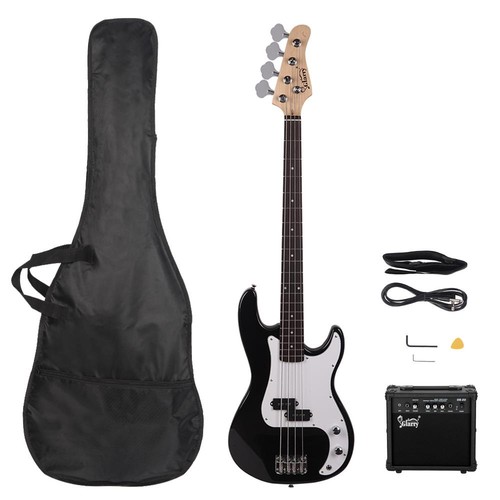
Complete beginner bundle with amp. View on eBay →
Bass guitar starter pack
Complete beginner bundle with amp. View on eBay →