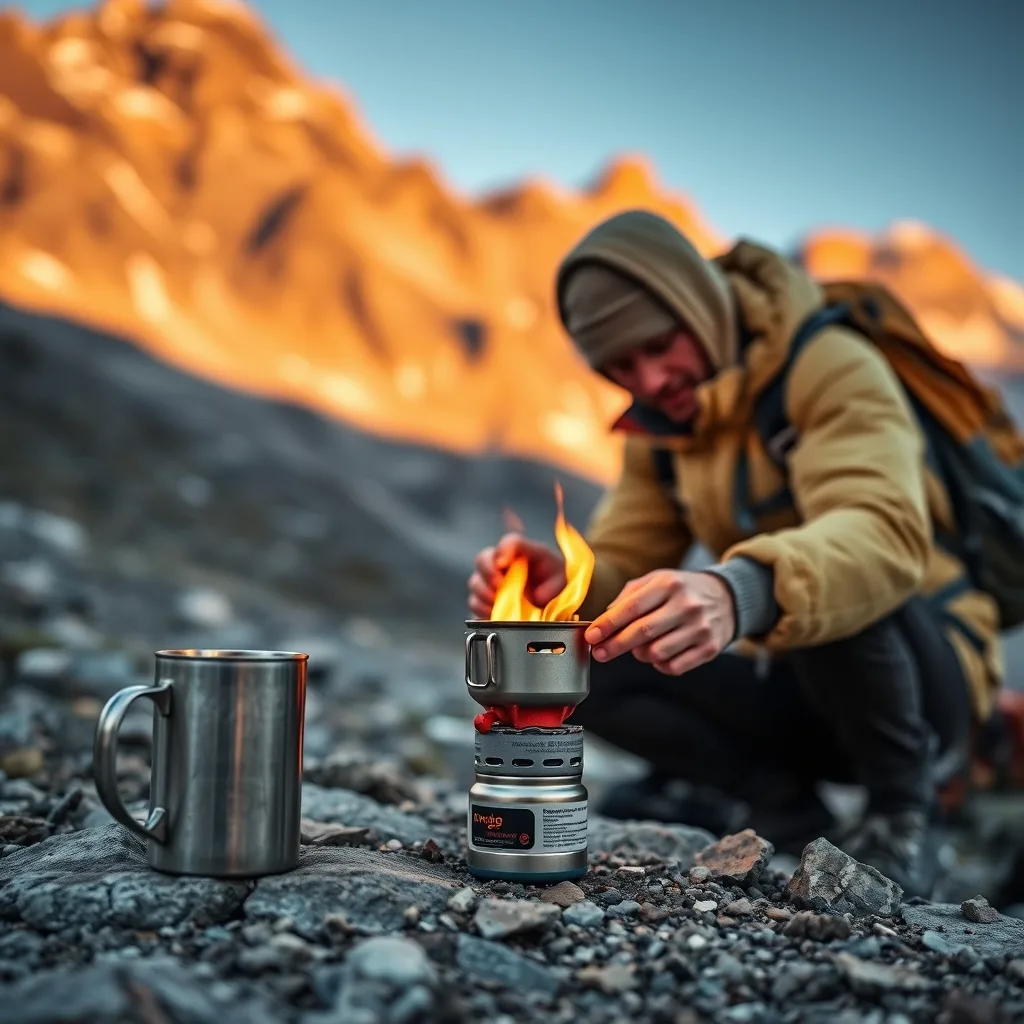
The fundamental split: canister vs liquid fuel
Almost every backpacking stove debate starts with the wrong question. People ask "which stove is the best" when the question that actually matters is: where are you cooking, for how long, at what temperature, and can you resupply your fuel?
Isobutane/propane canister stoves (Pocket Rocket, Jetboil, BRS-3000T, Soto Windmaster) are convenient. Screw on a canister, light it, done. The fuel is pressurized and vaporizes readily — at room temperature and mild elevations, these stoves perform well. Their weaknesses are predictable: below about 20°F (−7°C), isobutane doesn't vaporize efficiently, and output drops noticeably. And when the canister is below half-full in cold conditions, performance degrades further because the remaining fuel is under less pressure.
Liquid fuel stoves (MSR Whisperlite, DragonFly, Optimus Nova) use white gas, kerosene, unleaded gasoline, or jet fuel depending on model. You pump the fuel bottle to build pressure, prime the stove, and burn with consistent output regardless of temperature or altitude. They weigh more and require more maintenance, but they don't care about the cold and they run on fuel you can buy at a gas station worldwide.
The weight math changes with trip length
Ultralight hikers often cite the BRS-3000T at 25 grams as evidence that canister stoves win on weight. That comparison ignores the fuel container. For a solo three-day trip, a 100g isobutane canister (roughly 100g of fuel, ~200g total with the canister) plus a sub-100g stove creates a very light system. But the canister doesn't scale: you can't bring half a canister.
For a solo ten-day trip or a group of four cooking real meals, you're looking at multiple canisters. An MSR Whisperlite International weighs about 370g with pump, but you carry fuel in a reusable aluminum bottle — you bring exactly as much fuel as you need, no dead canister weight. At the ten-day threshold for two people, the Whisperlite system often wins on total fuel-container weight.
| Stove | Stove weight | Fuel type | Boil time (500ml, calm) | Cold weather |
|---|---|---|---|---|
| MSR Whisperlite International | ~370g with pump | White gas, kerosene, unleaded | ~3.5 min | Excellent — pressure-regulated |
| Jetboil Flash | ~371g (system) | Isobutane/propane canister | ~100 sec (integrated cup) | Degrades below 20°F |
| MSR PocketRocket Deluxe | ~87g | Isobutane/propane canister | ~3.5 min | Better than most canisters (regulator) |
| BRS-3000T | ~25g | Isobutane/propane canister | ~3–4 min | Poor — no regulation |
MSR Whisperlite International: the expedition standard
The Whisperlite has been in production since 1984 in various iterations. The International version added multi-fuel capability — it burns MSR HEET white gas (the preferred fuel for performance), unleaded automotive gasoline (emergency use), kerosene, and naphtha. This matters for international travel: in developing countries or remote areas, isobutane canisters are often unavailable outside outdoor specialty stores in major cities, but unleaded fuel is available at every roadside garage.
Setup requires priming — you open the fuel valve briefly, let a small amount of liquid fuel pool in the priming cup, and light it to heat the fuel line. This takes 30–60 seconds and produces a brief flare-up that can alarm new users. Once primed, the stove burns with a steady blue flame and the output is genuinely wind-resistant by design: the burner head sits low and the pot-support structure shields the flame.
Maintenance is real but manageable. The fuel line and jet require annual cleaning if you use the stove regularly; a maintenance kit with spare parts costs under $20. The stove will last decades with basic care. Field repair is practical — the design is simple enough that you can clear a blocked jet with the included shaker jet mechanism by shaking the stove.
Weight is the honest downside. At ~370g with pump, you're carrying more than a Jetboil system and far more than a canister burner. For three-season weekend trips in North America, this weight penalty rarely justifies itself unless you genuinely need multi-fuel capability or expect severe cold.
Jetboil Flash: integrated efficiency, specific use case
The Jetboil Flash is an integrated cooking system — the burner, pot, and insulating cozy are designed to work together with a proprietary flux ring on the bottom of the cup that dramatically improves heat transfer efficiency. Jetboil claims about 100 seconds to boil 500ml of water; real-world times in moderate conditions are typically closer to 2–3 minutes, but still faster than most open-burner canister stoves on equivalent fuel.
The Flash makes the most sense for trips where you're primarily boiling water — freeze-dried meals, coffee, ramen. It's less suited for actual cooking: the integrated cup is 1 liter, simmering is imprecise, and the tall narrow form factor doesn't work well with a wide frying pan or pot. If your camp kitchen involves more than boiling water, you'll want a different stove with a separate pot.
The push-button piezo igniter is convenient but has a finite lifespan and can fail in damp conditions. Carry a lighter. The fuel-level indicator window in the canister cradle is a genuinely useful feature — you can see remaining fuel through a transparent window rather than sloshing the canister.
MSR PocketRocket Deluxe: the mature canister stove
The PocketRocket 2 (the original ultralight version at ~73g) and the PocketRocket Deluxe (~87g) are different stoves. The Deluxe adds a pressure regulator and a WindClip windscreen. The regulator is the important addition: it maintains consistent fuel pressure as the canister depletes and as temperature drops, extending reliable performance further into cold conditions than a non-regulated burner.
At ~87g plus whatever pot you carry, the PocketRocket Deluxe is a practical three-season backpacking stove for solo to two-person use. It's not as light as the BRS-3000T or Snow Peak Litemax, but the regulator meaningfully extends the temperature range and canister efficiency. For shoulder-season trips where temperatures might dip below freezing overnight, the Deluxe earns its slight weight premium over the budget options.
The stove folds flat and stores inside a standard MSR pot (or most 750ml camp pots). No igniter on the standard version — add a long-reach lighter to your kit.
BRS-3000T: the ultralight budget case
The BRS-3000T from Chinese manufacturer BRS weighs approximately 25 grams and retails for under $20. It is legitimately one of the lightest canister stoves made. It is also genuinely fragile by design — the burner arms are thin titanium that can bend if a heavy pot tips, and the folding mechanism loosens with repeated use on some units. Quality control varies; the stove you receive may be perfect or may have a bent arm or a leaky valve.
For summer use by a solo hiker on short trips where the BRS is a backup or an ultralight-priority build, it's a reasonable tool. For year-round use, groups, or anywhere you'll be cooking in meaningful wind or cold, a BRS-3000T is the wrong choice. It has no regulator, no windscreen, and the thin arms don't hold a wide pot stably without a separate pot support.
The honest use case: a gram-counting solo hiker doing summer three-season trips in benign weather, who accepts that the stove might need replacement after a season or two. For anyone else, the Soto Windmaster, Snow Peak Litemax, or PocketRocket Deluxe give more robust performance at a modest weight penalty.
Fuel canister math: how much do you actually need
A standard 100g isobutane/propane canister (e.g., MSR IsoPro, Jetboil JetPower, Snow Peak GigaPower) contains approximately 100g of mixed gas. A 227g canister contains 227g of fuel. At typical backpacking use (boiling 500ml–1L twice per day, short simmer times), a 100g canister lasts a solo hiker roughly 3–5 days depending on conditions, altitude, and whether you're melting snow.
Canister weights: a 100g fuel canister itself weighs about 90–100g when empty; a 227g canister weighs about 200g empty. You carry the canister until it's empty, then carry the empty shell out. For long trips or cold trips where you'll need multiple canisters, the dead weight of empty canisters adds up. A Whisperlite with an 11 oz (330ml) MSR fuel bottle filled with white gas carries ~260g of fuel weight with a ~130g bottle — and you leave exactly as much fuel at the trailhead as you calculate you won't need.
Canister compatibility and fuel blends
All standard backpacking canisters use a Lindal valve fitting — MSR, Jetboil, Snow Peak, GSI, BRS, and essentially every other manufacturer's canister screws onto any standard canister burner. The fuel blend varies: most US brands use an isobutane/propane mix (typically 80/20 or 70/30 isobutane to propane). Propane has a lower boiling point and improves cold-weather performance; pure isobutane canisters exist but are less common.
In countries outside North America and Western Europe, compatible canisters may be unavailable — verify before international trips. Many Asian, South American, and African outdoor stores don't stock Lindal-valve canisters. This is a real logistics problem that liquid fuel stoves solve cleanly.
Three-season solo day through weekend trip: the honest recommendation
For the most common use case — a solo or duo hiker on three-season trips of 2–5 days in North America — the MSR PocketRocket Deluxe or Soto Windmaster paired with a 110g–227g isobutane canister is the right system. Sub-100g stove, reliable performance in moderate conditions, simple and durable. Budget-minded hikers doing summer-only trips can use a BRS-3000T with acceptable results; just don't drop the pot.
Add the Whisperlite International when: international routes, winter mountaineering, or multi-week trips where liquid fuel economics tip in your favor. The stove's longevity — properly maintained units last decades — means it's a buy-once investment if those conditions apply to your hiking life.
The Jetboil Flash earns its place for trips where fast boil-only cooking is the explicit priority: summit days, ultramarathon-style fast-and-light travel, or anyone who cooks exclusively freeze-dried. If you want to actually cook food rather than rehydrate it, skip the Jetboil and use a separate burner and pot.
Search eBay for these stoves
 MSR Whisperlite International
Multi-fuel expedition stove. Check for complete kit including pump, windscreen, and maintenance kit.
MSR Whisperlite International
Multi-fuel expedition stove. Check for complete kit including pump, windscreen, and maintenance kit.
 Jetboil Flash
Integrated canister system. Verify the flux-ring cup and plastic bottom are undamaged.
Jetboil Flash
Integrated canister system. Verify the flux-ring cup and plastic bottom are undamaged.
 MSR PocketRocket Deluxe
Regulated canister burner. Confirm it's the Deluxe (regulator) vs base PocketRocket 2.
MSR PocketRocket Deluxe
Regulated canister burner. Confirm it's the Deluxe (regulator) vs base PocketRocket 2.
 Snow Peak Litemax
~1 oz titanium burner. Pairs well with Snow Peak 450 titanium cup.
Snow Peak Litemax
~1 oz titanium burner. Pairs well with Snow Peak 450 titanium cup.
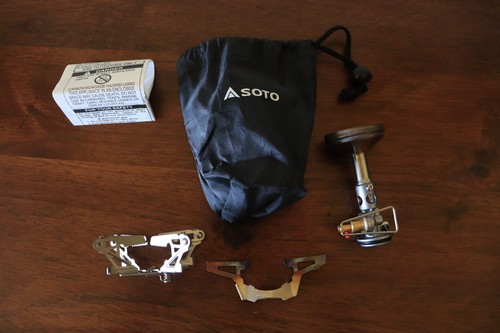 Soto Windmaster
4-flex burner with good wind resistance. Available with optional 4-flex pot support upgrade.
Soto Windmaster
4-flex burner with good wind resistance. Available with optional 4-flex pot support upgrade.