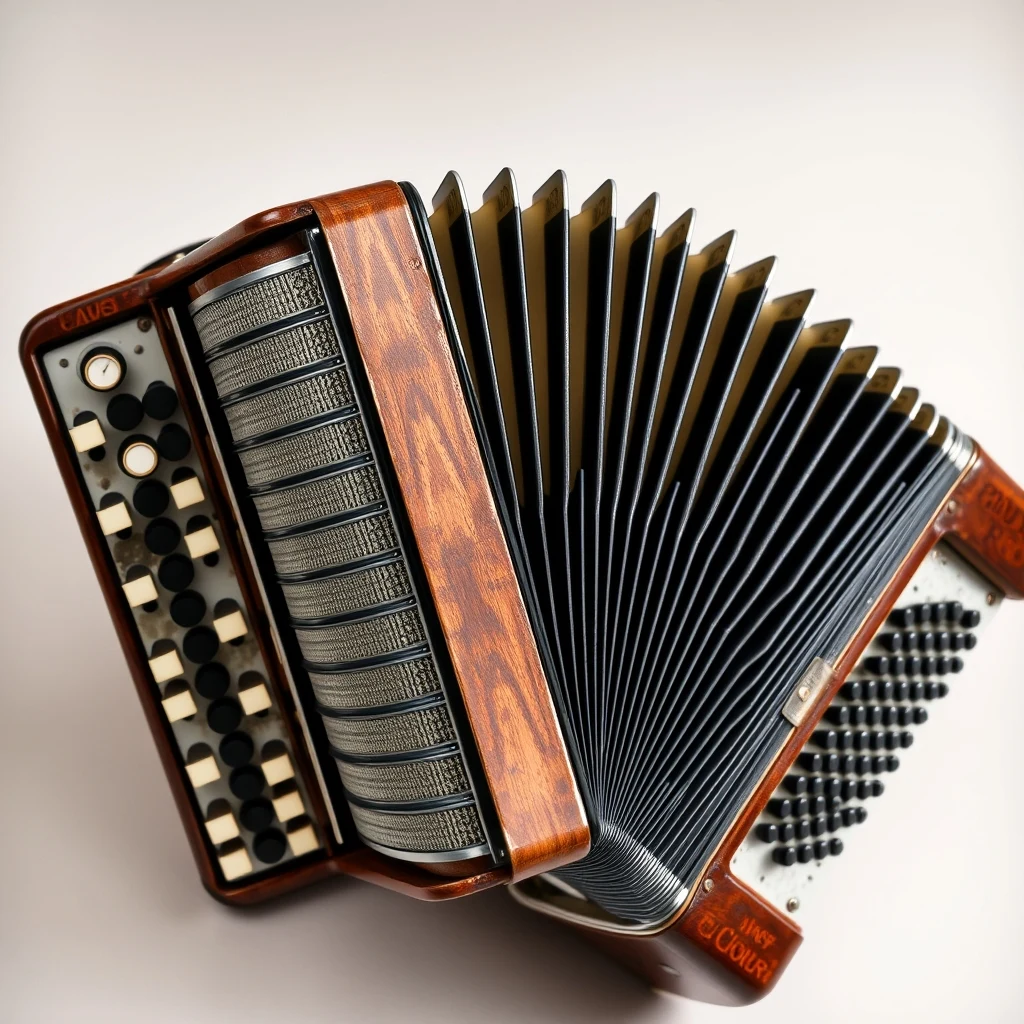
Piano vs button: two different instruments
The most fundamental split in accordion collecting is between piano-key and button-key treble manuals. A piano accordion has a standard piano keyboard layout on the right hand — familiar to any keyboard player. A button accordion (diatonic or chromatic) uses rows of buttons instead of keys.
The choice between them is not primarily aesthetic — it's practical. Piano accordions dominate in North American and popular music contexts. Chromatic button accordions (B-system and C-system) are the standard in Russian, Scandinavian, and classical European accordion traditions. Diatonic button accordions (bisonoric — each button produces two notes depending on bellows direction) are the instrument of choice in Cajun, Tex-Mex, Irish, and other folk traditions.
| Type | System | Primary tradition | Bisonoric? |
|---|---|---|---|
| Piano accordion | Piano keys, right hand | North America, popular music | No — unisonoric |
| Chromatic button (B or C system) | Button rows, right hand | Russia, Scandinavia, classical | No — unisonoric |
| Diatonic button (e.g. 2-row) | Button rows, right hand | Cajun, Irish, Tex-Mex, folk | Yes — push/pull different notes |
Both piano and chromatic button accordions use the same left-hand bass system in most cases — the Stradella system (120 basses in standard configuration) or occasionally a free-bass system on professional instruments. This means the left-hand evaluation is largely the same regardless of treble type.
Italian makers and quality tiers
The town of Castelfidardo in the Marche region of Italy has been the center of accordion manufacturing since the mid-19th century. Most high-quality Italian accordions come from this geographic cluster, which includes nearby towns like Camerano, Osimo, and Porto Recanati. The maker's name on the grille, not a country-of-origin sticker, is what determines instrument quality.
Excelsior
Excelsior accordions were produced in Castelfidardo, Italy and exported heavily to North America from the 1940s through the 1970s. They appeared in professional and semi-professional contexts. The quality of individual instruments varies by model line — Excelsior produced student, intermediate, and concert-grade instruments. The Concert model line (sometimes stamped with a Roman numeral quality designation) used hand-made reeds; student models did not.
Scandalli
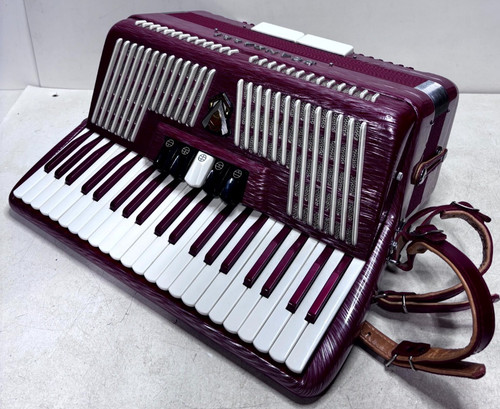
Scandalli is consistently regarded as one of the top Italian accordion makers. The Super VI in particular is one of the most sought vintage piano accordions — it used hand-voiced reeds and high-quality materials throughout. Scandalli instruments are typically well-documented in the accordion community; the model name and serial number can often be researched to determine approximate year of manufacture.
Other significant Italian makers
- Dallape: High-end maker, instruments comparably regarded to Scandalli. Less common in the US market.
- Settimio Soprani: Produced across a wide range of quality tiers. Professional models were genuinely excellent; student models less so. Don't evaluate a Soprani by name alone — find the model designation.
- Crucianelli: Made instruments under their own name and as an OEM manufacturer for some brands sold under other names. Solid mid-grade instruments.
- Hohner (Germany): Not Italian, but the Morino series and Tango series were genuinely professional-grade instruments. Hohner's Castelfidardo-sourced instruments from some eras add complexity — verify the production origin if buying a Hohner specifically for Italian-reed tone.
Reeds: the variable that matters most
The accordion reed is a thin steel tongue riveted to a reed plate. When air passes through the slot in the plate, the tongue vibrates and produces a pitch. The quality of the reed — its material, thickness, shape, and how it was voiced (adjusted for response and tone) — determines the instrument's sound and feel more than almost any other factor.
Hand-made vs machine-made reeds
Professional vintage Italian accordions used hand-made reeds: each reed was individually hand-cut, shaped, and voiced by a skilled reeder. Machine-made reeds (stamped from sheet steel in quantity) produce a more uniform but typically thinner sound, and they respond differently to voicing adjustments.
You generally cannot tell by looking whether reeds are hand-made in a used instrument — this is information that comes from the maker's documentation for the model, or from a knowledgeable technician examining the reeds directly. This is one reason knowing the specific model matters when evaluating Italian instruments.
How to test reed condition when playing
Play every note slowly, with gentle bellows pressure, in both push and pull directions. Listen for:
- Notes that cipher (sound when no key is pressed) — indicates a reed is stuck open or a valve is not seating
- Notes that don't speak at all — dead reed, broken rivet, or stuck valve
- Notes that speak slowly or require heavy pressure — reed is oxidized or slightly out of adjustment
- Buzzing or rattling on a single note — the reed tongue may be cracked, warped, or contacting the plate
Minor reed voicing issues — reed is slightly slow to speak, slightly flat or sharp relative to its neighbors — are often correctable by a competent accordion technician. A dead or cracked reed requires replacement, which is possible but adds to the service cost.
Shopping for accordions? Browse current eBay listings → (we earn a small commission; your price is unchanged).
Bellows inspection: what to check
The bellows is the air reservoir and pump of the accordion. A bellows that leaks allows air to escape without passing through reeds, making the instrument unresponsive and fatiguing to play. Minor leaks are common in older instruments and are often repairable; severe leaks may indicate corner tape failure or torn bellows fabric that requires full replacement.
The leak test
Close all keys and buttons (so no reeds are open). With the bellows clasps released, push the bellows in firmly and hold it under pressure. A tight bellows will hold steady; a leaking one will collapse slowly toward the closed position as air escapes. Repeat pulling the bellows out and holding under tension. Any significant movement indicates a leak.
To locate leaks: a thin bead of light (from a bright lamp behind the bellows in a dark room) or a piece of thin paper held near the folds can identify where air is escaping. Corner leaks (where the bellows fabric meets the frame) are the most common failure mode and are often repairable with bellows tape.
The Stradella bass system
Standard full-size piano and chromatic button accordions use the Stradella bass system on the left hand: 120 buttons arranged in six rows of 20. From left to right: Contrabass, Bass, Major chord, Minor chord, Dominant seventh chord, Diminished seventh chord. The two leftmost rows play individual bass notes; the four rightmost play pre-set chord voicings.
Testing the bass mechanism: press every bass button and every chord button, one at a time. Listen for:
- Silent buttons (no sound at all) — stuck mechanism or broken linkage
- Wrong notes — mechanism is out of alignment or adjusted incorrectly
- Buttons that don't return (spring failure)
- Rattling or clicking from the mechanism — worn parts, but often not immediately critical
Full bass mechanism service — disassembly, cleaning, and lubrication of all 120 bass mechanisms — is a significant professional repair. Factor this into cost if several basses are non-functional.
Weight and register switches
Accordion weight matters practically. Full-size 120-bass piano accordions can weigh 18–26 lbs depending on the number of reeds. A 4-voice (4 sets of reeds) instrument will weigh more than a 2-voice instrument. If you're buying for performance, the weight of the strap system and the weight distribution matters.
Register switches (the switches on the treble and bass grille, sometimes buttons, sometimes sliding tabs) change which reed sets are engaged. A full-size 4-voice accordion typically has 3 treble reed sets (8', 16', 4' — high, normal, low octave) and a master switch plus individual register combinations. Test all register combinations: some registers use only a subset of reeds, and dead reeds may only show up in specific registers.
What a realistic used purchase looks like
Most vintage accordions you encounter have not been maintained in years. They will need at minimum: a bellows check, a reed check, contact cleaning or re-leathering of the valves (the small leather flaps that cover unused reed slots — these harden and crack with age, causing leaks), and possibly a bass mechanism service.
Buying a vintage Italian professional instrument in non-playing condition is a legitimate acquisition strategy if the price reflects the service cost. A Scandalli Super VI in non-playing condition that requires $400–600 in service work is still potentially a good value relative to the instrument in playing condition. A student-grade instrument that needs the same service is not.
Identify the model, assess bellows and reed condition yourself, have a clear picture of what service is needed, and price accordingly. The accordion technician community is relatively small but knowledgeable — finding a qualified tech before buying can save significant money.
Search eBay for vintage accordions
 Italian accordion vintage
Castelfidardo-region makers. Test every reed and check bellows integrity before purchasing.
Italian accordion vintage
Castelfidardo-region makers. Test every reed and check bellows integrity before purchasing.
 Scandalli accordion
Top Italian maker. Super VI particularly sought. Verify model and reed condition.
Scandalli accordion
Top Italian maker. Super VI particularly sought. Verify model and reed condition.
 Button accordion vintage
Diatonic or chromatic. Confirm which system (B/C/diatonic) before buying.
Button accordion vintage
Diatonic or chromatic. Confirm which system (B/C/diatonic) before buying.