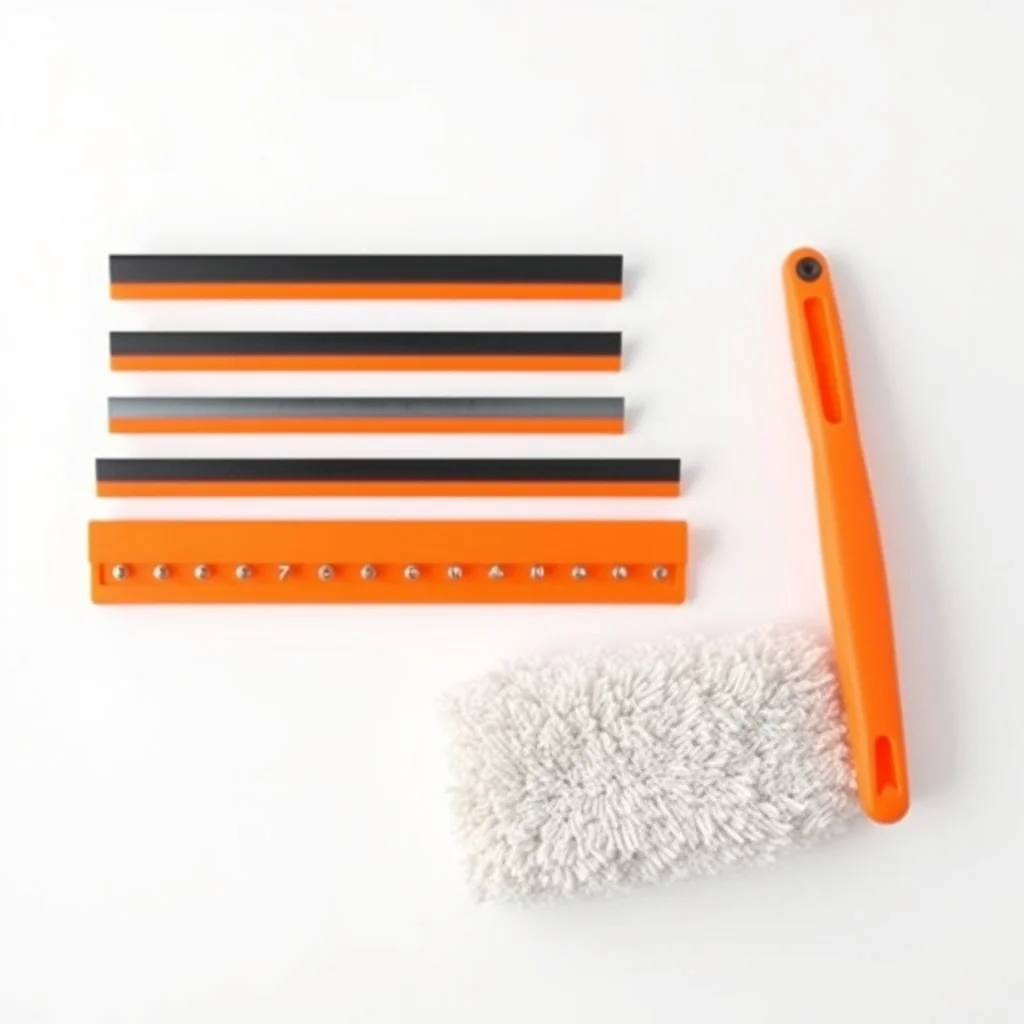
The Core System: Scrubber, Squeegee, and Channel
Most consumer window cleaning goes wrong because people try to clean windows with just a spray bottle and a squeegee — skipping the scrubber that loosens grime before the squeegee makes its pass. Professional window cleaning uses a two-tool system, and the distinction matters.
The scrubber (also called a strip washer or T-bar applicator) is the first tool to use. It has a T-bar handle that holds a washable sleeve — microfiber for light soiling, mop-style strip-washer sleeves for heavy grime and oxidation. You dip or spray the scrubber with cleaning solution, apply it to the glass, and agitate to lift debris. This step does not attempt to leave the glass clean; it loosens everything so the squeegee can remove it.
The squeegee channel holds the rubber blade against the glass. Professional channels (stainless steel or brass) maintain consistent pressure along the full width of the blade. Budget channels flex unevenly, leaving streaks where pressure drops.
The rubber is the consumable that actually removes water. It wears out, hardens in cold weather, and picks up nicks that cause drag lines. Replacing rubber on schedule (or when streaks appear) is the single highest-ROI maintenance task in window cleaning.
Squeegee Rubber: Hardness and Longevity
Squeegee rubber is graded by hardness (Shore A scale), with softer rubber (lower Shore A) working better in cold temperatures and on textured glass, and harder rubber (higher Shore A) working better in heat. Most professional rubber falls between 50–65 Shore A — appropriate for typical room-temperature glass cleaning.
Rubber degrades from UV exposure, contact with harsh chemicals, and physical wear. A squeegee that was streak-free six months ago and now leaves lines probably just needs new rubber, not a new squeegee. Replacement rubber for professional channels (Ettore, Sorbo, Unger, Pulex) is sold by the foot or in pre-cut lengths. It typically costs a few dollars per length versus the cost of a new squeegee.
Signs that rubber needs replacement: visible nicking, a rolled or curled edge, hardening (will not flex easily when pressed), or streaks that appear on clean glass with consistent technique.
Channel Width: Match to Window Size
Squeegee channels range from about 6 inches to 36 inches wide. Matching channel width to window size reduces the number of passes needed and minimizes the risk of water dripping off the channel end.
A general approach: choose a channel width that crosses the window in two or three overlapping passes. For standard residential windows (roughly 24–36 inches wide), a 14-inch or 18-inch channel is appropriate. For very wide glass (patio doors, bay windows), a 22–24-inch channel reduces pass count. For small windows, bathroom glass, or vehicles, a 6–12-inch channel gives better control.
Most professional handles accept interchangeable channels — so one handle can take a range of channel widths. This is far more economical than buying complete squeegees in multiple sizes.
Extension Poles: When and What to Look For
Extension poles let you clean exterior windows on upper floors and high glass without a ladder. They attach to the same T-bar handle and squeegee channel system used for standard window cleaning.
Pole reach: consumer poles typically extend to 5–8 feet; professional poles reach 15–24+ feet. For most single-story homes, a 5–6 foot pole is sufficient for typical window heights. Two-story windows require at least 10–12 feet of reach depending on ceiling height and window placement.
Materials: aluminum poles are affordable and adequate. Carbon fiber poles are lighter and stiffer (less flex at full extension), which matters significantly at 12+ feet. At shorter extensions, aluminum is perfectly serviceable.
Thread compatibility: poles use standardized thread sizes (typically male ACME thread). Most professional window cleaning equipment uses compatible fittings, but verify before mixing brands. Some budget poles use proprietary connections.
Water-fed poles are a separate category — poles with built-in water supply that feed purified water through the head for exterior cleaning without squeegee work. They require a deionization/reverse osmosis water system to produce spot-free rinse water. Genuinely useful for professional-frequency cleaning of large glass areas; overkill for occasional home use.
Shopping for window cleaning tools? Browse current eBay listings → (we earn a small commission; your price is unchanged).
Electric Window Cleaners
Electric window cleaners (cordless handheld units like the Karcher WV series) work by spraying or spreading water on the glass and then using a motorized squeegee to vacuum the dirty water into an onboard tank. They are designed primarily for interior glass: windows, shower screens, bathroom mirrors, and tiled splash areas.
They work well for their intended purpose and eliminate the drip-and-wipe step that manual squeegees require. The tank typically holds enough liquid for 20–30 window passes before emptying. They are not designed for exterior high-reach use or for heavily soiled glass — the motorized squeegee works best with a pre-loosened, pre-wetted surface.
The main limitation is window size. Electric cleaners handle pass widths of about 10–12 inches, so large windows require multiple parallel passes. The cleaning path is straightforward (horizontal or vertical passes) rather than the fanning technique professionals use. Results are good enough for maintenance cleaning of interior glass; they are not a replacement for deep exterior cleaning.
Scrubber Sleeves: Microfiber vs Strip-Washer
Scrubber sleeves attach to the T-bar applicator and are the contact surface for applying cleaning solution. Two main types:
Microfiber sleeves (sometimes called microfiber sleeved applicators) apply solution gently and agitate moderately. They work well for glass that is cleaned regularly — light dust, finger marks, water spots.
Strip-washer sleeves use longer, denser fibers (similar to mop construction) that hold more solution and agitate more aggressively. They are preferred for glass that has not been cleaned recently, for windows with environmental contamination (traffic grime, construction dust), or for heavy water mineral deposits.
Both types are washable and reusable. A sleeve that is not rinsed and dried properly will leave lint on glass. Wring out and hang-dry after each use. Most sleeves fit standard T-bar widths (10 inch and 14 inch are most common), but verify sizing against your T-bar before ordering.
Cleaning Solution: What Actually Works
Professional window cleaning solution is not glass cleaner — it is a low-residue concentrate added to water at small dilution rates (often 1 oz per gallon or less). The goal is to reduce surface tension so the squeegee wipes cleanly, not to add cleaning chemical to the glass surface.
Dawn dish soap diluted heavily in water (a few drops per gallon) is a genuine professional alternative that many window cleaners use. Ammonia-based glass cleaners can work for light cleaning but tend to leave residue if too concentrated and are not appropriate for tinted windows.
Vinegar-based solutions work for water spots (the acid dissolves calcium carbonate mineral deposits) but are not ideal for general cleaning — they do not reduce surface tension well and can leave odor in enclosed spaces.
Buying a Kit vs Individual Components
Window cleaning kits (squeegee + scrubber + handle, sometimes with an extension pole) are convenient but require evaluation of the individual component quality. A kit where the squeegee channel is low-grade stamped aluminum will not hold rubber tension well regardless of what else is included.
The better approach for anyone who wants lasting results: buy a professional channel (Ettore, Unger, or Sorbo are widely available) with replaceable rubber, a T-bar handle, and a scrubber sleeve separately. This costs roughly the same as a mid-range kit but gives you professional-grade components with straightforward consumable replacement.
The Decision in Plain Terms
For standard home window cleaning: a 14-inch or 18-inch professional channel with fresh rubber, a T-bar handle, and a microfiber scrubber sleeve covers most situations. Add a 5–6 foot extension pole if you have single-story exterior windows out of arm's reach. Buy an electric cleaner if you clean interior glass frequently and want to eliminate the drip-management step. Replace squeegee rubber at the first sign of streaking — rubber is cheap; repeat passes and frustration are not.
Search eBay for window cleaning tools
We earn a small commission on qualifying sales; your price is unchanged. Full disclosure.
 Window squeegee professional
Pro channels with replaceable rubber for streak-free results
Window squeegee professional
Pro channels with replaceable rubber for streak-free results
 Window cleaning kit
Complete sets with squeegee, scrubber, and handle
Window cleaning kit
Complete sets with squeegee, scrubber, and handle
 Electric window cleaner
Cordless motorized squeegees for interior glass and shower screens
Electric window cleaner
Cordless motorized squeegees for interior glass and shower screens
 Window cleaning pole
Telescoping poles for high exterior windows without a ladder
Window cleaning pole
Telescoping poles for high exterior windows without a ladder
 Window scrubber
T-bar applicators and replacement microfiber sleeves
Window scrubber
T-bar applicators and replacement microfiber sleeves