
Why the movement matters more than the dial
A watch's dial is its face to the world. The movement is everything that makes it function — and determines whether it will still function in ten years. Two watches that look identical on the wrist can contain movements separated by decades of engineering refinement, wildly different parts-supply situations, and service costs ranging from $150 to $600+.
On the used market, this gap gets exploited constantly. Sellers describe dials, not movements. Auction photos show dials, not movements. Buyers pay dial prices for movement realities. The goal of this guide is to give you the vocabulary to ask the right question: what caliber is inside, and can I verify it?
The Swiss workhorse tier: ETA 2824 and Sellita SW200
The ETA 2824-2 is probably the most widely deployed automatic movement in Swiss watches priced between $300 and $3,000. ETA, owned by the Swatch Group, produced it in enormous volume and licensed it to dozens of brands. You will find ETA 2824 variants inside watches branded as Tissot, Longines (in some configurations), Tudor (historically), Ball Watch, and hundreds of smaller Swiss brands.
Key specs: 25 jewels, 28,800 vibrations per hour (4 Hz beat rate), 38–42 hour power reserve depending on configuration, shock protection (Incabloc or Kif typically). The movement is 25.6mm diameter. ETA produces it in three grades: Standard, Elaboré, and Top — the grades differ in adjustment and finishing but share the same architecture. For a used-watch buyer, the grade matters less than the service history.
The Sellita SW200 entered the market as ETA began restricting supply to non-Swatch Group brands following consolidation moves in the 2010s. Sellita is an independent Swiss manufacturer; the SW200 is dimensionally and functionally interchangeable with the ETA 2824-2 — the same 25.6mm diameter, same 28,800 bph beat rate, same jewel count. The easiest way to confirm which movement is present is to look at the movement itself (requiring caseback removal) or consult the brand's specification sheet for the reference number in question.
| Caliber | Manufacturer | Beat rate | Jewels | Power reserve |
|---|---|---|---|---|
| ETA 2824-2 | ETA SA (Swatch Group) | 28,800 bph | 25 | 38–42 hr |
| Sellita SW200 | Sellita Watch Co. | 28,800 bph | 26 | 38 hr |
| Miyota 9015 | Miyota (Citizen) | 28,800 bph | 24 | 42 hr |
| Seiko 6R15 | Seiko Epson | 21,600 bph | 23 | 50 hr |
| Seiko 4R36 | Seiko Epson | 21,600 bph | 24 | 41 hr |
| Seiko 7S26 | Seiko Epson | 21,600 bph | 21 | 41 hr (no hacking/hand-wind) |
Miyota 9015: the Japanese mid-tier automatic
Miyota is a movement manufacturing subsidiary of Citizen Watch. The 9015 is their flagship automatic, used by a broad range of watch brands positioning in the $200–$800 range: Nomos Glashütte uses a modified Miyota 9015 base in some of their older offerings, Oris used it in early production runs before developing in-house capabilities further, and it appears in contemporary brands like Laco, Junghans, and numerous microbrands.
The Miyota 9015 runs at 28,800 bph and provides 42 hours of power reserve from a single barrel. Diameter is 26mm. Distinguishing it from Swiss alternatives: the rotor system differs in winding direction and efficiency (some users note slightly quieter winding than ETA movements), and the movement has a distinctive bridge layout visible when the caseback is open.
Service intervals for the Miyota 9015 are generally quoted at 3–5 years of continuous use, though many watchmakers note they go considerably longer without degraded performance. Parts availability is good through authorized Miyota parts channels and a robust aftermarket.
Seiko in-house calibers: 7S26, 6R15, 4R36
Seiko manufactures its own movements at facilities including Seiko Epson in Shiojiri, Japan. This gives Seiko watches a vertical integration unusual at their price points — a Seiko with an in-house movement is not "inferior Swiss" but a genuinely different engineering tradition.
7S26: the diver's workhorse
The 7S26 powered the Seiko SKX007 and many other sport Seikos through decades of production. Running at 21,600 bph (3 Hz), it trades some accuracy ceiling against sturdier construction for active use. Notable limitation: the 7S26 does not hack (stop the seconds hand for precise time-setting) and does not allow hand-winding — it charges only through rotor movement. For the used buyer, this means the only way to get the watch to accurate time is to set it while wearing it. Not a practical problem, but worth knowing.
6R15: the upgraded automatic
The 6R15 represents a meaningful step up within the Seiko production lineup. Still 21,600 bph, but it gains hacking and hand-winding capability, and the power reserve extends to approximately 50 hours from a single mainspring winding. The 6R15 is found in models like the Seiko SARB series (including the SARB033 and SARB065, both discontinued) and various Alpinist references. For the used buyer: SARB-series Seikos with the 6R15 represent excellent value propositions — in-house movement, long power reserve, easy serviceability.
4R36: the mid-tier with hacking
The 4R36 sits between the 7S26 and 6R15. It hacks and hand-winds (both features absent from 7S26), provides approximately 41 hours power reserve, and runs at 21,600 bph. Seiko uses it in mid-tier models including the SNZH series and various Seiko 5 Sports references. The used market for 4R36-equipped Seikos is deep and well-understood.
In-house premium tier: Rolex 3135 and Omega 8500
Rolex caliber 3135
The Rolex 3135 is the movement inside most modern Rolex Datejust and Day-Date references produced from the mid-1980s through approximately 2020 (when Rolex introduced the 3235). It runs at 28,800 bph with Rolex's Paraflex shock absorption and Glucydur balance wheel. The movement is COSC-certified (officially rated to ±4 seconds per day) though Rolex describes in-house testing to ±2 seconds/day. The 3135 is a 31.5mm movement with a quick-set date function via the crown.
For used-watch buyers, the 3135 matters because it is a fully proprietary Rolex movement — serviceability requires Rolex parts, which are controlled through Rolex's authorized service network. The practical consequence: a 3135 service is expensive (verify current Rolex Service Center pricing, as it changes regularly) and not easily done by an independent watchmaker without parts access.
Omega caliber 8500 co-axial
The Omega 8500 is a master chronometer-certified movement found in modern Seamaster and Constellation references. The co-axial escapement, developed by George Daniels and acquired by Omega, reduces friction at the escapement lever-to-wheel interface compared to a Swiss lever escapement. Omega states this allows longer service intervals — 8–10 years versus the traditional 3–5 year recommendation — because the reduced friction means less lubricant breakdown.
The 8500 runs at 25,200 bph (3.5 Hz) and provides approximately 60 hours of power reserve. The silicon balance spring (in later production) is antimagnetic and does not require lubrication. Master Chronometer certification means the movement has passed METAS testing to ±0/+5 seconds per day at magnetic fields up to 15,000 gauss.
Dating a watch from movement serial numbers
ETA publishes serial number tables that allow approximate dating of ETA movements. The serial is stamped on the movement plate and readable without disassembly when the caseback is removed. Third-party databases (Ranfft and Caliber Corner are established references, though verify any data against multiple sources) have compiled ETA serial ranges against production years.
Seiko serial numbers follow a different format — the serial on the caseback encodes both factory and year/month of production. The first digit after the case reference number is typically the year's last digit, and the second is the month (1–9 = January–September, O = October, N = November, D = December). This is a caseback marking convention, not a movement serial — the movement caliber is typically engraved on the caseback separately or identified via the model reference.
Rolex movement serials correlate to approximate production years via Rolex's production records. Third-party databases exist (Rolex serial number reference resources are widely available online — verify on manufacturer reference rather than relying on any single source), and Rolex service paperwork lists movement caliber explicitly.
Spotting redials, frankenwatches, and swapped movements
Redials
A redial is a watch whose original dial has been refinished or replaced — either to cover damage or, in more cynical cases, to make a common watch look like a rarer variant. Indicators of a redial:
- Printing that appears slightly raised, soft, or with inconsistent font weight compared to known genuine examples
- Color that doesn't match period-correct versions for the claimed reference
- Applied indices (hour markers) that aren't flush or show adhesive residue around the base
- Serial number on the dial that doesn't match the caseback serial (a common flag for Rolex)
Frankenwatches
A frankenwatch combines parts from different watches — most commonly a genuine case, dial, or hands married to a different movement, or a mix of parts from different reference variants. The motivation is usually to create the appearance of a desirable reference from cheaper component watches.
The most reliable check is cross-referencing movement serial against caseback serial for brands that publish serial tables. For Seiko, the caseback engraving and movement reference should be consistent with each other. For Rolex, the rehaut (inner case ring) engraving should match the caseback serial number, and the dial's serial printing (laser-engraved on modern references) should also match.
When to insist on documentation
For any watch above $1,000 on the used market, insist on the original box and papers where possible, or independent authentication before purchase. The cost of a brief examination by a qualified watchmaker is low relative to the cost of buying a franken or redial. For Rolex specifically, the authentication ecosystem (rotor engraving, rehaut text, serial placement) has become sophisticated enough that a trained eye can catch most fakes — but "most" is not "all." Third-party authentication services or a watchmaker with Rolex familiarity is worth using.
Reading caseback markings honestly
Most casebacks carry the model reference number, caliber number, case serial, water resistance rating, and material designation. Learn to read these together rather than in isolation. A caseback that says "SS" (stainless steel) but shows yellow metal is a problem. A caliber number that doesn't correspond to the brand's stated movement for that reference is a flag.
For transparent exhibition casebacks — common on watches marketed as showing their movements — the movement visible through the glass should match the stated caliber. If you can see the rotor, bridges, and engravings, compare them against reference photos for the claimed caliber before buying. The major calibers covered in this article are well-photographed on enthusiast forums and manufacturer technical sheets.
Search eBay for these watches
 Vintage Omega Speedmaster
Cal. 321, 861, 1861. Check reference number against known production tables.
Vintage Omega Speedmaster
Cal. 321, 861, 1861. Check reference number against known production tables.
 Seiko SKX007
7S26 movement, disc from 2019. Verify dial and bezel insert condition.
Seiko SKX007
7S26 movement, disc from 2019. Verify dial and bezel insert condition.
 Vintage Hamilton mechanical
Railroad-era and ETA-based pieces. Well-documented serial tables.
Vintage Hamilton mechanical
Railroad-era and ETA-based pieces. Well-documented serial tables.
 Tag Heuer Carrera used
Verify reference to confirm movement generation before bidding.
Tag Heuer Carrera used
Verify reference to confirm movement generation before bidding.
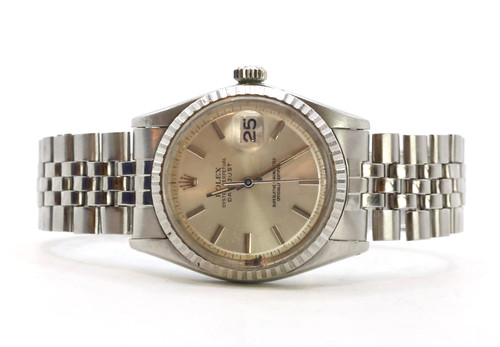 Vintage Rolex Datejust
Cal. 3135 era (post-1988). Rehaut and serial cross-check is mandatory.
Vintage Rolex Datejust
Cal. 3135 era (post-1988). Rehaut and serial cross-check is mandatory.