Tonewheel vs transistor: the fundamental split
The Hammond B3 (and its siblings the C3 and A-100) is not an electronic organ in the modern sense. It is an electromechanical instrument: 91 individual steel tonewheels rotate near electromagnetic pickups, generating sine-wave tones that combine through drawbars to produce the organ's voice. There are no oscillators, no digital samples, no circuits generating the pitch — just spinning metal. This is why the instrument sounds the way it does, and why it demands specific maintenance.
Combo organs — the Vox Continental, Farfisa Compact, and their relatives — are transistor instruments. They generate tones via reed contacts (a form of vibrating metal reed completing a circuit at a specific frequency) or early transistor oscillators. They are lighter, more portable, and do not require the same mechanical servicing as a tonewheel Hammond. But they have their own failure modes: oxidized contact boards, dead reeds, and leaking capacitors in the amplifier sections.
| Instrument | Technology | Era | Key maintenance concern |
|---|---|---|---|
| Hammond B3 / C3 / A-100 | Tonewheel electromechanical | 1955–1975 | Tonewheel oil, capacitor recap, key contacts |
| Vox Continental | Transistor / reed contact | 1962–1973 | Contact board oxidation, dead reeds, wiring |
| Farfisa Compact / Compact Duo | Transistor / reed contact | 1964–1975 | Reed oxidation, voice board capacitors, contacts |
| Hammond M-3 / L-100 | Tonewheel (spinet variants) | 1949–1973 | Same as B3, fewer tonewheels, different chassis |
The Hammond B3, C3, and A-100: what's the same and what differs
The B3 (1955–1974), C3 (1955–1974), and A-100 (1959–1965) are functionally identical in their tonewheel generator, drawbar system, and voice. The differences are cosmetic and structural: the B3 has a flat lid and fold-down legs, making it the most common touring instrument. The C3 has a furniture cabinet with a lower case suitable for churches. The A-100 adds a built-in speaker system with a rotating Leslie-style element inside the cabinet.
All three use the same 91-tonewheel tone generator. Any differences in sound between individual examples are due to the specific condition of the instrument, the oil level in the tonewheel generator, and the age of the capacitors — not to model differences.
The tonewheel generator: what to check before buying
The tonewheel generator is the heart of any Hammond organ. It runs in an oil bath. If the oil level drops, tonewheels can wear, bushings can fail, and the characteristic leakage between adjacent tonewheels (which creates the Hammond's characteristic harmonic bleeding) changes in undesirable ways. The first thing to ask any seller: when was the generator last oiled and serviced?
Generator service involves draining and refilling the oil (Hammond specified a particular oil weight; various modern equivalents work), inspecting and cleaning the contact rails that carry signal from the pickups, and checking for tonewheel wobble or worn bearings. This is specialist work — most Hammond technicians can do it, but not every keyboard tech is a Hammond tech.
What you can check without tools
With the organ powered on and all drawbars pulled to maximum on a single manual, play individual notes across the keyboard. Listen for notes that are weak, missing, or significantly different in volume from adjacent notes — these may indicate a failing tonewheel pickup, a bad contact, or a capacitor leak coupling a DC offset into the signal path. Uniform volume across the compass (even if some notes are slightly different in character) is a good sign.
Capacitor recap: necessary or not?
Hammond organs built in the 1950s and 1960s contain wax-paper and electrolytic capacitors that are now 60–70 years old. Many of these have drifted out of spec or are actively leaking. A "recap" — replacing all of the original capacitors with modern equivalents — is considered standard practice before returning a Hammond to regular use, particularly for the preamp and amplifier sections.
A full recap by a qualified technician typically involves the expression control, the preamplifier, and the built-in reverb (if present on the model). It does not necessarily involve the tonewheel generator itself, which uses different components. Expect the recap alone to be a meaningful expense; budget for it as part of acquisition cost when evaluating a used B3.
Shopping for vintage organs? Browse current eBay listings → (we earn a small commission; your price is unchanged).
Leslie speakers: matching, models, and what breaks
The Leslie speaker is not optional equipment for the Hammond sound — it is integral to it. The Leslie works by spinning a rotor (treble) and drum (bass) in front of fixed speaker elements, creating a Doppler-effect pitch modulation and amplitude variation that gives the organ its characteristic swirl. Without a Leslie, a Hammond sounds fundamentally different — not necessarily worse in all contexts, but not the classic sound.
Leslie models vary significantly. The most collected for Hammond use:
- Model 122: Tube amplifier, single rotor and drum, 40W. Connects to the Hammond via a 6-pin or 9-pin cable depending on the organ. The standard choice for a B3.
- Model 147: Tube amplifier, same rotor/drum configuration as the 122, but the cabinet tilts backward slightly. Functionally similar to the 122.
- Model 251: Solid-state amplifier, stereo output. Later production. Preferred by some players; generally considered less desirable by traditionalists.
- Model 145: Smaller footprint than the 122, tube amp, suitable for smaller venues. Slightly different tonal character due to the smaller cabinet.
The 6-pin vs 9-pin connector issue: early B3/C3/A-100 organs used a 6-pin Leslie connector; later organs used 9-pin. Adapters exist and work reliably, but confirm the cable situation before buying a Leslie-Hammond pair expecting plug-and-play compatibility.
What fails in a Leslie
The rotor motor and drum motor drive leather pads or belts (depending on model) that spin the rotor and drum. These wear out. Replacing them is a standard repair and the parts are available. A Leslie that hums but doesn't spin, or spins at the wrong speed, usually needs motor work or new drive components. The tube amplifier in a 122 or 147 will benefit from tube replacement and may need capacitor service for the same reasons as the organ itself.
Vox Continental: what you're actually buying
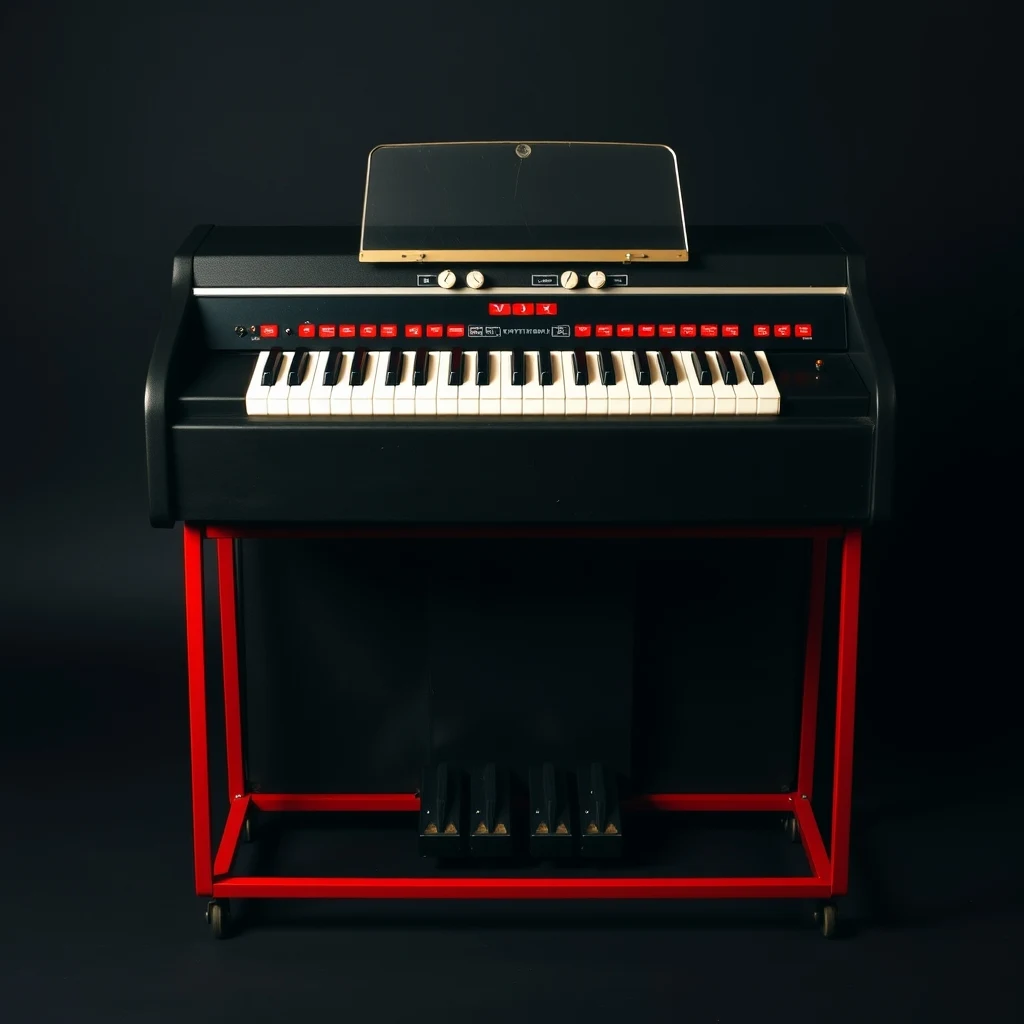
The Vox Continental is a British transistor organ produced from approximately 1962. It uses a reed-contact tone generation system and is famous for its distinctive reverse-color keys (black naturals, white sharps) and the red-angled metal stand. The original Continental is 44 keys; a two-manual version also exists.
Sonically, the Continental produces a bright, reedy, slightly nasal tone that sits very differently in a mix from the Hammond — it cuts through rather than filling harmonic space. This is why it appeared on recordings like "House of the Rising Sun" and "Light My Fire" — it works in a band context where the Hammond would overwhelm.
When inspecting a used Continental: play every key and listen for dead or weak notes. The reed contacts oxidize over decades; a contact cleaner application can revive some, but dead reeds may need replacement or careful manual cleaning. Check the power transformer — originals run on 240V in European models, and US-market units should have been converted.
Farfisa: the Italian counterpart
Farfisa (Fabbrica Armoniche Riunite Fisarmoniche) is an Italian manufacturer whose Compact and Compact Duo models are the most collected. The Farfisa tone is brighter and thinner than the Vox — more nasal, less sustain. It appears prominently in early progressive rock and Italian library music of the 1960s–70s.
Farfisa models vary in the number of manuals, octaves, and register tabs. The Compact and Compact Duo are the 1-manual and 2-manual versions of the same base instrument. The Fast 3 and later models introduced more voices and different construction.
Common failures: the individual voice boards (each controls a specific register) are separate cards that can be individually reseated or replaced. Contact boards again accumulate oxidation. The amplifier section uses electrolytic capacitors that should be replaced after this many decades. Some Farfisas have power supply issues that cause hum or instability — replacing the main filter capacitors in the PSU typically resolves this.
Transport and weight: the practical reality
A Hammond B3 with a Leslie 122 is not a casual acquisition. The B3 alone weighs approximately 400 lbs (181 kg); the Leslie 122 adds another 140 lbs (63 kg) or so. Moving one requires planning, muscle, and ideally a ramp or freight elevator. This is not an exaggeration — Hammond organs have caused injuries and damaged buildings.
Combo organs are far more manageable. A Vox Continental typically weighs around 50–60 lbs without the stand. A Farfisa Compact is similar. These can travel in a van; the Hammond requires a truck and crew.
Factor transport into the total cost of acquisition. Many B3s appear in local listings specifically because they're difficult to move; sellers often price them lower knowing that buyers must arrange their own logistics.
What a pre-purchase inspection looks like
For any vintage organ, in-person inspection before purchase is strongly preferred. Power it on; let it warm up for 10–15 minutes (tonewheel organs in particular). Then:
- Play every note on every manual, all drawbars at maximum.
- Test the expression (volume) pedal — it should be smooth and continuous.
- For Hammonds: engage the vibrato/chorus at every setting; listen for dropout or crackling.
- For combo organs: test every register tab or switch combination.
- Check the keys for broken or missing key return springs.
- Smell the instrument: a burning smell when warm indicates a failing component.
- For Leslies: listen to both speeds (chorale and tremolo) and confirm the speed change is smooth.
Transistor organ alternatives worth knowing
Beyond Vox and Farfisa, several other transistor combo organs appear on the vintage market:
- Acetone: Japanese manufacturer, early models are precursors to the Roland brand lineage. Capable of vintage sounds in their own right.
- Jennings (JMI): British manufacturer that also produced the Vox Continental under license arrangements. Their own instruments share some construction approaches.
- Magnus: American chord organ manufacturer. Lower-end instruments, less collected, but some models have character useful in specific contexts.
- Elka / Galanti: Italian manufacturers producing transistor organs roughly contemporaneous with Farfisa. Less documented in English-language resources but occasionally valuable.
The honest bottom line on buying
If you want the classic Hammond sound and you play in contexts where the instrument is central to the performance — jazz, soul, gospel, classic rock — a real tonewheel B3 with a matched Leslie is irreplaceable. Budget for acquisition, transport, servicing, and the ongoing maintenance an electromechanical instrument requires. It is not a plug-in-and-go purchase.
If you want the combo organ sound for recording, gigging in a band, or budget-sensitive collecting, a Vox Continental or Farfisa Compact is far more practical. They require maintenance but not the same level of investment as a B3. They're portable. And their sounds, while narrower than the Hammond, are entirely their own.
Either way: buy in person when you can, power the instrument on before committing, and budget for at least a basic service — even an instrument in "working" condition may need attention after sitting for years.
 Hammond B3 organ
 Leslie speaker vintage
 Vox Continental organ