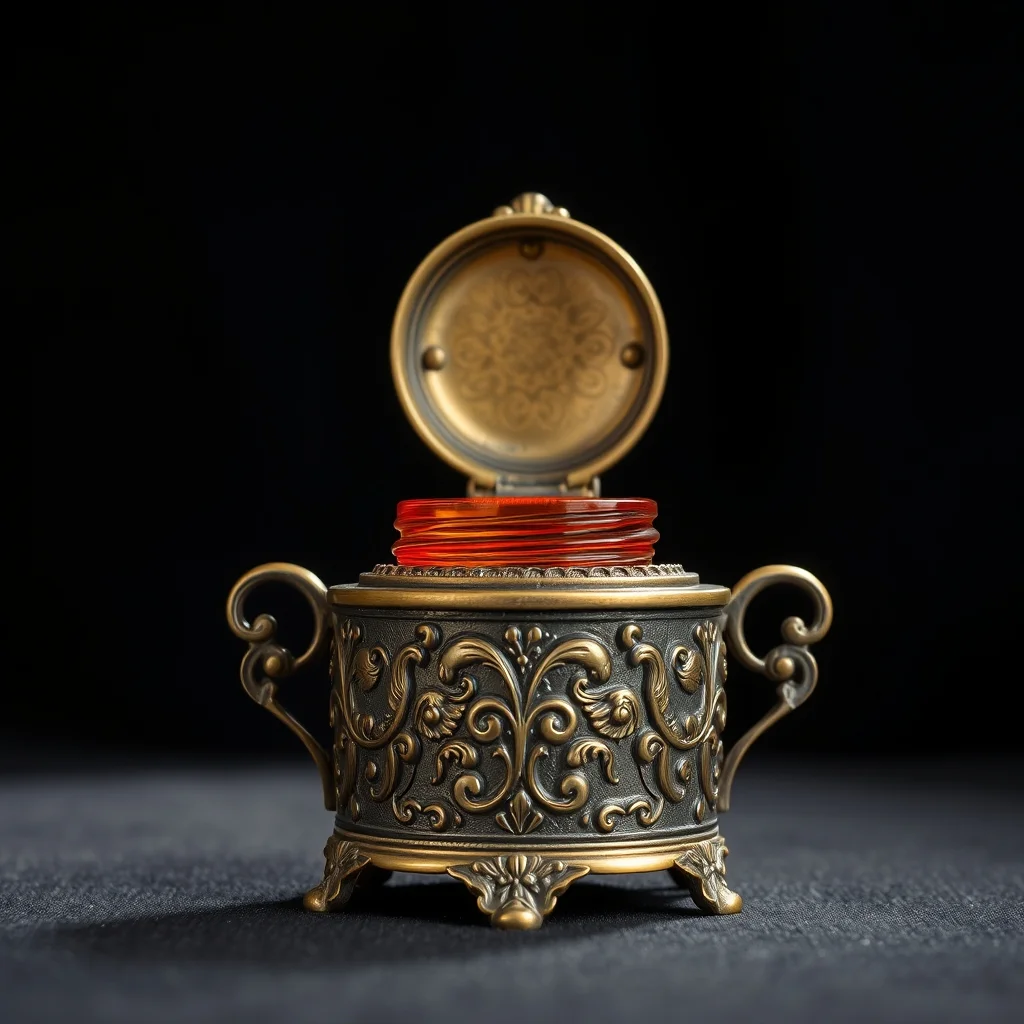
Why inkwells are worth collecting
Inkwells were everyday objects for three centuries, which means they were made in every price tier: cheap pressed glass sold by the gross to schoolrooms, engraved sterling silver presented as wedding gifts, and heavy cast bronze commissioned for executive desks. That range is what makes the category interesting. A serious Victorian standish and a pressed-glass pen rest share a function but not a collector market.
The field is also relatively accessible. Fine examples from recognized makers occasionally surface at general estate sales where the seller doesn't know what they have, and pressed glass examples remain genuinely affordable for beginning collectors. The challenge is developing the eye to tell the difference — and understanding what condition issues matter.
Material categories
Pressed and blown glass
The majority of surviving antique inkwells are some form of glass. Pressed glass — made by pressing molten glass into a mold — was cheap to produce and widely used from the mid-1800s onward. Early American pressed glass inkwells often show a pontil mark on the base (the rough or polished scar left where the glassblower's rod was attached), which can help with approximate dating.
Blown glass examples, where the glassblower shaped the piece by inflating a glass bubble, typically predate the pressed-glass era or represent higher-end production. Cone-neck inkwells — a bulging base tapering to a narrow filling neck — are a common blown glass form. The narrow neck was functional: it minimized evaporation and spills.
Cut glass inkwells, where facets are ground into the surface after blowing, occupy the upper tier of the glass category. Brilliant Period American cut glass (roughly 1880–1915) with deep, sharp miter cuts and a high-pitched ring when tapped is collectible in its own right. Look for the original hinged or removable lid and the metal collar that joined the lid to the glass body — these are frequently missing and their absence reduces value meaningfully.
Bronze and metal
Cast bronze desk inkwells range from unmarked foundry pieces to signed work from recognized studios. Tiffany Studios (New York, active roughly 1893–1933) produced inkwells in their characteristic "Zodiac," "Grapevine," "Venetian," and other patinated bronze patterns, often with favrile glass inserts. Authenticated Tiffany pieces carry strong premiums; the marks to look for include "TIFFANY STUDIOS NEW YORK" impressed into the base with a pattern number.
Bradley & Hubbard (Meriden, Connecticut, late 1800s–early 1900s) produced a large volume of cast-iron and bronze desk accessories including inkwells, often in Mission, Renaissance Revival, or figural styles. Their pieces are typically marked "B&H" with a patent or design number.
Unsigned cast bronze pieces — which represent the majority of what you'll encounter — can still be high quality, and figural designs (owls, horses, ships, Egyptian revival motifs) have their own collector following independent of maker attribution. The quality test is weight, sharpness of casting detail, and the finish on the interior glass or ceramic insert.
Pottery and ceramic
Stoneware inkwells were a staple of American country stores and offices from the colonial period through the Civil War era. Unmarked cylindrical stoneware inkwells with a small filling hole and a larger well for the quill are among the oldest surviving American-made examples. English pottery inkwells — particularly those marked with a maker's stamp on the base — attract specialist collectors.
Art pottery studios including Rookwood, Weller, and Roseville produced inkwells as part of their desk accessory lines, typically in the 1900–1930 period. These carry full art pottery premiums when in fine condition with clear marks.
Form factors and their implications
Desk or standish sets
A standish is a writing desk tray holding multiple inkwells (typically two — one for black ink, one for red) plus a sandbox or pounce pot for drying ink, a pen tray, and sometimes a taper holder or seal. Complete Victorian standish sets in sterling or Sheffield plate are among the more valuable pieces in the category — completeness matters enormously. A standish missing even one component is significantly less desirable than a complete set.
Traveling inkwells
Designed for field or coach use, traveling inkwells had to be leak-proof. The dominant design was a screw-top or bayonet-lock cap with a cork or rubber gasket. Silver-plated and sterling traveling inkwells, often in an oval or rectangular form to fit a vest pocket, were produced in large quantities in the Victorian and Edwardian periods.
The condition test for traveling inkwells is threefold: the seal mechanism still works (cap closes firmly, gasket is intact or cleanly replaced), the glass or metal interior is uncracked, and any original case or pouch survives. A fine traveling inkwell in its original fitted leather case is notably more collectible than the same piece loose.
Shopping for antique inkwells? Browse current eBay listings → (we earn a small commission; your price is unchanged).
Reading maker marks
Not all antique inkwells are marked, and the absence of a mark doesn't indicate low quality — many fine pieces were made by workshops that didn't bother to mark desk accessories. But when marks are present, they're useful.
English silver inkwells carry full hallmarks: maker's mark, assay office mark (lion passant for sterling), date letter, and city mark. The date letter allows you to pin English silver pieces to a specific year of manufacture with reasonable precision. American silver pieces from the late 1800s onward often carry a maker's mark (Gorham, Tiffany & Co., Howard & Co.) and a purity stamp ("STERLING" for American silver after roughly 1860).
Pressed glass manufacturers rarely marked individual pieces. Attribution to specific glasshouses — Heisey, Cambridge, New England Glass Company — typically relies on pattern identification matched against reference catalogs rather than marks. The Glass Collector's Digest and specialist references for American pattern glass are the tools here.
For bronze pieces, look for impressed marks on the base or underside of any attached tray. Marks on Tiffany Studios pieces are typically crisp and deep; later reproductions often have shallower or slightly blurry impressions.
Condition issues specific to inkwells
Ink staining
Interior ink staining is nearly universal in used inkwells and is generally accepted by collectors as evidence of use. Exterior staining — drips down the side, staining on the lid hinge — is a different matter and reduces desirability. Heavy exterior staining that has etched or permanently discolored glass is a significant condition issue.
Chips at the lip
The filling opening of a glass inkwell is the most vulnerable point. Chips at the lip — where a pen nib was wiped repeatedly — are common. Minor chips are generally priced in; large chips that compromise the function or appearance of the mouth reduce value substantially.
Missing lids and inserts
Many inkwells originally had glass, ceramic, or metal liners (inserts) and hinged or removable lids. When these are missing, the piece is incomplete. Replacement inserts exist and are sometimes used to restore the appearance of a piece, but original hardware surviving intact is the preferred condition.
Replated or repainted bronze
Original patina on cast bronze develops slowly and is difficult to replicate convincingly. Factory-applied lacquer or later replating is usually identifiable by its uniformity — original patina is uneven in a natural way. Avoid pieces that have been stripped and mechanically polished, as the original surface texture is lost.
What to look for at estate sales
Estate sales and general antique shows are where the better finds still happen, because sellers don't always know what category an item belongs to. A few practical notes:
- Check the base for marks before assuming something is unmarked. Bronze pieces in particular may have a mark only visible when the piece is lifted.
- Test traveling inkwell caps: screw the top fully closed and check that it seats without wobble. A degraded gasket can be replaced, but a bent or cracked cap cannot.
- On glass pieces, hold the piece up to the light and look for hairline cracks that are invisible in normal light.
- On standish sets, count all components before buying — pen tray, pounce pot, both wells. Ask if there were other pieces the seller has separated.
- Stoneware inkwells often sit in general "crockery" lots rather than with other writing items. The cylindrical form with a small well opening is distinctive once you know to look for it.
Building a coherent collection
Inkwells reward focus. Collections organized around a single material (all glass, or all bronze), a period (Victorian specifically), a form (traveling inkwells only), or a maker (Bradley & Hubbard, or Art Nouveau unsigned bronzes) are generally more satisfying — and more legible to future buyers — than mixed accumulations.
The traveling inkwell sub-category is particularly manageable for new collectors: the pieces are small, relatively self-contained, and the condition criteria are clear. Glass traveling inkwells in original cases are genuinely scarce and command real premiums when they appear.
At the high end, Victorian standish sets with full provenance and documentation represent one of the few areas of this market where condition is almost everything — a complete set in fine condition is worth multiples of an incomplete set in identical individual piece condition.
Antique inkwells on eBay
We earn a small commission on qualifying sales, and 90% of it goes to charity (you can pick which); your price is unchanged. Full disclosure.
 Antique glass inkwell
Pressed, blown, and cut glass. Check lip condition and original lid hardware.
View on eBay →
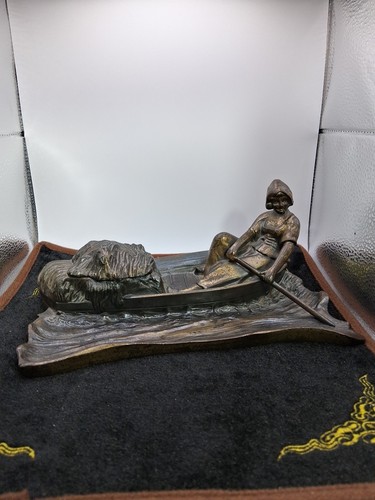 Vintage bronze inkwell
Cast bronze with glass inserts. Check base for maker marks and original patina.
View on eBay →
 Victorian inkwell antique
Sterling-mounted or pewter-lidded Victorian desk pieces. Standish sets command full premiums.
View on eBay →
 Vintage desk inkwell
Stationary desk formats with hinged lids. Bakelite and Art Deco pieces appear here.
View on eBay →
 Antique traveling inkwell
Screw-top pocket inkwells in silver-plate or sterling. Original case adds meaningful premium.
View on eBay →