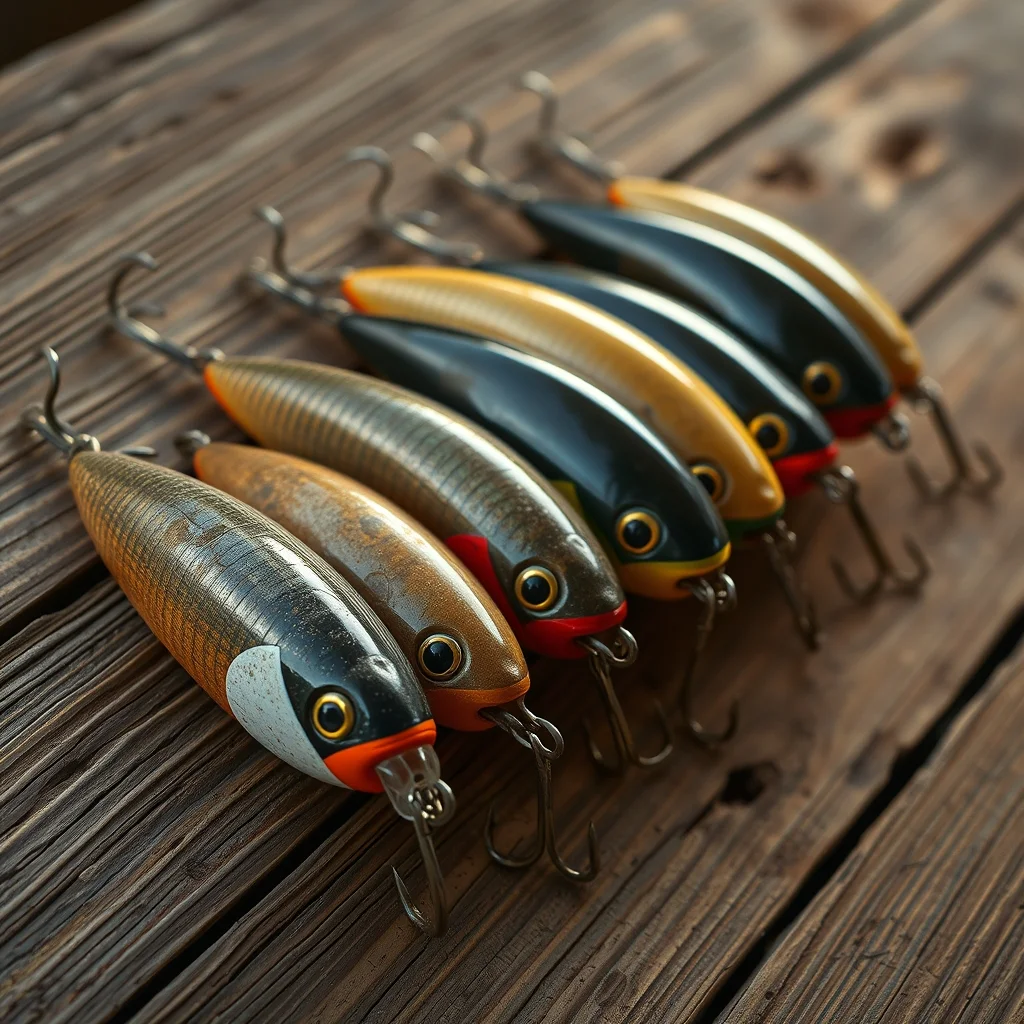
How production era affects value
Vintage lure collecting is fundamentally a production-era discipline. The same model from the same maker can differ in materials, construction method, hardware style, and paint process across a production run spanning 30–50 years. Early production typically means: higher-quality materials, hand-applied finishes, glass eyes rather than tack-eyes, more complex hardware, and lower survival rates — all of which push value up. Later production typically means: cheaper materials, die-cast or injection-molded bodies, tack eyes, simpler hardware — and higher survival rates, which suppresses value.
The challenge is that a later piece in near-mint condition can look better in a photograph than an early piece with normal aging. Understanding the physical markers of each era matters more than condition alone.
Heddon River Runt: body, lip, and hook hardware
The Heddon River Runt was introduced in the 1930s as a diving minnow for bass fishing. Heddon produced it through multiple eras until the company's eventual decline in the 1980s–90s. The most collectible versions are early wood-body examples with specific hardware configurations.
Body construction
Early River Runts used carved and turned wooden bodies. The transition to plastic bodies occurred in the late 1940s and continued through the 1950s. Wood-body River Runts have a subtly different profile — slightly more organic variation in body taper — compared to the uniformity of molded plastic. Under a loupe, wood grain is visible through the finish on unrestored examples. Plastic bodies show mold parting lines, typically along the belly.
Eye type
Glass eyes were standard on higher-grade Heddon lures through the 1930s–40s. Glass eyes are distinct from tack eyes (a painted metal tack pressed into the body): glass eyes are three-dimensional, rounded, and typically amber or green with a dark pupil. Tack eyes are flat on the body surface. Later versions used painted eyes — a printed or hand-dotted iris — or simple cup-and-hook hardware that implied no eye detail at all. Glass eyes are the most desirable and the clearest early-era marker.
Hook hardware
Hook hangers on early Heddon lures used a cup-and-screw configuration — a stamped metal cup recessed into the body with a screw eye through the center. Later hardware used a simpler L-rig (a bent wire rig passing through the body) or through-wire construction. Examining the hook hardware style is one of the most reliable era markers across multiple Heddon models, not just the River Runt.
Color naming
Heddon used a proprietary color-name system with two-letter codes on boxes (e.g., "RH" for Red Head, "SD" for Shad, "XRW" for Extra Rainbow). The box, if present, is the most reliable color identification source. On unboxed lures, the pattern must be identified by reference against collector catalogs (the most referenced is the Heddon Heritage guide series). Color rarity varies significantly — common production colors in common condition have low premiums; rare colors or special-order finishes in original condition can multiply value several times.
Creek Chub Pikie: glass eyes and the hardware sequence
The Creek Chub Bait Company of Garrett, Indiana produced the Pikie minnow from approximately 1920 until the company's sale in the 1970s (production continued under later ownership but collector focus is on the original Garrett-era pieces). The Pikie is one of the most systematically studied vintage lures, with collector references that date production by hardware sequence.
Glass eyes: the decisive marker
Early Creek Chub Pikies used glass eyes, typically in a blue-and-white or amber configuration depending on finish era. The glass eye is set into a painted socket and is distinctly three-dimensional. Tack eyes on later Pikies are flat metal with a painted or lithographed iris. The transition from glass to tack occurred gradually from the late 1940s through the 1950s; the exact timing varies by model and size. A Pikie with original glass eyes in good condition is substantially more collectible than a tack-eye example.
Body sizes
Creek Chub produced the Pikie in several sizes, numbered in their catalog system. The standard Pikie (model 2000 series) was approximately 4.5 inches. The Muskie Pikie was larger; the Baby Pikie was smaller. Size affects the available color pattern range — not all colors were offered in all sizes — and therefore affects value identification. A Baby Pikie in a common color at good condition is a different market than a Muskie Pikie in a rare color.
Box presence and condition grades
Creek Chub boxes used a consistent style across production eras with era-specific typography and coloring that can be used to date the box independently. A lure with a matching-era box is categorically more valuable than a lure without. "Matching era" means the box style, the catalog number, and the color name on the box are consistent with the lure's physical hardware. Mismatched boxes are a common issue in estate lots where boxes were sorted loosely.
Bomber Lure: solid wood versus hollow plastic
The Bomber Bait Company of Gainesville, Texas produced the original Bomber from 1939. Early Bombers used a solid wood body — cedar or similar hardwood — with a distinctive propeller-style spinner at the tail and front. The body profile is torpedo-shaped with through-wire hardware running the full body length.
The transition to hollow plastic bodies occurred in the post-war period as plastic manufacturing costs fell. Hollow plastic Bombers are physically identifiable by the hollow sound when tapped and by mold parting lines on the body. Solid wood examples are heavier for their size and may show natural wood characteristics at any chips in the finish.
Hardware details on early Bombers
Early Bombers used specific spinner blade styles and treble hook configurations. The brass hardware — body screws, wire, blades — ages distinctly from later zinc or plated steel hardware. Patina on early hardware is natural and consistent; polished or replaced hardware breaks the patina pattern and indicates restoration. Through-wire construction (a single wire running from nose to tail through the body) is characteristic of early production and is a durability and construction-quality marker.
Color patterns
Original Bomber color patterns followed naming conventions similar to other makers of the era — pattern names like "Firetiger," "Silver Shiner," and various natural-scale patterns. Some color patterns were produced only in early solid-wood eras and are genuinely rare; others have been reproduced in later plastic production. Differentiating an original early-era color from a later reproduction requires examining the hardware simultaneously — a rare color on plastic-era hardware is not an early piece regardless of how the finish looks.
Rapala Original Floating: balsa and foil quality
Lauri Rapala began carving lures from Finnish pine bark in the 1930s. The Original Floating Minnow has been in production since the 1950s in essentially the same form. Vintage Rapalas — broadly, pre-1980s Finnish-made examples — are collected for the quality of the original balsa construction and foil finish rather than for rarity; the lure was produced in large numbers but early examples show higher handwork quality than later production.
Identifying Finnish versus later production
Finnish-made Rapalas typically have "Made in Finland" stamped or printed on the lip or body. Later production moved to Estonia (post-Soviet era) and Ireland. Construction quality of Finnish-made examples is generally considered superior: more consistent body taper, more careful foil application, tighter belly seams. On older Finnish examples, the foil (which creates the reflective scale effect) was applied by hand and wrapped more precisely around the nose and tail tapers. Under magnification, later production foil often shows more air bubbles or lifting at the edges.
Value drivers on vintage Rapalas
Unlike Heddon or Creek Chub, vintage Rapala value depends heavily on condition rather than hardware variation, since the lure design has changed less dramatically across production. Foil condition is decisive: a Finnish-made Original with full, intact foil showing no lifting, cracking, or separation is in a different class than the same era lure with degraded foil. The original box matters, but the foil condition is typically the primary price driver. Color patterns were standardized globally — the silver, gold, and natural perch patterns were all produced continuously — so color rarity is less of a factor than in the American lure market.
Condition factors that move prices most
| Factor | High-value state | Value-reducing state |
|---|---|---|
| Original finish | Factory paint/foil intact, no touch-up | Any repainting or touch-up, even minor |
| Eyes | Original glass or tack eyes present, intact | Missing eyes, replaced eyes, cracked glass |
| Hook hardware | Original trebles, correct to era | Replaced hooks, wrong-era hardware |
| Original box | Matching-era box, intact, correct color listed | Wrong-era box, damaged box, no box |
| Body integrity | No cracks, no repairs, no filler | Cracks, chip repairs, filled holes |
| Color rarity | Documented rare production color | Common color, heavy production run |
The repainting problem
Repainting is the most common misrepresentation in the vintage lure market. A repainted lure in a rare color pattern looks identical in a low-resolution photograph to an original lure in that pattern. In hand, the tells are:
- Paint thickness: a repainted lure has thicker paint that obscures hardware recesses and lip attachment points
- Hardware patina discontinuity: original hardware shows age; newly painted hardware over old hardware shows the contrast of aged metal under fresh paint at hardware margins
- Eye socket depth: repainting fills in around the eye socket; on an original, the socket depth matches the eye diameter precisely
- Body seam coverage: original paint follows body seams naturally; repainted lures often show paint bridging over body seams
- UV light test: many original finishes fluoresce differently than modern lacquers under UV light — not conclusive, but a useful initial screen
If buying from eBay photographs alone, request additional images of the hook hardware connections, eye sockets close up, and the belly seam area. Sellers unwilling to provide these on a high-value piece are a flag.
Search vintage tackle on eBay
 Vintage Heddon lure
River Runt, Zara Spook, Crazy Crawler — active market
Vintage Heddon lure
River Runt, Zara Spook, Crazy Crawler — active market
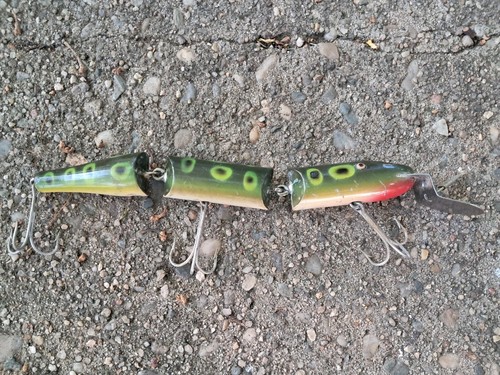 Creek Chub Pikie vintage
Glass-eye examples command the highest premiums
Creek Chub Pikie vintage
Glass-eye examples command the highest premiums
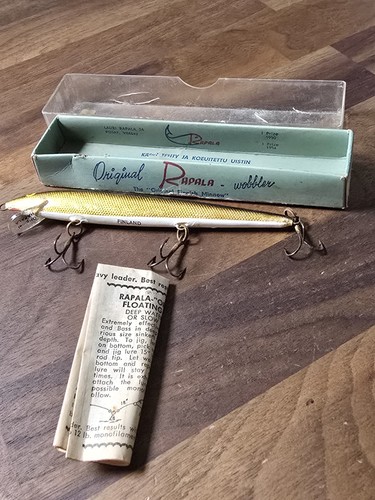 Vintage Rapala Original
Finnish-made balsa, condition-driven value
Vintage Rapala Original
Finnish-made balsa, condition-driven value
 Bomber Lure vintage
Solid-wood early examples; hardware is the dating key
Bomber Lure vintage
Solid-wood early examples; hardware is the dating key
 Vintage fishing tackle lot
Estate lots — knowledge is the edge on mixed-era lots
Vintage fishing tackle lot
Estate lots — knowledge is the edge on mixed-era lots