Terrarium Plants — Setup
Closed vs. open terrariums: light requirements, humidity, and which plants survive each
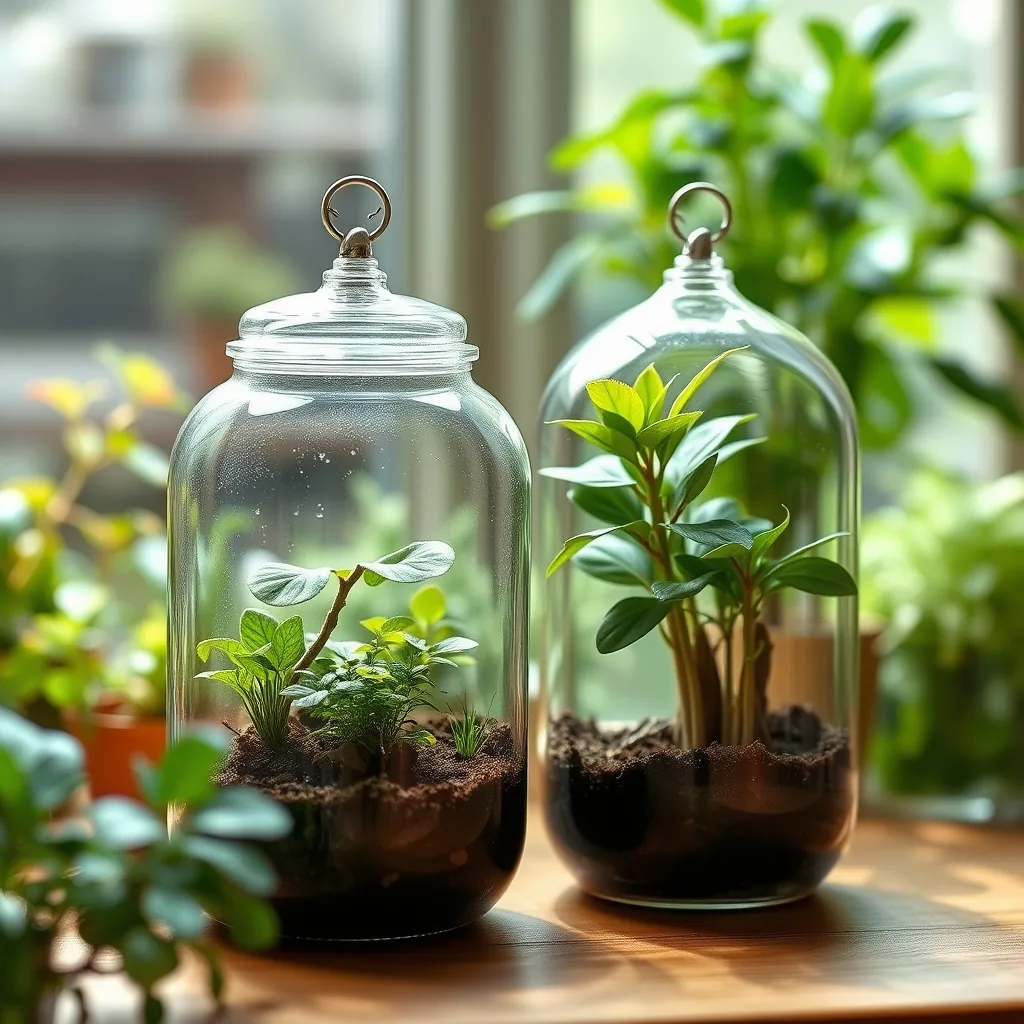
The most common terrarium mistake is putting the wrong type of plant in the wrong type of vessel. A succulent in a closed terrarium will rot within weeks. A tropical fern in an open bowl will desiccate in days. The closed vs. open decision drives everything else — humidity targets, light placement, substrate depth, and plant selection — and it needs to be made before you buy anything.
What makes a terrarium "closed" or "open"
A closed terrarium is a sealed or nearly sealed glass enclosure. The seal can be a cork stopper, a hinged lid, a glass lid, or a tight-fitting top. Sealed terrariums create their own water cycle: water evaporates from substrate and plant surfaces, condenses on the glass walls, and drips back down. In a well-balanced closed build, you may water it once at setup and not need to add water again for months or years.
An open terrarium is a vessel with a wide, uncovered opening — a bowl, a geometric open shape, a fish tank without a lid. Ambient humidity in the room determines the humidity at the plant's roots and leaves. In most homes, that's 30–50% relative humidity. Open terrariums require regular watering because the water cycle is broken by evaporation into the room air.
There's a middle category: partially covered terrariums, usually a glass or acrylic enclosure with mesh or screen ventilation on one side. These are common for dart frog vivaria and some carnivorous plant builds, and they target an intermediate humidity range of 60–75%. The same decision logic applies, but the plant palette is different from both extremes.
Closed terrariums: conditions and requirements
Humidity
A well-sealed closed terrarium maintains 80–100% relative humidity at the substrate surface. Condensation on the glass during temperature changes is normal and expected. If you never see condensation, the seal may be insufficient or the build is too dry. If the glass is so heavily condensed that you can't see the plants, the build is too wet — open the lid for a day or two to let some moisture escape.
Light
This is where beginners make the most costly mistakes. Closed terrariums cannot tolerate direct sunlight. The glass acts as a greenhouse amplifier — direct sun through a sealed glass enclosure will raise internal temperatures to levels that cook the plants within hours. A closed terrarium sitting in a south-facing window in summer will kill everything inside on the first sunny day.
The correct lighting for a closed terrarium is bright indirect light or artificial grow lighting. Bright indirect means near a north or east-facing window, or set back from a south or west window with a sheer curtain diffusing the light. Most closed terrarium plants — mosses, ferns, Selaginella, Peperomia — evolved on the forest floor under dense canopy and are adapted to lower, diffuse light.
For artificial lighting, full-spectrum LED grow lights in the 5000–6500K color temperature range work well. Intensity matters more than duration: 8–12 hours of moderate light is better than 16 hours of very dim light. A light meter or lux app on your phone can help — most closed terrarium plants do well at 500–1500 lux at the plant surface.
Temperature
Most closed terrarium plants are tropical and prefer temperatures of 65–80°F (18–27°C). They do not tolerate freezing. They also do not want temperature swings — a cold windowsill in winter followed by a heated room creates condensation management issues and plant stress. Stable room temperature near the vessel is the goal.
Substrate for closed builds
Standard potting soil does not work well in a sealed environment. Closed terrariums accumulate moisture and need substrate that doesn't become anaerobic when wet. The standard layered approach:
- Drainage layer (1–2 inches): coarse lava rock, LECA (lightweight expanded clay aggregate), or pea gravel. This holds water below the root zone rather than letting roots sit in saturation.
- Separation layer (optional but helpful): a thin sheet of sphagnum moss or window screen between the drainage layer and substrate, preventing substrate from falling into the drainage layer.
- Substrate (2–4 inches): a mix designed for tropical closed terrariums — typically 40% peat or coco coir, 30% orchid bark or perlite, 30% worm castings. Commercial ABG mix (named after Atlanta Botanical Garden's formula) is the common reference. Avoid potting mixes with synthetic fertilizers — the sealed environment accumulates nutrient salts.
- Top layer (optional): sheet moss, decorative pebbles, or bioactive elements (leaf litter, springtails).
Open terrariums: conditions and requirements
Humidity
Open terrariums track ambient room humidity — typically 30–55% in most homes. This is fine for succulents, most cacti, and Tillandsia (air plants), all of which are adapted to dry conditions and prefer infrequent watering and periods of drying out between waterings. High humidity will rot most of these plants.
Light
The plants suited to open terrariums — succulents, cacti, Haworthia, Echeveria, Tillandsia — generally need more light than closed terrarium plants. Many succulents etiolate (stretch toward light and lose their compact rosette shape) if they don't get 4–6+ hours of direct or very bright indirect sunlight daily.
South or west-facing windows are ideal. Grow lights are effective but need to be brighter than for closed terrariums: 2000–4000 lux at the plant surface, 12–16 hours per day for succulents. The compact form of many succulents is largely a product of high light intensity.
One specific mismatch to avoid: putting Haworthia in direct summer sun. Haworthia is a shade-adapted succulent native to South Africa — it grows under other plants and rocks in the wild, not in full sun. Unlike Echeveria or Aloe, Haworthia wants bright indirect light, not direct sun. It's one of the few succulents that does well in east-facing windows.
Substrate for open builds
Open terrarium substrate needs to dry out between waterings. Succulent and cactus mixes, or regular potting soil mixed 1:1 with coarse perlite or coarse sand, are appropriate. Drainage is critical — open terrariums often look better with shallow, wide vessels, but shallow vessels have less substrate depth to buffer moisture. For very shallow open builds (under 3 inches of substrate), water even more infrequently and err toward dryness.
Plant species decision table
| Plant | Vessel type | Light need | Notes |
|---|---|---|---|
| Sheet moss (Hypnum, Thuidium) | Closed only | Low–medium indirect | Thrives in 80–100% humidity; brown and die in open builds within days |
| Selaginella (spike moss) | Closed only | Low–medium indirect | Looks like a fern but is a lycophyte; collapses and desiccates in low humidity |
| Fittonia (nerve plant) | Closed strongly preferred | Medium indirect | Will survive open in a high-humidity room but thrives sealed; wilts dramatically when dry |
| Peperomia species | Closed or semi-open | Medium indirect | More tolerant than true tropical ferns; some species handle 50% humidity in open builds |
| Miniature ferns (Nephrolepis, Adiantum) | Closed only | Medium indirect | Maidenhair fern (Adiantum) in particular needs 70%+ humidity — it fails in most homes open |
| Miniature orchids (Lepanthes, Pleurothallis) | Closed / semi-open | Medium indirect | Need high humidity but good airflow; pure sealed containers develop rot; mesh panels help |
| Echeveria (rosette succulent) | Open only | Bright direct / very bright indirect | Will rot in closed build in weeks; needs airflow and dry periods between waterings |
| Haworthia | Open only | Bright indirect (not direct summer sun) | One of the few succulents that tolerates lower light; still needs open vessel and dry cycles |
| Tillandsia (air plants) | Open only | Bright indirect to moderate direct | Absorb moisture through leaves; need airflow and drying within 4 hours of misting |
| Cacti | Open only | Direct sun | Require the driest conditions; even open terrariums may be too humid for desert cacti in wet climates |
| Carnivorous plants (Dionaea, Sarracenia) | Semi-open / bog setup | Direct sun | Need pure water (distilled or rainwater only); need high light and specific wet/dry seasonal cycles |
The most common failure modes
Succulents in a closed terrarium
This is by far the most common beginner mistake, partly because many terrarium kits and online tutorials show succulents in sealed glass vessels — a look that photographs well but kills the plants. Succulents in a sealed environment experience 80–100% humidity continuously. Their roots sit in perpetually moist substrate. Most will show root rot within 3–6 weeks. The leaves become translucent and mushy at the base. There's no recovery once rot sets in.
If you want succulents and you want glass: open vessels. Wide-mouth bowls, fish tanks without lids, geometric open frames. They'll need more watering attention than a closed build, but the plants will survive.
Tropical ferns in an open bowl
The opposite failure. Maidenhair fern (Adiantum) and similar high-humidity ferns are frequently sold as "terrarium plants" in stores where they're displayed in open terrariums. Most home environments cannot sustain them open-air — the ambient humidity required (consistently above 60–70%) simply isn't present. The fronds go brown and crispy within 1–2 weeks. Moving them to a sealed or near-sealed vessel with proper drainage will rescue them.
Too much water in a closed build
The self-contained water cycle of a closed terrarium means overwatering at setup is nearly impossible to correct without dismantling the build. Add water in small amounts (a few tablespoons at a time for a mid-sized vessel) and wait 48 hours to see how much condensation develops. A small amount of condensation on the upper walls is ideal. Heavy condensation covering the entire lid means excess water — open the vessel for several hours to let some escape.
Lighting for indoor builds without a good window
Both vessel types can be maintained under grow lights if window access is limited. The difference is intensity. For closed tropical builds, modest full-spectrum LEDs work — Nicrew and Barrina T5 bars on adjustable arms are popular because they're size-adaptable and don't generate significant heat close to the glass. For open succulent builds, higher output is needed — strip lights designed for plant shelves or horticultural grow lights at appropriate hanging distance (12–18 inches above the canopy for most succulents).
Photoperiod: closed terrarium plants do fine at 10–14 hours. Open succulent builds should be closer to 14–16 hours to compensate for the reduced intensity of artificial vs. direct sun.
Maintenance differences over time
A well-balanced closed terrarium requires very little maintenance. The main interventions: occasional pruning of plants that outgrow the vessel, removing any dead material quickly to prevent rot, and misting lightly if the condensation cycle ever stops (which may indicate the seal has failed). A healthy closed build can go months between any significant attention.
An open terrarium requires consistent watering — weekly or bi-weekly depending on substrate depth, vessel size, ambient humidity, and plant species. Succulents signal underwatering through slightly wrinkled leaves and overwatering through soft, translucent base leaves or crown rot. Learning these signals takes a season, but they're reliable once you know them.
Open builds also need more attention to soil salt buildup over time, since there's no closed water cycle to buffer accumulation. Flushing the substrate with a slow pour of water every few months helps prevent the white crusty residue that indicates salt accumulation from fertilizer or tap water minerals.
Gear relevant to this article
Smart eBay searches for the equipment discussed above. We earn a small commission on qualifying purchases; your price is the same either way. Full disclosure.
 Closed glass vessel (hinged or cork)Hinged-lid apothecary jars, Wardian cases, and cork-stopper bottles all work for closed tropical builds. Round bowls clean easier than geometric shapes.
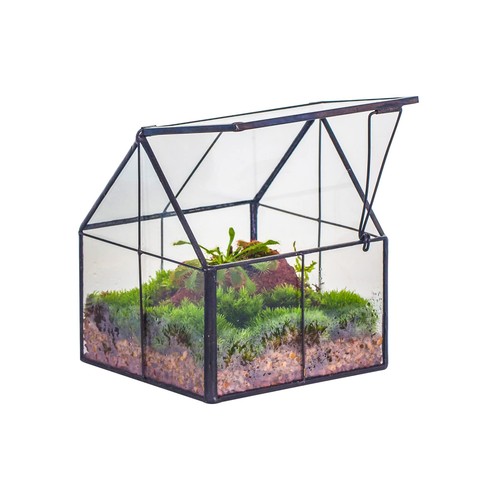 Open geometric vessel (succulent build)Geometric open-frame terrariums are the right vessel for succulents and air plants. Wide openings ensure airflow and allow dry cycles between waterings.
 Terrarium substrate (ABG-style mix)Josh's Frogs, Bio Dude, and similar suppliers sell premixed tropical terrarium substrate. Avoids the potting-soil-goes-anaerobic problem in closed builds.
 Full-spectrum LED grow light (6500K)Nicrew and Barrina T5 bars work well for closed tropical builds. Higher-output LED panels or strips for succulent builds where more intensity is needed.
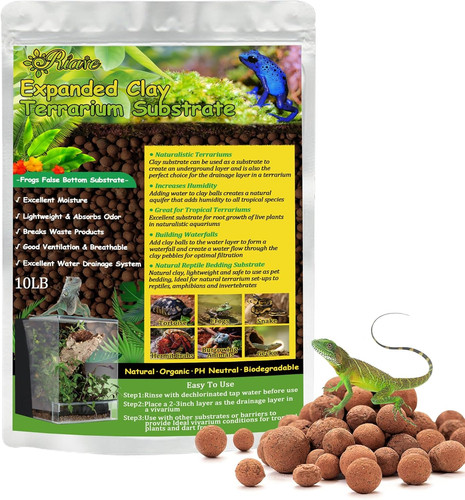 LECA / clay balls (drainage layer)Expanded clay aggregate creates the false-bottom drainage layer that keeps closed terrarium roots out of standing water. Lava rock works too; LECA is lighter and cleaner.