
String tension is one of the most discussed variables in recreational tennis and one of the most frequently misunderstood. The standard advice — "lower tension for power, higher tension for control" — is accurate as far as it goes. But most players who act on it do not understand the mechanism behind it, and that gap leads to decisions that work against their actual game.
This article covers how tension affects ball behavior, what polyester and synthetic gut strings actually do differently, and why the trampoline effect is misapplied more often than it is correctly applied.
What Tension Does to the Ball
When a tennis ball contacts the string bed, two things deform: the ball and the string bed. Both absorb energy, and both return energy. The ratio of energy absorbed versus returned — and the duration of contact — changes with string tension.
A tighter string bed deflects less when the ball hits it. Because the string bed moves less, the ball must deform more to accommodate the contact. Ball deformation wastes more energy as heat than string bed deformation does, so more energy is lost in a tight-strung racquet. Less energy returns to the ball. The ball leaves with lower velocity for the same swing speed.
A looser string bed deflects more. The strings do more of the work, the ball deforms less, and less energy is lost in the contact. The ball leaves with higher velocity for the same swing speed.
This is the mechanism behind the tension-power relationship. It is not that a loose string bed "catapults" the ball or acts as a slingshot — the physics are simply about energy loss in deformation.
Where "control" comes from
Higher tension gives more control in a specific sense: it reduces dwell time (the time the ball is in contact with the strings) and reduces string-bed deflection, which means the ball leaves the strings in a more predictable direction with less angular sensitivity to off-center contact.
With a loose string bed, the strings move more during contact and the ball can "pocket" — sink deeper into the string bed and ride a wider arc before leaving. This increases the sensitivity of the shot to contact point variation. Off-center hits on a loose-strung racquet produce more directional deviation.
So "control" in the tension sense means predictability and directional consistency, particularly on mishits. It does not mean the ball will land where you aim it if your stroke mechanics are poor. The majority of recreational players do not hit consistently enough to notice string-bed deflection differences in directional control.
The Trampoline Effect: What It Actually Is
The trampoline effect is a real phenomenon, but it is not what most players think it is. The full name used in racquet sports physics is the "trampoline effect" or "spin trampoline effect," and it refers specifically to the behavior of strings that snap back to their original position during the contact phase.
When a ball contacts an angled string bed and causes the strings to deflect laterally (slide across one another), the strings store elastic energy. As the ball begins to leave the string bed, the strings snap back — like a rubber band returning to rest — and this snap adds rotational force to the ball, increasing topspin. This effect is more pronounced with strings that have lower friction (can slide more easily) and lower stiffness (can deflect and snap back more quickly).
Why this matters for string choice more than tension
The trampoline spin effect is primarily determined by string material and string-to-string friction, not by tension alone. Polyester strings have relatively low inter-string friction and are stiff — they slide, then snap back sharply. Multifilament and synthetic gut strings have higher inter-string friction and move less during contact, so they produce less spin via the trampoline mechanism.
Players who read "trampoline effect = more spin" and conclude "therefore loose tension gives more spin" are following a logic chain that is incomplete. The effect is more material-driven than tension-driven. A polyester string at 50 lbs will produce more spin via this mechanism than a synthetic gut at 40 lbs, not because of the tension difference but because of the string-to-string friction difference.
The confusion is compounded because lower tension does loosely correlate with more spin potential (more string movement, more snap-back) in the same string type. But across string types, material dominates.
Polyester vs Synthetic Gut: The Actual Differences
Polyester (Co-Poly)
- Stiff — high dynamic stiffness
- Low inter-string friction → more snap-back spin
- Durable — holds surface texture longer
- Loses tension quickly (first 24–48 hrs)
- Harsh on arm at higher tensions
- Best for: heavy topspin, durability, competitive play
- Not for: arm problems, slower swing speeds
Synthetic Gut / Multifilament
- More elastic — lower dynamic stiffness
- Higher inter-string friction → less snap-back spin
- Less durable — notches faster
- Holds tension longer (more consistent feel)
- Arm-friendly — more shock absorption
- Best for: comfort, recreational play, arm sensitivity
- Not for: players who break strings frequently
The practical implication: if you want more spin, switching to a polyester co-poly string (Luxilon ALU Power, Babolat RPM Blast, Solinco Tour Bite, Tecnifibre Black Code) will do more for spin than lowering the tension on your current synthetic gut. The string type change is a bigger variable than the tension change when spin is the goal.
If you have arm problems — tennis elbow, wrist issues, shoulder sensitivity — synthetic gut or multifilament at lower tension is the correct choice, full stop. Playing polyester with a compromised arm to get more spin is not a reasonable trade. The vibration and shock characteristics of polyester at high tension are documented contributors to arm stress.
Tension Ranges by Play Style
Most racquets are labeled with a manufacturer-recommended tension range, typically 50–60 lbs for most mid-size frames, with wider ranges on some player's frames. These ranges are safe mechanical limits, not playing recommendations. Playing at the top of the range because you want "control" when you have a smooth stroke is unnecessary and harmful to arm comfort.
Tension Loss: The Variable Most Players Ignore
String tension is not static. All strings lose tension from the moment they leave the stringing machine. The loss is not gradual and linear — it is front-loaded, with the largest tension drop occurring in the first 24 hours (for polyester strings) or first several days (for synthetic gut and multifilament).
How much tension is lost
Polyester strings can lose 10–20% of their strung tension in the first 24–48 hours. A racquet strung at 55 lbs might measure 44–49 lbs after one day of play. This is normal and expected. The string does not become unusable — it settles at a consistent tension — but the "55 lb" number on your stringer's ticket is not what you are actually playing with after your first session.
Synthetic gut and multifilament strings lose tension more slowly, which is part of why their playing feel is more consistent over time even though they are less durable in terms of surface wear and breakage.
Implications for re-stringing
The standard recommendation is to re-string as many times per year as you play per week. If you play three times a week, three re-strings per year is the general guideline. This is not about breakage — it is about maintaining a consistent feel as strings lose tension and their surface texture wears down. Dead strings (low tension, worn surface) play differently from fresh strings even if they have not broken.
For recreational players who rarely break strings, the string going "dead" is often the reason their game feels inconsistent without an obvious cause. They are playing on strings that have lost 25–30% of their original tension and whose surface has worn smooth, reducing bite on the ball.
Hybrid Stringing: Polyester Mains, Synthetic Gut Crosses
Hybrid stringing — using one string type for the main strings and another for the crosses — became common when the Tour adopted polyester mains. The typical hybrid uses a polyester main (which runs vertically and contributes most to snap-back spin) and a softer multifilament or natural gut cross (which reduces the overall stiffness of the string bed and improves comfort).
This is not a fringe technique — it is how a large percentage of professional players are strung, including some who appear in manufacturer marketing for full-bed polyester strings. Natural gut mains with polyester crosses is a different configuration, favored for feel and power.
For club players, a hybrid with polyester mains and synthetic gut crosses gives most of the polyester spin advantage at significantly lower arm stress than a full polyester setup. It is worth trying if you want the spin of a co-poly but find full polyester uncomfortable.
Hybrid tensions typically run 2–4 lbs lower on the crosses than the mains, to account for the higher stiffness of the cross string and to achieve a balanced string bed feel.
A Practical Starting Point
If you are currently playing on synthetic gut and happy with the feel but want more spin: try a co-poly string like Solinco Tour Bite or Tecnifibre Black Code at 2–3 lbs below your current tension. The material change will give you more spin than the tension change, and dropping the tension partially compensates for co-poly's arm stiffness.
If you are currently playing on polyester and experiencing any arm discomfort: drop the tension by 3–4 lbs immediately and consider switching to a hybrid or synthetic gut. The comfort benefit is real and immediate. The spin difference between a comfortable tension and an uncomfortably tight tension is not worth the injury risk for recreational players.
If you are not sure what you are currently strung with or at what tension: ask your stringer to note the string and tension on the receipt. Most clubs and stringing services will do this if asked. Knowing your baseline is the minimum requirement for making any systematic comparison when you change something.
Stringing gear worth having
We earn a small commission on qualifying eBay purchases. Price you pay is unchanged. Full disclosure.
 Luxilon ALU Power
The original premium co-poly. Silver and Rough versions. String at 10% below your normal tension. Used by a majority of tour professionals for mains. Durable, consistent, good snap-back.
Luxilon ALU Power
The original premium co-poly. Silver and Rough versions. String at 10% below your normal tension. Used by a majority of tour professionals for mains. Durable, consistent, good snap-back.
 Babolat RPM Blast
Octagonal co-poly profile for extra bite. The string Nadal plays on. Stiffer than ALU Power; arm sensitivity matters more here. Best on well-matched frames with larger heads.
Babolat RPM Blast
Octagonal co-poly profile for extra bite. The string Nadal plays on. Stiffer than ALU Power; arm sensitivity matters more here. Best on well-matched frames with larger heads.
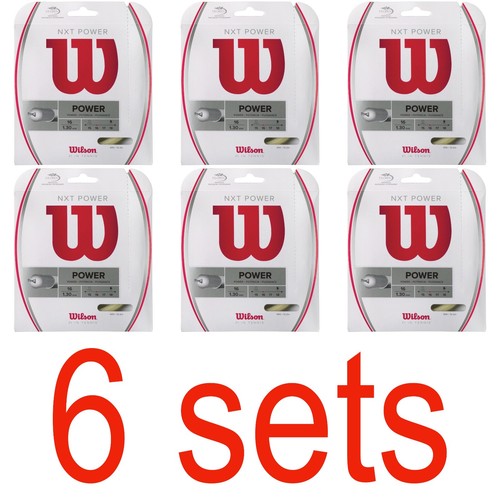 Wilson NXT (multifilament)
The reference arm-friendly multifilament. Good tension maintenance relative to other nylon strings. Better feel than basic synthetic gut. Works well as cross string in a hybrid setup.
Wilson NXT (multifilament)
The reference arm-friendly multifilament. Good tension maintenance relative to other nylon strings. Better feel than basic synthetic gut. Works well as cross string in a hybrid setup.
 Prince Synthetic Gut
The most affordable reliable full-bed string for recreational players. Solid comfort, decent tension maintenance, available in bulk sets. Not for players who want co-poly spin, but a sensible default otherwise.
Prince Synthetic Gut
The most affordable reliable full-bed string for recreational players. Solid comfort, decent tension maintenance, available in bulk sets. Not for players who want co-poly spin, but a sensible default otherwise.
 String tension meter
A basic ERT (Electronic Racquet Tester) lets you measure the dynamic tension of a strung racquet. Useful for understanding actual tension drop post-stringing and for comparing fresh vs dead strings.
String tension meter
A basic ERT (Electronic Racquet Tester) lets you measure the dynamic tension of a strung racquet. Useful for understanding actual tension drop post-stringing and for comparing fresh vs dead strings.