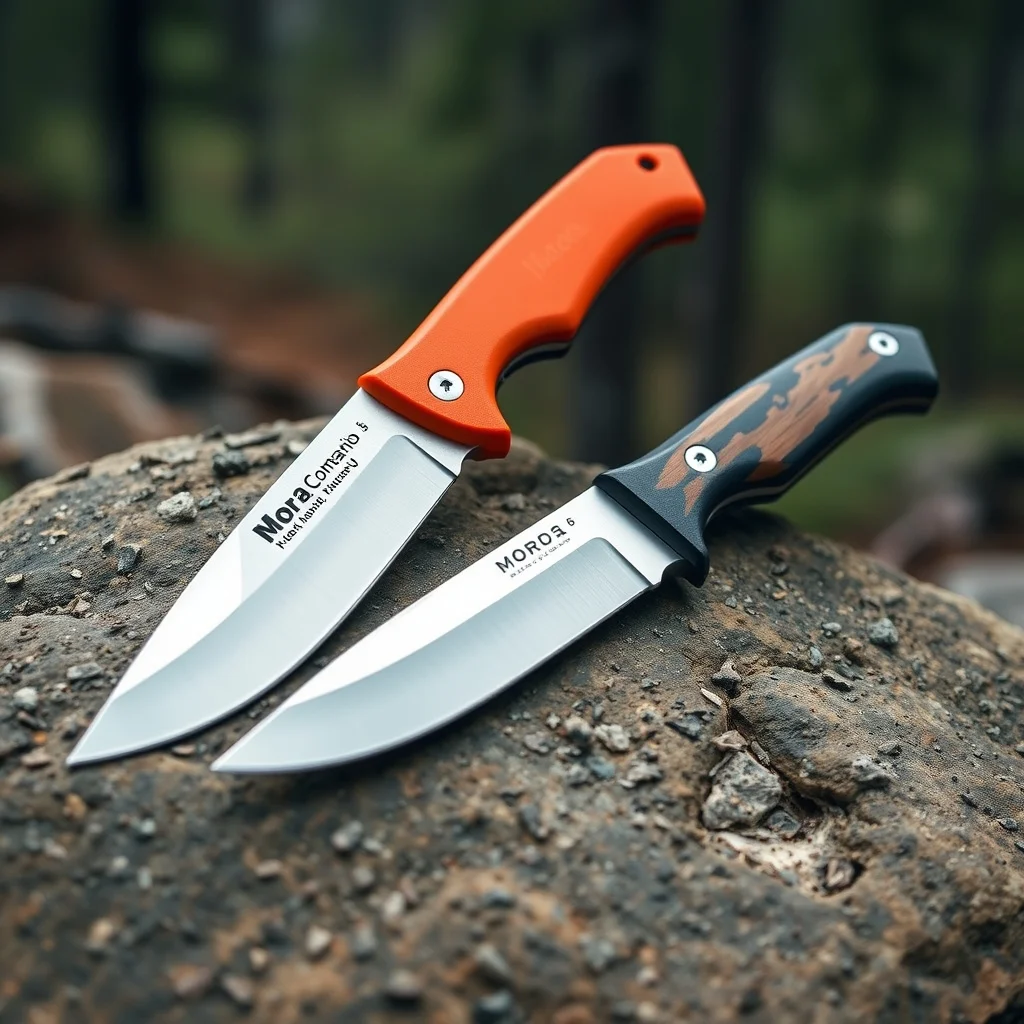
The three specs that determine what a survival knife can actually do
Tang construction, edge geometry, and steel alloy are the three specifications that determine whether a fixed-blade knife can handle the physical demands of survival and bushcraft use. Marketing language around "tactical" design, handle material aesthetic, or brand heritage is largely irrelevant to function. Understanding these three specs tells you what any knife will actually do in the field.
The five knives covered here — Mora Companion, ESEE 5, Becker BK2, Tops Tom Brown Tracker, and Fallkniven F1 — represent a range of approaches to each of these three specs. They are not the only competent survival knives, but they cover the meaningful tradeoffs clearly enough that understanding them provides a framework for evaluating any fixed blade.
| Knife | Tang | Blade length | Steel | Grind | Weight (w/o sheath) |
|---|---|---|---|---|---|
| Mora Companion (carbon) | Partial | 4.1 in | Carbon steel | Scandi | 3.5 oz |
| ESEE 5 | Full | 5.25 in | 1095 high carbon | Flat | 10.3 oz |
| Becker BK2 Campanion | Full | 5.25 in | 1095 Cro-Van | Flat | 16.5 oz |
| Tops Tom Brown Tracker | Full | 4.625 in (primary) | 1095 high carbon | Flat + saw spine | ~14 oz |
| Fallkniven F1 | Full | 3.8 in | VG-10 laminated stainless | Convex | 5.5 oz |
Full tang vs partial tang: why it matters for batoning
Tang refers to how far the steel of the blade extends into the handle. A full tang knife has the steel running the full length and width of the handle — the handle scales (the grips on each side) attach to the flat steel tang. A partial tang has the steel narrowing to a rod or spike that extends partway into the handle, with the handle material surrounding that rod.
For most cutting tasks — food prep, carving, rope cutting, skinning — tang construction makes no practical difference. A sharp partial tang knife cuts identically to a sharp full tang knife. The difference appears under impact loads.
Batoning is the practice of placing a knife's spine on a piece of wood and striking the spine with a baton (typically a wood billet) to split or chop the wood. The force transmitted through the blade during batoning creates torque at the blade-handle junction — the weakest point in any knife's construction. In a full tang knife, this junction is reinforced by the continuous steel running through the handle; the handles are essentially decorative protection for the steel. In a partial tang knife, the junction between blade steel and handle material absorbs the impact directly. Under repeated batoning loads, this junction is where partial tang knives eventually fail.
This does not mean partial tang knives are poorly made or unsuitable for survival use. The Mora Companion's partial tang is well executed and the knife is legitimately used by bushcraft practitioners worldwide. The accurate statement is: a full tang knife will handle indefinite batoning without structural risk, whereas a partial tang knife can handle moderate batoning but carries a failure mode under heavy sustained impact that full tang knives do not share.
Edge geometry: scandi vs flat grind
Grind refers to the cross-sectional geometry of a blade above the edge. The grind profile determines how the knife cuts through material, how easily it takes a new edge in the field, and how durable the edge is under lateral stress.
Scandi grind
A scandi (Scandinavian) grind runs a single flat bevel from the spine side of the blade all the way down to the edge, without a secondary microbevel. In cross-section, a scandi grind looks like a thin wedge with a flat face meeting at the cutting edge. The bevel is wide and flat, which means when you place the bevel flat against a sharpening stone, the geometry tells you the exact angle to hold — you simply lay the bevel flat and maintain contact. There is no skill in establishing the angle because the geometry establishes it for you.
This makes scandi grind knives significantly easier to sharpen in the field without tools. A flat rock, a leather strop, or a basic sharpening puck will restore a scandi edge reliably. For wilderness survival use where you may not have quality sharpening equipment, this matters. The Mora Companion in carbon steel combines scandi grind with relatively soft steel (easy to deform, easy to restore), making it the field-sharpening benchmark in its category.
The tradeoff: scandi grind produces a thicker edge than a flat grind knife of comparable thickness, which means it bites into soft material (meat, rope, green wood) with slightly more resistance. For food prep and fine carving work, a flat grind cuts with less effort.
Flat grind
A flat grind tapers the blade from a wider cross-section at the spine progressively to a thinner edge. The edge is thinner behind the bevel than a scandi, which produces a blade that slices through soft material more efficiently. The ESEE 5 and Becker BK2 both use flat grinds — for their intended heavy-use applications (chopping, batoning, processing game), the flat grind provides a durable edge geometry that handles lateral stress better than a very thin scandi would at similar blade thickness.
The field sharpening tradeoff: flat grind knives require consistent angle maintenance when sharpening. Without practice or angle guides, maintaining the same bevel angle across a sharpening stroke is harder than laying a scandi bevel flat. This is a skill that develops with practice; it is not an insolvable problem. But for a user who rarely sharpens knives, scandi is more forgiving.
Convex grind (Fallkniven F1)
The Fallkniven F1 uses a convex grind — the bevel curves outward rather than meeting at a flat or straight angle. Convex grinds are known for edge durability under impact because the outward curve distributes stress along the bevel rather than concentrating it at a thin edge. The F1's convex is combined with a laminated steel construction (hard VG-10 core, softer stainless cladding) that adds toughness at the edge. The tradeoff is that convex grinds are difficult to sharpen on flat stones; they require stropping technique, sandpaper wrapped on a curved surface, or specialty systems.
1095 high-carbon steel vs stainless: the field tradeoff
Steel choice in a survival knife involves one core tradeoff: ease of sharpening versus rust resistance. Carbon steels (1095, used in the ESEE 5, Becker BK2, and Tops Tom Brown Tracker) are easier to sharpen because they are softer — they wear at the edge faster under use, but they also respond more quickly to a sharpening stone. A 1095 knife that has gone dull can be restored to field-sharp in minutes with basic equipment. High-hardness stainless steels (like the VG-10 in the Fallkniven F1) hold their edge longer between sharpenings but require more effort and better equipment to restore when they do dull.
The rust tradeoff in wet conditions is real but manageable. 1095 carbon steel will develop surface rust within 24–48 hours of sustained wet exposure without any treatment. The standard field approach is to allow the blade to develop a forced patina early (a brief soak in apple cider vinegar produces a gray-black ferric oxide patina that partially passivates the surface), then wipe the blade dry after each use and apply a thin coat of oil at camp. This adds a maintenance step that stainless knives do not require.
For extended expeditions in wet climates — PNW rainforest, coastal environments, rainy season tropics — stainless or the laminated stainless of the Fallkniven F1 reduces the maintenance burden meaningfully. For weekend use or drier climates, 1095 is a practical choice that rewards its lower sharpening difficulty.
Five knives across the range
Mora Companion (carbon): the accessible baseline
The Mora Companion in carbon steel offers scandi grind, partial tang, a 4.1-inch blade, and sub-4 oz weight. It is the knife that bushcraft instructors hand students because the scandi grind makes learning to sharpen straightforward, the light weight reduces pack burden, and the price is low enough that a beginner can buy one and use it hard. Its partial tang is a real limitation for heavy batoning but a non-issue for the vast majority of backcountry cutting tasks. The carbon steel dulls faster than VG-10 but sharpens on any flat rock. A stainless Companion version is also available; the stainless model is easier to maintain in wet conditions but harder to field-sharpen than the carbon.
ESEE 5: the benchmark full-tang field knife
The ESEE 5 is a 5.25-inch full tang, 1095 high-carbon, flat-grind knife made in the United States by Rowen Manufacturing. It carries a full lifetime warranty with no fine print. At 10.3 oz without sheath, it is a serious field tool rather than an ultralight option. The 1095 steel is deliberately specified for easy field sharpening rather than maximum edge retention — ESEE's design philosophy prioritizes restorability over hold time. The flat grind and 1095 combination produces a knife that handles sustained batoning, heavy-duty camp chores, and multi-week use without structural concern.
Becker BK2 Campanion: maximum spine thickness for batoning
The Becker BK2 has a 0.25-inch thick spine — unusually thick for a production survival knife, and deliberately so. That spine thickness means the knife handles batoning loads that would damage thinner-spined knives. At 16.5 oz without sheath, it is heavy enough that it functions more as a dedicated wood-processing and camp-chopping tool than a general carry knife. The 1095 Cro-Van steel is moderately harder to sharpen than plain 1095 but more corrosion resistant. Ka-Bar acquired the Becker line in 2008; quality and specification have remained consistent.
Tops Tom Brown Tracker: multi-function blade geometry
The Tom Brown Tracker is a collaboration between TOPS Knives and wilderness survival instructor Tom Brown Jr. The blade profile includes a primary flat-ground edge, a serrated saw spine, a gut hook at the base of the spine, and a secondary small notch blade. Whether the multi-function geometry is useful or a compromise depends entirely on how you use a knife. Practitioners who process game, cut cordage, and saw wood in the same tool value having those functions integrated; users who want a clean, simple blade profile find the extra geometry a complication without benefit. The 1095 steel and full tang construction are standard; the multi-function blade is the point of differentiation.
Fallkniven F1: the premium stainless option
The Fallkniven F1 is a 3.8-inch, full tang knife in laminated VG-10 stainless steel with a convex grind. It is the issued survival knife of the Swedish Air Force, which provides one direct data point on durability under field conditions. The laminated construction places a hard VG-10 core (around 59 HRC) within a softer stainless cladding, combining edge hardness with overall blade toughness. At 5.5 oz with handle, it is lighter than the ESEE 5 or BK2 while offering full tang construction. The tradeoff is sharpening difficulty — VG-10 at 59 HRC does not respond quickly to casual sharpening, and the convex grind requires specific technique. For a user who maintains edges regularly with quality equipment, the F1 holds an edge through extended use without maintenance. For a user who sharpens reactively when the knife dulls, the 1095 alternatives are more forgiving.
Search eBay for these knives
 Mora Companion
Scandi grind, partial tang, carbon or stainless. The accessible field-sharpening baseline.
Mora Companion
Scandi grind, partial tang, carbon or stainless. The accessible field-sharpening baseline.
 ESEE 5
Full tang, 1095, flat grind. Lifetime warranty, USA made. The serious field benchmark.
ESEE 5
Full tang, 1095, flat grind. Lifetime warranty, USA made. The serious field benchmark.
 Becker BK2 Campanion
Full tang, 0.25 in spine, 1095 Cro-Van. Maximum batoning capacity in a production knife.
Becker BK2 Campanion
Full tang, 0.25 in spine, 1095 Cro-Van. Maximum batoning capacity in a production knife.
 Tops Tom Brown Tracker
Full tang, 1095, multi-function blade: edge, saw spine, gut hook, notch blade.
Tops Tom Brown Tracker
Full tang, 1095, multi-function blade: edge, saw spine, gut hook, notch blade.
 Fallkniven F1
Full tang, VG-10 laminated stainless, convex grind. Swedish Air Force issued. Premium stainless option.
Fallkniven F1
Full tang, VG-10 laminated stainless, convex grind. Swedish Air Force issued. Premium stainless option.