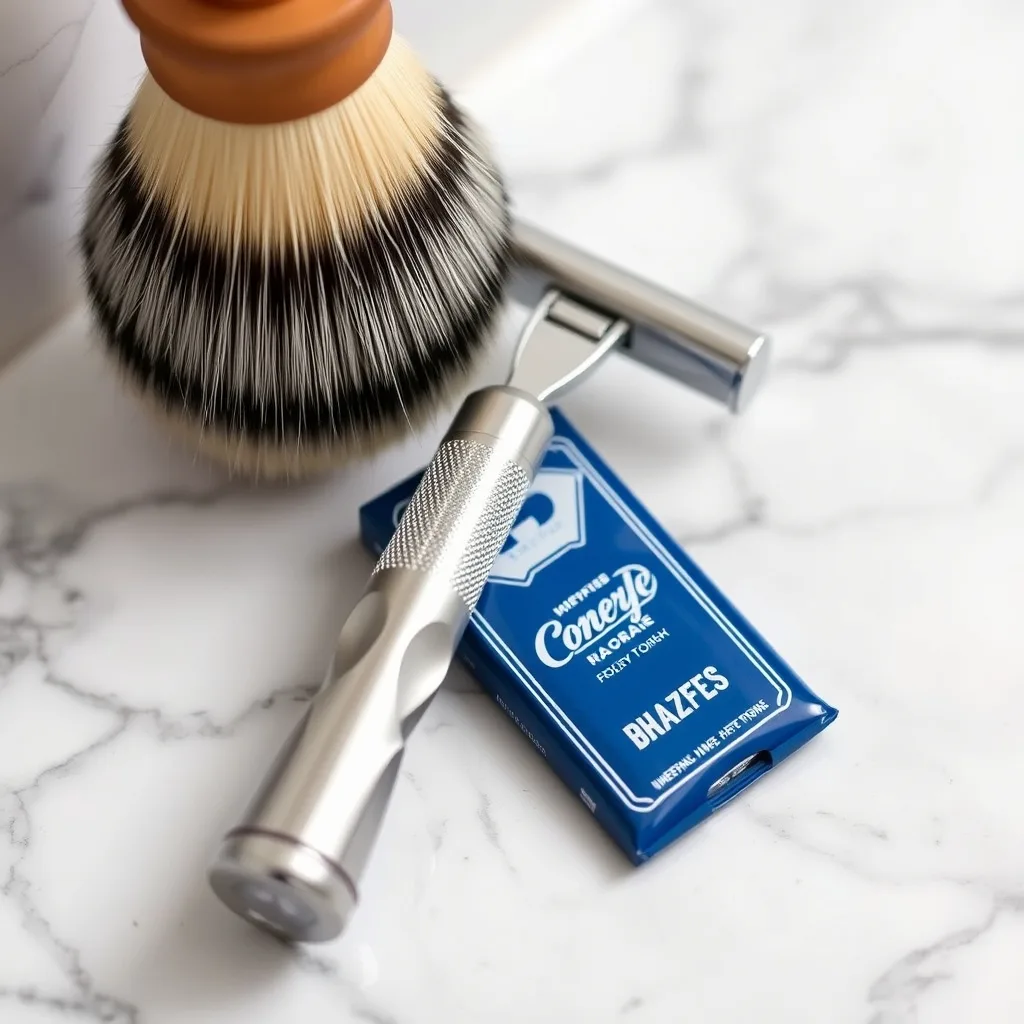
Aggressiveness: the spec that matters most
Safety razor aggressiveness describes how exposed the blade edge is relative to the safety bar. A more aggressive razor presents more blade, bites into stubble faster, and requires better technique — but can deliver a closer single-pass shave. A milder razor offers more protection, is more forgiving of angle errors, and is almost always the right starting point for beginners.
Aggressiveness is determined by two interacting measurements: blade gap (the distance between the blade edge and the safety bar, measured in millimeters) and blade exposure (how far the blade edge protrudes beyond the plane of the top cap, which can be positive, neutral, or negative). Manufacturers rarely publish these numbers directly, but most DE razor reviewers measure and publish them.
Closed comb vs open comb
The bottom plate of a safety razor head is either a closed comb (solid safety bar) or an open comb (scalloped or toothed bar with gaps).
Closed comb (CC): The safety bar is a solid ridge. It stretches the skin before the blade contacts it, making the shave more forgiving and consistent. Closed-comb razors are the standard for most people and dominate the market.
Open comb (OC): The safety bar is cut with teeth or scallops. This allows foam and longer stubble to channel through rather than accumulate on the bar. Open-comb razors typically feel more aggressive for a given blade gap measurement, because there's less surface area spreading the skin before the blade. They're often recommended for shavers with dense or longer stubble — a daily shaver on short growth typically finds them harsher than necessary.
| Feature | Closed comb | Open comb |
|---|---|---|
| Safety bar style | Solid ridge | Toothed or scalloped |
| Skin stretching | More consistent | Less — stubble channels through |
| Effective aggressiveness | Milder feel for same gap | More aggressive feel |
| Best for | Daily shavers, beginners, fine–coarse stubble | Longer stubble, experienced shavers |
| Clogging tendency | Higher with dense foam | Lower — channels clear |
Adjustable razors: the flexible option
Adjustable safety razors (the Merkur Futur, Rockwell 6C, Edwin Jagger Chatsworth, and equivalents) allow the user to dial blade exposure up or down via a numbered setting mechanism. This has two genuine advantages: you can match the razor to changing stubble length (e.g. a lower setting on Monday, higher on a 3-day growth on Thursday), and you can progress through aggressiveness levels as technique improves without buying a new razor.
The tradeoff is complexity: adjustable mechanisms add engineering, and cheaper adjustable razors can have loose settings or inconsistent blade alignment. Mid and upper-tier adjustables from established manufacturers are generally well-executed; budget adjustables sometimes less so.
Shopping for safety razors? Browse current eBay listings → (we earn a small commission; your price is unchanged).
Handle weight and length
Handle weight and length affect shaving technique more than most guides acknowledge. Heavier handles (typically brass-cored, 80–120g range) allow the razor's own weight to do the work — you apply minimal pressure, letting gravity and mass provide cutting force. This is the technique DE shaving depends on: no applied pressure. Lighter handles require more active technique to maintain consistent angle without pressing.
Handle length is a preference issue that interacts with grip style:
- Short handles (roughly 75–85mm): Compact, good control for shavers with smaller hands or those who grip close to the head.
- Long handles (roughly 95–110mm): Better for those who prefer a lower grip point or shave their head — the extra length provides mechanical advantage around the skull.
Textured handle knurling matters for wet-shaving grip. Deep, even knurling on a moderate-weight handle is generally the most forgiving combination for beginners.
Blade selection: why it matters
Double-edge blades are universal in form factor — any DE blade fits any DE razor. But blade characteristics vary significantly by brand and production run: sharpness, coating (platinum, stainless, PTFE), steel hardness, and edge geometry all differ. The result is that the same razor can feel quite different with two different blade brands.
The standard recommendation is a sampler pack: buy a 5–10 brand sampler, use each brand for 3–5 shaves (replacing as the blade dulls), and identify which suits your skin and stubble best. Once identified, buy that brand in bulk — DE blades are inexpensive in quantity.
A single DE blade typically lasts 3–7 shaves depending on stubble coarseness and shaving frequency. Replace before sharpness degrades, as a dull blade requires more passes and causes more irritation than a fresh one.
Loading mechanisms: three-piece, two-piece, and butterfly
Three-piece razors (top cap, bottom plate, handle as separate pieces) are the most common. They allow full access to the head for cleaning and are mechanically simple. Two-piece razors (top cap attached to handle, bottom plate separate) are slightly quicker to load. Butterfly (twist-to-open) razors load via a mechanism that opens the top cap like wings — convenient but adds mechanical complexity.
For longevity, three-piece construction is the most robust — fewer moving parts, easier to source replacements, and simpler to verify blade alignment.
Common mistakes
- Applying pressure. The single most common error. Safety razors are designed to cut with gravity and mass — pressing the blade into the skin is the leading cause of irritation and cuts.
- Wrong angle. The correct shaving angle is typically 30–45 degrees from skin surface. Too steep or too flat reduces cutting efficiency and increases drag.
- Starting with an aggressive razor. A mild razor with good technique produces a closer shave than an aggressive razor with poor technique. Learn on mild, progress when technique is solid.
- Ignoring the blade variable. If a new razor feels wrong, try a different blade brand before returning the razor. The blade is as consequential as the head geometry.
- Buying blades only from the same brand as the razor. DE blades are universal — brand loyalty to the razor maker's own blade brand is not necessary and often not optimal.
 Safety razors
 Adjustable safety razors
 Safety razor sets
 Double edge razor blades
 Butterfly safety razors