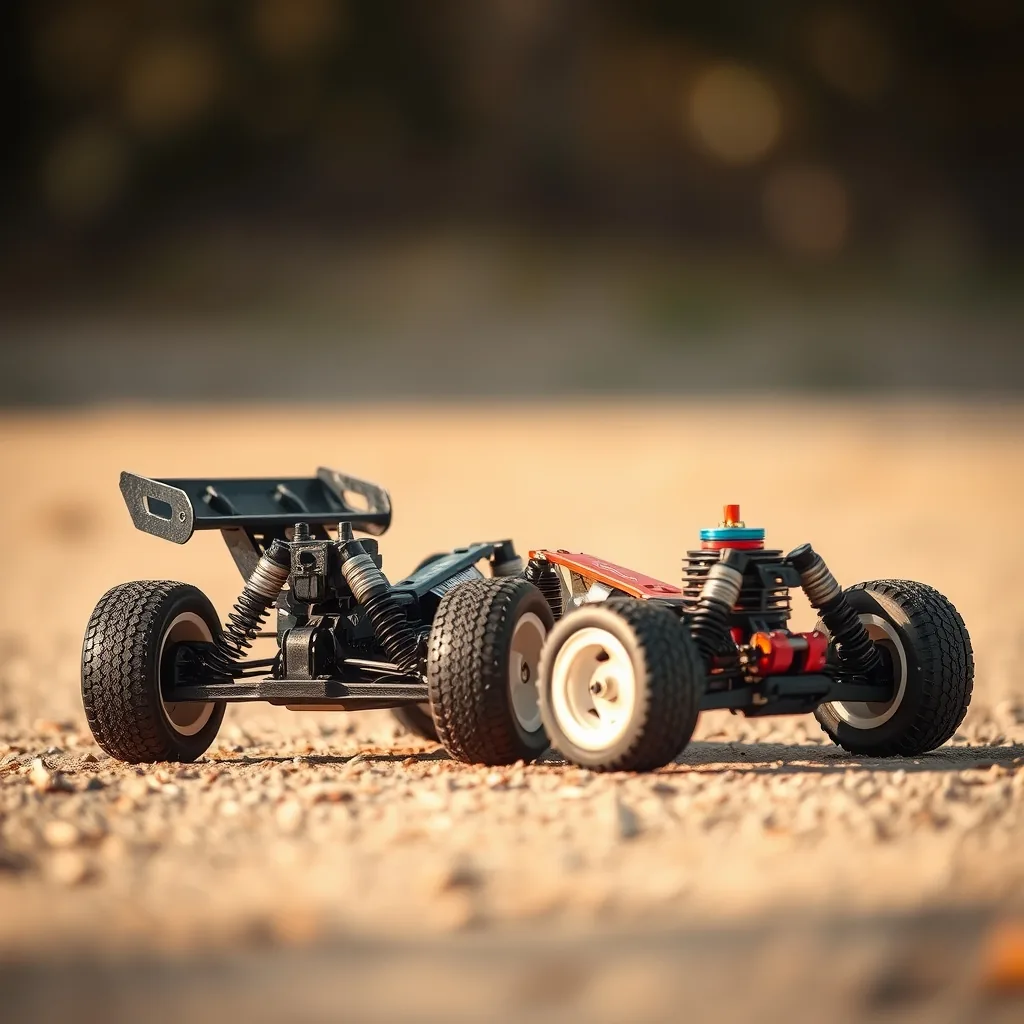
Most RC car builders hit the same wall about three upgrades in: the brushless motor is installed, the car is faster, and then something breaks. Sometimes it's the spur gear. Sometimes it's a plastic diff. Sometimes it's the ESC itself. And sometimes the car is faster but handling is worse, because a heavier motor shifted the balance point forward in ways the stock suspension doesn't compensate for.
None of this means brushless is wrong. It means brushless-without-matching is wrong. This guide covers what KV actually means, how ESC ratings interact with motor choice, and the specific chassis conditions where brushless is a genuine upgrade versus where it will just move your failure point.
How brushed motors work — and why they eventually wear out
A brushed DC motor passes current through carbon brushes that press against a rotating commutator ring on the armature. The friction of the brushes against the commutator is what limits both speed and lifespan. As the brushes wear, resistance goes up and power drops. As the commutator arcs under load, it pits and scores. On a typical hobby-grade brushed motor in a 1/10 basher, you'll start noticing power loss around 15–20 hours of hard running.
This isn't a flaw — it's a deliberate engineering choice that made brushed motors cheap, simple, and good enough for 30 years of RC cars. The Mabuchi 540 can, which fits almost every 1/10 touring car, buggy, and basher on the market, is still in production and still adequate for grass, dirt, and pavement bashing. The motor replacement cost is $8–$15. No programming required. No firmware to update. Plug it in and go.
The brushed motor's weakness is heat under sustained load. If you're running continuous wide-open throttle — racing circuits, long straight bashes — the brush contact area limits how much current the motor can dump before the brushes overheat and fail. That's the actual gap brushless fills.
How brushless motors work — and where the complexity lives
A brushless motor has no physical contact between the rotating part and the stationary part. The rotor has permanent magnets. The stator has coils. The ESC switches current through those coils in a precise rotating sequence, which is what makes the motor spin. Because nothing is touching, there's no wear in the traditional sense. The limits are heat in the windings and bearing wear — both of which happen on much longer timescales than brush wear.
The complexity moves into the ESC. A brushless ESC needs to know where the rotor is at all times to fire the coils in the right order. It determines this either through sensors (a hall-effect sensor embedded in the motor, connected by a sensor wire to the ESC) or through back-EMF detection at speed, which is called sensorless operation. Sensored motors are smoother at low speeds and instant starts. Sensorless motors are cheaper and fine at speed but can cog or hesitate at crawl.
What KV actually means
KV is RPM per volt at no load. A 3000KV motor running on a fully charged 2S LiPo (8.4V) will spin at approximately 25,200 RPM with no load. Add load (like, say, wheels on the ground), and actual RPM drops significantly — how much depends on the motor's efficiency, winding resistance, and the mechanical load.
KV does not directly tell you torque. But lower KV generally means more torque at the expense of top speed, and higher KV means more top speed at the expense of torque. This is because a lower-KV motor typically has more winds per coil, which increases torque multiplication but reduces free-spinning speed.
For 1/10 scale cars:
| Battery | Bashing/street | Racing/track |
|---|---|---|
| 2S (7.4V) | 3300–4000KV | 5000–6000KV |
| 3S (11.1V) | 2200–3000KV | 3200–4000KV |
| 4S (14.8V) | 1800–2200KV | 2000–2800KV |
These are not hard rules — they're ranges where the motor's heat output stays in range for the vehicle class. A 4000KV motor on 3S in a 1/10 basher is going to overheat on sustained runs unless the chassis has excellent airflow and the gearing is conservative.
ESC matching: the part most guides skip
Buying a brushless motor and forgetting the ESC is like buying a supercharger without upgrading the fuel pump. The ESC has to handle every amp the motor draws.
ESC current ratings are given in continuous amps and burst amps. Continuous is the sustained load it can handle without thermal shutoff. Burst is what it can handle for a few seconds. A typical 1/10 basher motor pulls 50–100A on hard acceleration. An ESC rated at 60A continuous is fine for moderate bashing but will heat-throttle or fail outright if you're doing WOT on pavement repeatedly.
The other matching consideration is sensored vs sensorless. If you buy a sensored motor and a sensorless ESC, the sensor wire is irrelevant — the ESC can't use it. The motor will still run, but it'll behave like a sensorless setup. If you run a crawler or short-course truck where you're at near-stall speed regularly, this matters. For bashers at speed, it usually doesn't.
Practical matching rule: Buy an ESC rated at 20–30% above your motor's expected continuous draw, from the same brand family if possible. Hobbywing, Castle Creations, and Tekin all publish compatibility matrices. When in doubt, the ESC manufacturer's motor recommendation list is more reliable than generic KV calculators.
When the motor outruns the chassis
This is the real practical question — not whether brushless is faster, but whether the rest of the car is ready for what brushless delivers.
The spur gear problem
Plastic spur gears are the first casualty of a too-powerful motor upgrade on a stock chassis. The spur gear transmits torque from the motor pinion to the drivetrain. On a $150 hobby-grade basher, the spur is often 48-pitch plastic rated for the stock motor's torque output. A 3300KV brushless motor on 3S produces roughly 3–4× the torque of a stock brushed 540. The spur doesn't always fail immediately — it strips progressively, usually when you punch the throttle from a dead stop on pavement.
The fix is a metal spur or upgrading to a chassis that ships with metal diff cups, metal drive shafts, and a proper motor plate rather than a plastic motor mount that flexes under load.
The diff problem
Stock plastic differentials in entry-level cars are designed for the power they ship with. When you multiply motor output by 3–4×, the diff sees that same multiplication. You'll usually hear the problem before you see it: a clicking or grinding on full-throttle turns. The fix is either a rebuilt diff with metal ring gears and diff balls (available as spare parts for most major platforms) or a ball diff, which handles power spikes better than an oil-filled gear diff.
The suspension problem
Less talked about but equally real: a chassis tuned for 15–20mph handling becomes unstable at 40mph. Stock shock springs on a basher are soft. Stock oil weights are generic. At brushless speeds on hard surfaces, the car's rear end lifts under acceleration and the front washes out in corners. This isn't dangerous the way it sounds — RC cars are small — but it means you're driving a faster car that handles worse, not better.
The battery problem
Brushless motors on 3S draw current fast. A 5000mAh 3S LiPo at 30C can deliver 150A burst. An older NiMH pack or a cheap LiPo with a C-rating that doesn't match the motor's demand will sag voltage under load, which both reduces power and accelerates wear on the pack. Match the battery's discharge rating to what the motor-and-ESC combination actually requires.
When brushless is a genuine upgrade
Once you know the failure modes, the cases where brushless pays off become clear:
- Cars that already ship with metal drivetrain components. The Arrma Granite BLS, Traxxas Rustler VXL, and similar mid-tier cars are built from the factory with brushless-rated gears and diffs. These don't need drivetrain upgrades because they shipped expecting the motor's output.
- Racing where run time and consistent power matter. Brushed motors lose power as brushes wear during a race session. Brushless is flat from first pack to last. For club racing, this consistency is worth the ESC complexity.
- Crawling and slow-speed technical driving. Sensored brushless at very low speeds is genuinely better than brushed — more precise throttle control, no cogging, holds position on inclines without brake. Crawlers running sensored setups from Castle or Hobbywing behave like a different vehicle.
- High-ambient-temperature running. In summer bashing sessions, brushed motors heat up faster and lose power before brushless motors get warm. If you're running 3+ consecutive packs in July, brushless stays in operating range longer.
When brushed is fine and brushless is overkill
- Kids' cars and beginner use. A 540-brushed basher is forgiving, cheap to repair, and plenty fast for learners. Putting brushless in a car being driven by someone who hasn't developed throttle feel will shorten its life considerably.
- Grass bashing on stock chassis. Grass limits top speed regardless. The mechanical loading from rough terrain and rocks is the constraint, not the motor. Brushless doesn't help grass performance if the rest of the drivetrain can't handle the torque.
- Budget builds. A $25 metal-can brushed motor and $40 ESC combo will outlast a $60 brushless motor paired with a $30 ESC from a brand you can't find replacement firmware for. Mismatched cheap brushless is worse than well-matched brushed.
Practical buying checklist
Before ordering a brushless system:
- Identify your battery voltage (2S, 3S, 4S). This determines KV range before anything else.
- Check whether your chassis has metal or plastic spur gear. If plastic, budget for a metal spur before the motor goes in.
- Look up your car's diff design. If it's plastic bevel gears with no upgrade path, plan that too.
- Choose an ESC with at minimum 20% headroom over your motor's expected draw, from a brand with active firmware support (Hobbywing, Castle, Tekin — all have downloadable firmware and active user bases).
- Decide sensored or sensorless based on how you drive. Bashers at speed: sensorless is fine. Rock crawlers and slow technical: sensored is worth the cost.
The brushless upgrade is real. Longer motor life, higher sustained power, and consistent performance across a session are all genuine improvements over brushed. But the improvement only exists if the rest of the car is rated for what brushless delivers. Build the car to handle the motor before you put the motor in.


